August 29, 2012

Blog Reader Question

Could we have both a SPA and AA? AA for US market and some kind of SPA to get approval in Europe, Australia and ROW? What do think the markets reaction would be with an AA in September?
I think an investor or shareholder's near-term focus should be on the SPA for metastatic melanoma. I do not believe AA is likely in the near-term (i.e., in September). I think Big Pharma thinks AA is a possible [but not probable] outcome and very worthy of an attempt to obtain it.

There is a lot on which to focus in the months of September and October in hopes of hearing or reading about material updates and progress, including (in no particular order):
  • The non-core spin-offs,
  • A dermatology deal and/or publication,
  • The melanoma regulatory path, license deal and/or publications,
  • Moffitt immunology results of additional mouse and initial human studies,
  • The liver/HCC regulatory path, license deal and/or publication, and
  • The pancreas regulatory path.
For now, we wait...

August 26, 2012

BioX

Management is presenting at BioX in late-September 2012.


Consultants

I previously highlighted the warrant issuance below noted in the Q1 2012 10-Q filing:


Following up on this thread, now from the Q2 10-Q filing:


1,003,000 issued in Q1. Another 454,500 in Q2. Different consultants? The same consultant? Pardon the pun, but what kind of relationship warrants these amounts (this amount) of warrants?

August 25, 2012

Blog Reader Question

Will the SPA have any influence on the [share price] at all?
The SPA should have a significant influence on the share price.

The premise is simple. Receive an SPA, and certain life sciences-focused investors will buy stock. This has been the observation of my anecdotal due diligence on this topic,and what I believe is management's own perspective. From Friday's closing price of $0.71 and a market capitalization of, per Google Finance, about $80MM, the SPA, which thus paves the regulatory path for PV-10 to be approved primarily as a local-regional treatment, should spur some life sciences-focused and a good number of generalist professional and retail investors to jump into a stock whose market capitalization they could see as multi-hundreds of millions of dollars (i.e., $2-3 per share).

A positive outcome (i.e., closer to or in excess of $2 per share), however, is not so simple.

First, is supply too much? Weighing down the flight of the share price are:
  • The [purported] remaining selling of Dr. Adams' shares. It has been speculated, I think on the Yahoo! Finance Provectus board, that this figure is about 2 million shares.
  • Profit taking by some investors. The amount of profit taking will increase as the share price approaches $2. Many retail investors who have been underwater on their holdings for some time very likely will sell if their respective cost bases are exceeded by 20-30%. I guess several million shares will come to market as we near $2; and
  • Warrant exercising into common stock that are then sold rather than held: As at 12/31/12, ~12MM at $0.95 and $1.00, ~4MM at $1.12, ~5MM at $1.25 and ~3MM at $1.50. Not taking into account the adjustment for cashless exercises, etc., this is about 25MM shares that would be $0.50 to more than $1 in-the-money as the share price approaches $2.
Second, is demand enough?
  • Some life sciences-focused investors may be constrained by fund criteria that prevents the purchase of the stock while it is an over-the-counter stock. After a minimum $2 closing price after 5 days, followed by the transition of the PVCT ticker to the NASDAQ, they should jump in, too.
  • Some investors will wait until the share price exceeds $5 before their fund criteria permits then to buy stock; and
  • Despite the receipt of the SPA, other life sciences-focused investors will wait for the second release of Moffitt murine study work and/or the first release of Moffitt human study work before they too will buy shares. This also, I believe, is management's perspective.
Is there demand for 20-30MM shares, in the near-term, after the SPA PR is issued? Quite possibly. More demand should come on-line when more Moffitt results are released. Even more demand will materialize as a dermatology deal is done, mini-oncology deals are consummated, and Big Pharma relationship revelations are made.

But the first portion of the share price ascent surely will be tested.

August 23, 2012

Blog Reader Question

As investors in PVCT we all are looking for the end result to be getting acquired by a large pharma company. Could you quantify for me your thoughts on what large pharma will eventually pay to acquire the whole company? Could you break it down into two prices. One being with PV-10 designated as systematic and the other price if the designation is strictly local.
Local treatment value. The acquisition of BioVex and OncoVEX by Amgen for about $1 billion, $425 million upfront and $575 million in additional development and sales milestones, provides a good baseline for the value of the company strictly as a local-regional treatment. Making a few assumptions (e.g., using melanoma as the lead and primary indication, the fully diluted share number, applying certain discounts to the headline number to adjust for present value and other things, etc.), I'd see a share price in the range of $3 to $5, where I'd lean towards the higher end of the range.

This analysis does not ascribe value to the application of PV-10 to other indications beyond melanoma or PH-10 to inflammatory skin disorders. If we add other indications, like scan-guided treatments of visible, solid tumor liver cancer, among others, one might add another $500 million of headline value, increasing the range to $5 to $7 per share.

Systemic treatment value. This is the more lustrous brass ring. Again, making several initial assumptions, the share price range is $15 to $20, with other indications potentially adding another $5 to $10 per share.

Blog Reader Question

I know that news will be presented at ESMO, but am not sure which. I speculate it can be the SPA (or even AA) but more likely new data from Moffitt on both human trials and other cancers in mice. Which news would you expect we will see at ESMO?
The company noted in its June 26 PR the ESMO poster presentation would include a full statistical analysis of the MM Phase 2 trial data.

As I have previously written, I think the SPA will be announced before ESMO. I think accelerated approval (AA), if management can obtain it from the FDA (under a different label, of course, than the one being pursued for the SPA), may come next year, as I think it relies on Moffitt's results (e.g., the next round of murine study results, human study work) to further bolster the case for PV-10's systemic benefit and use for such.

ESMO could be the venue for the release of more Moffitt results, whatever they be at the time, (e.g., mouse, human, mouse and human).

I think EMSO will be used to further raise awareness of PV-10 and the company's profile with the medical and biopharmaceutical communities in a very particular fashion.

August 21, 2012

The Dialog Has Definitely Changed

The crux of the matter [to me] is the presentation of PV-10 as a systemic agent. The brass ring is the large market for melanoma. The more lustrous brass ring is the use of PV-10 for the systemic treatment of [lots of] other cancer indications.

That is what makes the murine study results from Moffitt potentially extremely interesting. In their first release of information, Moffitt identified the quintessential immune response for melanoma, confirming PV-10's very beneficial/positive systemic impact. It has been widely speculated the next release could contain comparable success and confirmation for several other cancer indications.

Recall Koevary's work on rose bengal for ovarian cancer.

Clinical trials, the compassionate use program, Moffitt, Koevary, etc. clearly point to the broad application of PV-10 to effectively and safely treat all sorts of cancers.


It is very notable how much the dialog about PV-10 has changed within the medical and scientific community.

I learned (from speaking to someone, who kindly shared his due diligence on Provectus) that several surgeons conceived of a thoughtful, potential diagnostic/treatment approach for PV-10 and patients of theirs afflicted with breast cancer.

These surgical oncologists would use PV-10, when the appropriate time comes, as a pre-surgery diagnostic tool to precisely highlight cancerous regions or areas in a breast and a post-surgery diagnostic to precisely highlight cancerous locations (if any) potentially missed by surgery. PV-10 of course would also be used to treat breast cancer, as part of the physcian's decision tree.

This information in many respects closes the loop for me about past discussions I had with Craig where he raged against the destruction of breast tissue in search of ways or means to beat breast cancer and women's emotional pain and identity loss of losing such breast material (my mother is a two-time breast cancer survivor). Craig also shared his thoughts on how PV-10 could be effectively used to reduce or minimize unnecessary tissue removal (and, thus, emotional hurt).

This is but one example of how the dialog has changed about PV-10, elevating the dialog from the drug's novelty or novel features to how PV-10 can be used as productively as possible to eradicate cancer.

August 19, 2012

Getting To Yes

There's time and space between now and an equity investment by Pfizer or another Big Pharma company, between now and a license deal with one of them, between now and the acquisition of Provectus.

How much? It's unclear, of course, but perhaps not as much as you might think.

In a prior post, I presented an etheric-like plane in which the company exists, between a world where no one moves unless someone moves and one where someone moves because they have to move.

So, when/why does someone move? It is a result of several things:
  1. PV-10 is in strategy and aligned with commercial capabilities,
  2. The drug has reached sufficient technical maturity to be sufficiently de-risked to the point that it is worth a bet (e.g., SPA, technical data, clinical data,  KOL support), and
  3. There is a menu/revenue gap in the strategic plan of the pharma company interested in Provectus.
Big pharma is there, so to speak, with nos. 1 and 3. That leaves no. 2:
  • The timing of the SPA is base case Q3.
  • Technical data refers to a large category of data, from immunology-related murine study work by Moffitt to toxicity to manufacturing (CMC: Chemistry, Manufacturing and Control) to direct and indirect data. Moffit's next round of murine results is inbound (perhaps available as early as late-Q3 but more likely some time in Q4). Other technical data is at or nearing sufficiency.
  • Clinical data refers to all PV-10 clinical study and compassionate use program data. Clinical data should be at or nearing sufficiency (although that's not to say more data cannot be generated from other new and later stage trials such as pancreas and liver), likely culminating at ESMO 2012.
  • Key opinion leader (KOL) support is in process. It should reach sufficiency with the announcement of the SPA and the full characterization of PV-10's systemic benefit, which could be the next round of Moffitt data.
As you can see, I am trying to understand why and when someone like Dr. Eagle at Pfizer or his counterparts at other Big Pharma companies will move.

August 16, 2012

Blog Reader Question

Could you please quantify for me the percentage of companies that apply for an SPA that eventually receive it? Are large investors waiting on the sidelines because they want to see the endpoints and efficacy of PV-10 compared to standard care/placebo? What causes the large investors to wait on the sidelines when their entry point into PVCT could be 3/4 times the present stock price in a relatively short period of time?
Could you please quantify for me the percentage of companies that apply for an SPA that eventually receive it? Under a well-defined but at times opaque process companies work with the FDA to seek SPAs for their drug compounds and pivotal trials. A cursory Web-based search reveals one or three companies who sought SPAs but ultimately did not secure them because the companies terminated the process (presumably strongly influenced by their interactions with the FDA). As I have written before, I think Provectus has reached a verbal agreement on the SPA with the FDA. We await the PR to make this agreement known.

Are large investors waiting on the sidelines because they want to see the endpoints and efficacy of PV-10 compared to standard care/placebo? No. The life sciences investors to whom I refer are not waiting for this information, but rather the SPA PR from Provectus. Others wait for the PR and the stock to trade on the NASDAQ. You appear to be referring to the interim analysis of the MM Phase 3 trial or, perhaps, the post-trial analysis.

What causes the large investors to wait on the sidelines when their entry point into PVCT could be 3/4 times the present stock price in a relatively short period of time? Some of these life sciences specialists (i.e., large investors) want to see management have an SPA fully in hand to provide certainty of the regulatory path. Others want the SPA and the stock to trade on a major exchange like the NASDAQ, together with the comfort that comes with greater liquidity and trading volume. Others, but a much smaller subset, want the SPA, the NASDAQ and the final dispelling of any lack of comprehension about PV-10's systemic benefit that comes with the pending release of more Moffitt murine study work. Despite the return proposition you proffer, these investors consider the risk-return proposition. It is less risky for them to buy upon or after the SPA announcement than before, no matter how much they think the SPA is in the bag for the company.


Your question is a good one, and one that perplexes me from time to time. I began my capital markets career as a proprietary currency derivative trader for a Top 20 global commercial bank. Then, I spent several years making strategic equity investments in technology start-up companies on behalf of a Fortune 300 corporation that, while guided by business unit goals and interests, provide my team with a very open-ended mandate. This experience was followed by stints opportunistically investing in both privately held and publicly traded companies for an ultra-high net worth individual and, later, a small hedge fund. As I invest for my own firm, I look for the best investment idea, irrespective of who, what, when, where, why and how. This applies to both long and short approaches to an asset class or equity security.

Inevitably, I have been early to take action in many cases. In most cases, it has worked out because of discipline and conviction in the face of emotional macro and micro reaction, unless the underlying investment theses change. Sometimes, however, I am just plain wrong. For Provectus, I began nibbling in 2007 and 2008, but increased our holdings significantly from 2009 to 2011. I made the decision to convert our profits in mid- to late-2010 (early), from being mostly out of the market starting in late-2007 (early) and returning in March/April 2008 ("lucky"), into more shares of the company.

Over the course of my career, I have never been truly constrained by the institutional investment charters or frameworks that appear to be restraining the life sciences investors to whom I referred. They have a set of investment rules and criteria they think works best for them and sets them up for success. Management has presented to them, and continues to update them. Many of them see and understand Provectus' clinical, regulatory, business and stock value propositions. The lack of an SPA and the stock on a major exchange seem to be the crux of what holds them back.

Pete travels a good deal, meeting with existing and prospective equity research analysts, existing and prospective investors, board members, corporate advisory board members, prospective partners, etc. Typically, this travel does not necessitate an Out of Office [automated] e-mail notice, since he is very diligent in responding to inquiries. Occasionally, he utilizes this notice (about 6 times in the last 2 years), traveling for a few days in such instances. In July he traveled for the entire month, utilizing the Out of Office notice:


Life sciences investors think Provectus will get the SPA, but they want to see it formally and officially in hand. So, they wait, but those who have dipped a toenail or toe into the water, and those who stand at water's edge have been prepped by Pete. These investors, firms and funds will descend on the stock when the SPA is announced. A feed frenzy should ensue when a mini-oncology or dermatology deal is announced. The dam breaks completely when a relationship with Pfizer finally comes to light.

I will know if I have been early or am wrong in short order.

August 15, 2012

"Pursuing a strategic investment strategy"

I first blogged on this topic when the 10-Q was filed last week (see here).

Management did not include "[w]e are...pursuing a strategic investment strategy..." in the 10-Q filing as or to be a throwaway statement. They did this to inform Provectus shareholders, among other constituents (like prospective investors), of recent (i.e., since the last 10-Q filing three months ago) and currently ongoing material discussions with Big Pharma.

I have speculated about the implications of Dr. Eagle's presence on Provectus' corporate advisory board ("CAB"). If you use the blog's search function and query "Craig Eagle," my posts to this effect will list. My latest such post is here (each "below the waterline" is a real data point). Connect the dots: I think the material discussions I reference above are with Pfizer (although probably not exclusively).

I have wondered if Big Pharma has approached Provectus to license PV-10, invest in the company or acquire it, particularly after Dr. Eagle joined the CAB in August 2011. Having spent several years myself making equity investments in and helping to forge strategic relationships with life sciences and information technology companies on behalf of a large corporation in support of its business units' respective goals and interests, I know the drill.

There have long been rumors of alliance discussions with Big Pharma. The 10-Q indicates to me these discussions are more than rumors. I speculate we will learn much more in September, and I think it will be revealed that the Big Pharma is Pfizer.

Disclosure: I am a large shareholder of Provectus Pharmaceuticals. I started due diligence on the company in 2006 and purchased my first share of Provectus sometime in 2007. My share holdings number in the seven figures. I have not sold any shares to date.

Disclaimer: This blog is neither intended to be nor is investment advice. The author of this blog (the "Author") is not a registered investment advisor. Under no circumstances should any content from this blog be used or interpreted as a recommendation of a trade or investment in Provectus Pharmaceuticals, Inc. Trading and investing can be hazardous to your wealth, health or both. Any investment decision must, in all cases and without exception, be made by the reader or by his or her registered investment advisor. This blog is only and strictly for educational and informational purposes. The Author may have a position in Provectus Pharmaceuticals, Inc. at any given time that is not disclosed at the time of publication. All opinions expressed by the Author are subject to change without notice. You, the reader, should always obtain current information and perform the appropriate due diligence before making any investment or trading decision.

All efforts are made to ensure the information contained in the blog and/or a blog post is factual and accurate; however, the Author does not guarantee its accuracy under any circumstances.

August 14, 2012

The SPA

In the grand scheme of things the receipt of the SPA from the FDA (for Provectus' pivotal MM Phase 3 trial) is one step, of many, on the path to the widespread use of PV-10 to treat cancer.

Yet, [at the risk of pushing the analogy too far] the SPA acts like a falling domino, nudging other dominos to fall (happen):
  • Some life sciences funds buy the stock, now that the company has an SPA;
  • The stock moves to the NASDAQ;
  • More life sciences funds buy the stock, now that Provectus trades on a major stock exchange;
  • Within a month or so, the MM Phase 3 trial begins;
  • Much greater national media interest, now that the Phase 3 trial has commenced and the stock trades on the NASDAQ;
  • etc.
Given the manner in which the FDA and Provectus have been communicating and collaborating, I have long thought management reached agreement with the federal agency on the SPA. What remained was a company issued-PR to make it "official." It appeared to me there were two communication tracks: regular management interaction with agency staff to collaborate on the final design, and design submission that started the so-called 45-day clock.

I have no ability to assess the precise timing of events.

When did the first communication track (i.e., bilateral talks) end? And when did the second track (i.e., design submission)?

I think management only would submit a design it had full confidence eventually (i.e., after 45 days) would be approved. Given the collaborative nature of management's interaction with the FDA, I don't think it is unreasonable to believe or assume Provectus reached a verbal agreement on a final design (i.e., a design suitable to submit for approval that ultimately would be approved).

But when did management reach a verbal agreement? Probably in or around June, before the Munich presentation. In this presentation, as I previously blogged, the final trial design was shown:


If you followed the presentation of this slide since 2010, you will have clearly observed its development, maturation and finalization.

So, when did management submit the final design and start the 45-day clock? If they submitted the final design in late-June, we'd probably hear about it in mid-August.

August typically sees illiquid capital markets as traders and investors are away from their desks. The impact of an SPA PR, this month, could be muted by vacationing market participants. Perhaps we'll read the PR after Labor Day.

While I'm not going to go into detail about the underlying assumptions and rationale of what follows, the observation itself [to me] is very meaningful, historically (at the time), cumulatively (over time) and, in particular, now. I previously blogged on my assessment of the players' individual backgrounds. personal situations and financial wherewithals.

Why has Eric -- the most prolific exerciser of stock options (and purchase of the underlying security), the company principal most intimately involved with clinical trials and data analyses and the company principal most intimately involved with FDA regulatory path discussions -- stopped exercising options, completely, in 2012? In large part, to prevent any aspersion to be cast about his stock-related actions in relation to whatever [positive] information he has or will have.


In the end, I am not going out on much of a limb to write "the company, in my view, has received an SPA for its pivotal MM Phase 3 trial." Management's base case guidance, for some time, has been Q3. So whether the related PR arrives this week or shortly after Labor Day, it is coming, and soon.

Closer Than You Think

Source: 2Q12 10Q filing (p. 14). Click to enlarge.
I've wrapped up a few weeks of due diligence on several Provectus-related threads.

The company, in my view, has received an SPA for its pivotal MM Phase 3 trial, the top-line parameters of which, were presented in Munich at the end of June.

We await the PR for this, whether that PR is issued before the end of the month or shortly after Labor Day.

I will delve into the SPA topic and others (highlighted above) in subsequent blog posts, presenting my analyses that supports my conclusions, over the next few days.

August 12, 2012

Are We There Yet?


It seems to me two items are unresolved in the minds of life sciences investors who remain on the sidelines but interested in Provectus.

How quick is the path to regulatory approval for PV-10? The SPA provides one measure of speed and time under the contemplated label. Accelerated approval provides another.

How big is the opportunity for the drug? The opportunity, of course, is the recognition of PV-10 as a systemic agent, not simply a local one. Further Moffitt data, both murine and human studies, should dispel any lack of comprehension.

Without answers to these questions, there is not sufficient rationale and impetus, for the most part, to buy shares (or, at least, a lot of them).

Management reiterated its base case guidance of Q3 for receipt of the SPA. More Moffitt results should be available some time in Q4 (perhaps, I speculate, as early as ESMO 2012, which runs from September 28 to October 2). On the one hand, both Big Pharma (including Pfizer in the pole position) and life sciences investors wait. And so do the rest us. Are we there yet? No.

Big Pharma: No one moves, including Pfizer, unless someone moves. Game theory.

On the other hand, Dr. Craig Eagle and his counterparts at Johnson & Johnson, Novartis, Roche, Bristol Myers, etc. fully understand the so-called perfect storm facing their companies: the patent cliff, which saw and will see an estimated $250 billion in sales become at risk between 2011 and 2015. Drug replacement costs, drug approval times and risk of approval failures exacerbate the situation caused by the patent cliff.

Big Pharma:
 Someone moves, including Pfizer, because they have to move. More game theory.

 Are we there yet? Perhaps. If Big Pharma thinks Provectus will get its SPA and, in many corners, acknowledges the implications of Moffitt's results, all it takes is a phone call to Knoxville.

August 9, 2012

10-Q: Q2 2012

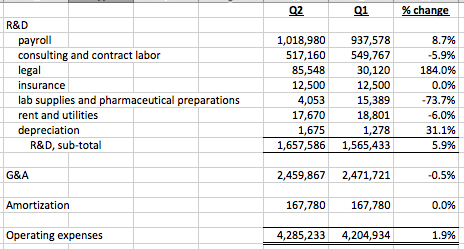
Provectus released its 10-Q filing for Q2 2012 today. See here. A quick 'n dirty analysis suggests:
  • A. Quarter-over-quarter ("QoQ") R&D expenses increased by 5.9%. QoQ G&A expenses decreased by 0.5%. Figures below are in dollars. Operating expense line items include both cash and non-cash charges.
  • B. The QoQ monthly cash expenditure increased by 3.6%.
Should some of the monies raised in the quarter be used to capitalize the spin-off entities, the financing activities figure below would be lower (as spin-off capitalization funds would be segregated on their respective balance sheets), reducing Q2 quarterly and monthly burn figures (where "burn" refers to the burning of cash for strictly operating expenses of the parent corporation).
  • C. The fundraising during the quarter, presumably related to the spin-offs, was completed at, roughly, a pre-money valuation of about $76MM. Shares were sold at $1.12 per share (not including warrant coverage). My original post on this topic is here. Click on the figure to enlarge it.
  • D. I did some basic modeling on monthly cash burn (cash on hand, in dollars, is the Y-axis), understanding that management has significant discretion over cash expenses and the actual fixed [cost] burn is very low. Click on the figure to enlarge it.
Management notes in the filing's MD&A section: "By managing variable cash expenses due to minimal fixed costs, we believe our cash and cash equivalents on hand at June 30, 2012 will be sufficient to meet our current and planned operating needs until well into 2013 without consideration being given to additional cash inflows..." 
I'd hazard a rough guess that "well into" means Q2.
  • E. The company notes, for the first time in a quarterly or annual filing: "...geographic licensure of PV-10 on the basis of...[both]...Phase 2 metastatic melanoma and Phase 1 liver results in certain areas of the world."
Such ongoing discussions could refer to, at a minimum, MM in Australasia and HCC (liver cancer) in China. Previous blog posts on this topic are here, here and here.
  • F. Provectus notes, for the first time also: "...a strategic investment strategy."
This, of course, refers to a minority equity investment by Big Pharma, such as Pfizer.
It's clear those money managers interested in but uncommitted as yet to Provectus (i.e., those on the sidelines) are waiting for, in their estimation, the inevitable dilution to come. From their perspective, the company will have to raise money to run the pivotal MM Phase 3 trial and money for day-to-day operating expenses in 2013 and beyond. Their likely varying beliefs as to the difficulty or ease with which Provectus would raise such funds might be informing their approach to and decision-making over buying shares.

The game Peter Culpepper is playing -- or perhaps put differently the strategy he is working to see unfold from a cash balance perspective but in the context of current and future company valuation -- is, rather obviously, trying very hard to close the dermatology deal, a mini-oncology transaction or two and/or a minority strategic equity investment. The upfront cash component of one or more of these transactions would be sufficient to fully fund company operations through the playing out of the end-game.

August 7, 2012

Days To Cover

Monthly volume remains anemic. Through July:


Days to cover short interest, through mid-July, has gone parabolic:


That (days to cover) is certainly interesting.

August 6, 2012

PVCT on SeekingAlpha: Yervoy Vs. Zelboraf: Melanoma Drugs Battle For Market Share

An article on SeekingAlpha by Peter Geschek on July 24 contrasted and compared metastic melanoma drugs Yervoy (Bristol Meyers) and Zelboraf (Roche). Towards the end, the author briefly mentions Provectus.

August 5, 2012

The Tip Of The Iceberg


As the dog days of summer get doggier, and we wait for the SPA to be received, much, much more Moffitt data to arrive, a dermatology and/or mini-oncology deal(s) to materialize, and other events to occur, it might be constructive and cooling to think about Pfizer...

If the addition of Dr. Craig Eagle to Provectus' corporate advisory board is the tip of the iceberg, what's below the waterline?

Below-the-waterline items not in chronological order.

August 4, 2012

Spin-offs


Provectus made a Form D filing yesterday that is related to the remainder of the spin-off of the non-core products (companies). More information on Form Ds may be found here. The other previous Form D filing related to the spin-off process is here. I will have more to say after Q2 10-Q is filed, likely late this week or early next week.

August 2, 2012

Intralesionally-Delivered Local Agents with Potential Systemic Benefits: PV-10, Allovectin-7 and T-Vec (formerly OncoVEX)

As you will recall, Vical's Allovectin-7 and BioVex's OncoVEX, now Amgen's T-Vec (or talimogene laherparepvec), were profiled by Dr. Merrick Ross in his Update on Intralesional Ablative Therapies presentation at The HemOnc Today Melanoma and Cutaneous Malignancies meeting in April.

Dr. Robert, Andtbacka, in his Intralesional Therapy for Systemic Disease: Where Will it Fit in? presentation at the same conference, presented the critical comparison table for these three emerging therapies (PV-10, Allovectin-7 and T-Vec):


Clearly, each of the companies with a dog in this hunt -- Provectus, Vical and Amgen -- are pursuing local agents they believe to have systemic benefits.

Vical & Allovectin-7. One month ago, Theodore Cohen wrote an article at SeekingAlpha about Vical's pivotal MM Phase 3 trial for Allovectin-7. The author has written a few articles on Vical, including a more recent interview with this company's CEO. I encourage you to read them. Author Cohen wrote about the delay in Vical releasing data from its MM P3 trial. This trial began enrolling patients in January 2007 and completed enrollment by February 2010 (a total of 390 patients). Final treatments were completed in February 2012.Trial results are slated for late-2012, although timing may see a 2013 release of information depending on the trial reaching the target number of event deaths.

Mr. Cohen theorizes the delay is due to the trial using healthier patients. An historical review of dacarbazine (DTIC) or temozolomide (TMZ) use shows patients given this treatment have a median overall survival in the range 6 to 11 months. It is possible the median overall survival in the control arm could be greater than 11 months.

It also makes you wonder why the trial has not been stopped by now. According to Mr. Cohen, the trial's safety board only had access to safety data, not efficacy data: "Put another way, the board did not have the ability to halt the trial except for serious safety issues."

In reading and re-reading Mr. Cohen's articles and Vical's CEO's explanations, as well as asking the author about the design of the trial's primary endpoint, I come away more skeptical.

Most studies have large patient numbers because their effect size is lower, which means very incremental improvement. Vical probably did not design an interim analysis or efficacy read into their design (and, thus, did not provide patients in the control arm with a cross-over benefit) because it probably would have put a greater burden on the trial's efficacy outcome. If Vical were supremely confident about the fundamental improvement and significance of the drug's results (vis a vis the primary endpoint), management would have included an interim look. Ultimately, for Allovectin-7, it probably will boil down to [median] overall survival, the original assumption for which was 18 months.

I cannot help but think the primary endpoint was not well designed and wonder if the endpoint was indeed met. As the analyst from Cowen & Company asked on yesterday's Q2 earning's call, paraphrasing: If overall survival (the secondary endpoint) is good, isn't this a drug you would expect to be approved regardless of the success on the primary endpoint. Vice versa, if the overall survival is poor, does primary endpoint data have any chance of rescuing Vical?

Amgen & T-Vec.
 Similar to The Curious Case of Benjamin Button, T-Vec gets smaller and smaller. Amgen acquired BioVex for $1B, more than 80% of which was an upfront payment. It later shut down OncoVEX's head & neck cancer P3 trial, and delayed the release of the drug's pivotal MM P3 trial results into 2013. Amgen, it would seem, makes less and less mention of T-Vec in its earnings calls. 1 mention on the Q2 call. 2 mentions on the Q1 call. 2 mentions on the Q4 2011 call.  3 mentions on the Q3 2011 call. 6 mentions on the Q2 2011 call.

While one might question whether Allovectin-7 met its primary endpoint (it's possible the company met it's secondary endpoint), T-Vec's shrinking causes one to question whether the drug met either its primary or secondary endpoints.

Nevertheless, all things being equal from when Amgen acquired BioVex in January 2011 to now, nearly 18 months later, I think Amgen would have paid a higher price for the local agent it believed would have systemic benefits.

Which brings us back to Provectus and PV-10. The comparison of the Company's contemplated pivotal MM Phase 3 trial to Allovectin-7 and T-Vec's is stark. A primary endpoint of progression free survival. 180 patients; a higher effect size drives a lower study size, meaning a fundamentally large improvement. A response assessment after 12 weeks, which allows patient cross-over from the comparator arm to the PV-10 treatment arm. An historical review of DTIC/TMZ use shows progression free survival in the range 2 to 3 months.

Given the apparent challenges facing Allovectin-7 and T-Vec, it seems clear PV-10 is pulling ahead because it is swimming faster and the others are falling behind because they are swimming slower.