Showing posts with label Math. Show all posts

August 4, 2015

Assessing Provectus' Pivotal Melanoma Phase 3 Trial, Part VI

The sixth in a series of blog posts and news items assessing the company's pivotal Phase 3 trial for unresectable locally advanced cutaneous melanoma (Stage III patients, and not metastatic [Stage IV] melanoma).
  1. Win or lose: Will the trial succeed in meeting or fail to meet its primary and/or secondary endpoints?
  2. Time-to-success or -failure: How long might it take for the trial to succeed or fail?
  3. Good or bad process: Are there process steps and aspects thereof that may provide hints of potential future trial success or failure.
This blog news item, (i) 1. Win or lose: Predicting outcomes, (ii) 2. Time-to-success or -failure: An unusual response in one of the randomized controlled trial arms, and (iii) 3. Good or bad process: Multiple triggers.

Blog post takeaways
  • Provectus' pivotal melanoma Phase 3 trial should be successful, meeting its primary endpoint of progression-free survival (PFS).
    • Meeting the secondary endpoint of overall survival (OS) in the context of PFS as a surrogate for OS, assuming the beneficial support of patient-reported outcomes (PROs), is worth a separate discussion and blog post or news item,
  • It appears the single planned interim analysis for efficacy and safety (based on a prescribed number of events) is very unlikely to (can't) be triggered. There [probably] won't be enough events. As a result, trying to project the timing of trial success, on an interim data readout basis, ultimately must rely on speculating what triggers, boundaries, safeguards, etc. have been designed into the trial to compensate for PV-10's non-normal or unexpected distribution of events to assure a timely readout of interim study results.
  • If Provectus management believe they can adequately predict the outcome of the pivotal trial, then such adequacy may extend beyond whether the trial would be successful to when they think it could be so. Fundamental to these beliefs is the trial's actual enrollment rate.
An article like Seeking Alpha contributor Steven Giardino's June 2014 one (h/t InvestorVillage PVCT poster leave_the_gun) discussing the role, responsibilities and mandate(s) of a pivotal trial's data monitoring committee (DMC) could encourage us to take a step back when assessing Provectus' Phase 3 trial, before rejoining more analysis and opinion-making as well as prior deep dives.

1. Win or lose: Predicting outcomes 

The trial's outcome of winning or losing, succeeding or failing, may simply boil down to observing that PV-10 just kills cancer, which is how I believe the company's Chairman and CEO Dr. Craig Dees, PhD would see and say it. The preclinical and clinical dataset of PV-10 ablating a cancerous tumor or lesion continues to grow, while also demonstrating the drug's agnosticism to disease presentation: e.g., clinically in potentially different melanomas (mutations or variations, but lesions don't appear to be categorized by Provectus), hepatocellular carcinoma (Hepatitis B and C, cirrhosis), breast cancer, and liver metastases (colorectal, non-small cell lung, melanoma, ovarian), and preclinically in at least melanoma, liver, renal, breast and pancreatic tumors. If PV-10 just kills cancer, then the Phase 3 trial ultimately should win or succeed. If it doesn't, it won't.

Provectus' CTO Dr. Eric Wachter, PhD on the other hand already said "[w]e firmly believe that Phase 3 testing should not be started unless you can adequately predict the outcome" when considering what PV-10 does or can do, what chemo does, the trial's patient population, the primary endpoint, secondary endpoints, etc., all in the context of the company's pivotal trial. If Eric thinks he can predict the trial's outcome, then he clearly also believes the trial will win or succeed.

"It just kills.." or "being able to predict the outcome..." could present itself, in my over-analytical or analyzed manner, as:
  • In the melanoma Phase 2 trial the overall response rate (ORR) for patients who had all their existing melanoma lesions injected with PV-10 was 71%, with 50% achieving a complete response (CR) despite receiving PV-10 up to four times over a 16-week period (i.e., week nos. 0, 8, 12 and 16) [1],[2],
    • In the Phase 3 trial patients in the PV-10 treatment arm would receive the drug every 4 weeks until CR or disease progression (e.g., week nos 0, 4, 8, 12, 16, 20, etc.).
  • In the Phase 2 trial the ORR for the lesions of patients who had all their lesions injected with PV-10 was 80%, with 74% achieving a CR [1], and
  • In the Phase 2 trial the progression-free survival (PFS) of patients who had all their lesions injected was 9.8 months [1].
    • In the pivotal Phase 3 trial the control arm is systemic chemotherapy of either dacarbazine (DTIC) or temozolomide (TMZ), which have PFSs of less than 2.5 months for DTIC/TMZ [2].
    • I believe Eric designed the trial for a 90% power to detect a 70% improvement in median PV-10 PFS (over DTIC/TMZ PFS) — if the trial's DTIC/TMZ median PFS is 1.5 months then PV-10's must be >2.55 months, or if 2 then >3.4, or if 2.5 then >4.25.
[1] Subgroup Efficacy in Patients Receiving Intralesional Rose Bengal to All Existing Melanoma in Phase II Study PV-10-MM-02, European Society For Medical Oncology, Abstract #1120P, September 2014. [2] Janet Fricker, PV-10 delivers greatest effects when all lesions are injected, Pharmiweb.com, October 15, 2014
  • As the pivotal trial's principal (lead) investigator, St. Luke's Cancer Center's Dr. Sanjiv Argawala, MD, said last year following ESMO 2014, “The progression free survival of 9.8 months compares favourably with historical progression-free survivals of less than 2.5 months for DTIC/TMZ.” [2]
2. Time-to-success or -failure: An unusual response in one of the randomized controlled trial arms

Compare and contrast PV-10 and chemotherapy above, or the distribution of responses ("events") for chemotherapy and PV-10 below.
Click to enlarge.
See July 23rd blog post Assessing Provectus' Pivotal Melanoma Phase 3 Trial, Part IV
I think it's fair to describe PV-10's historical objective tumor response results for melanoma as non-normal distribution curve or very likely to produce an unexpected distribution of events, where the baseline of what is or should be expected being chemotherapy's distribution curve. Thus, trying to estimate the timing of early and/or interim readouts of Provectus' pivotal study results must rely heavily on what if any as yet unmentioned multiple triggers, boundaries or safeguards Eric designed into the trial to augment the publicly discussed planned interim analysis for efficacy and safety based on a prescribed number of events (which is probably never going to [won't] get triggered).

In my July 23, 2015 Assessing Provectus' Pivotal Melanoma Phase 3 Trial, Part IV blog post I tried to make the argument Eric designed a planned interim analysis of efficacy and safety based on prescribed time, in addition to the planned one based on prescribed events. The analysis suggested the timing of this second trigger (starting in July 2016) was generally in line with (but later than) public comments by management of when an interim analysis might occur ("likely in the first half of 2016"). If there can be two interim analysis trigger, why cannot there be more for a drug with an effect size large enough to withstand the statistical dings or alpha spend of additional efficacy looks?

3. Good or bad process: Multiple triggers

Planned/prespecified or unplanned/not prespecified reviews of safety data of randomized controlled trials do not cause bias or incur alpha spending, and thus do not result in statistical dings of study results. Reviews of or "looks" into efficacy data, however, do incur dings or spend alpha (if you take multiple looks at the data, there is an increase in the risk of Type I error). Thus, if the addition of a second trigger (a prescribed time one) indeed is true (the first being a prescribed event trigger), then Provectus' statistical analysis plan (SAP) would have to address and thus account for three efficacy looks: (i) a final analysis, (ii) the single planned prescribed event interim analysis and [potentially] (iii) a prescribed time interim analysis. As an aside, the aim of an SAP is "to minimize bias by clearly stating the proposed methods of dealing with protocol deviators, early withdrawals, missing data, and the way(s) in which anticipated analysis problems will be handled as well as many other possible issues."

Using current parameters (such as the trial's N of 225), Eric's design yields a 90% power to detect a 70% improvement in median PFS. As I noted above, if the trial's actual DTIC/TMZ median PFS turns out to be 1.5 months then for the trial to win PV-10's actual median must be >2.55 months, or if 2 then >3.4, or if 2.5 then >4.25. PV-10's median Phase 2 trial PFS of 9.8 months (out of a 12-month follow-up period) compared to a 70% improvement of 4.25 over Agarwala's 2.5 month historical median PFS for DTIC/TMZ should mean PV-10 has a lot more alpha to spend if Eric wants to spend it. And if he spends his alpha early (on a much earlier interim analysis than expected) and never has to spend it again (on the planned interim analysis), then he can continue through the final analysis with the planned spend equalling the actual spend.

What might these additional triggers be and when (if at all) could they facilitate earlier study readouts than the interim analysis (prescribed event or time)? My guess tries to keep simple: There may be efficacy looks that of course cost alpha, presumably planned or prespecified but not publicly discussed, that occur after a certain number of events (one event per person). The planned interim analysis requires 113 events for a trial N of 225 (50%). Maybe another trigger is 20 events, 30 events, etc. The analysis of what "early" eventually could be defined as may boil down to the number of patients (and thus events) required to show statistically significant PV-10 and chemotherapy PFS curve separation acceptable to a DMC and/or the FDA. Returning to 2. Time-to-success or -failure above, the timing of success then becomes the sum of (i) the enrollment time of the patients (e.g., 60, 90, etc.) required to generate the smaller number of events (e.g., 20, 30, etc.) and (ii) the separation time required of the last patient treated in that smaller trial n.
Click to enlarge. 20 events.
Click to enlarge. 30 events.
Eric has been repeatedly and consistently wrong in the past with regard to the timing of things. Peter's guidance of a 1H16 interim data readout, based presumably on Eric's guidance, thus is questionable because it requires the trial's actual enrollment rate to track Eric's projected monthly enrollment rate figure. A interim analysis trigger requiring a lower number of events, and thus patients, might fit into Peter/Eric's sense of timing given lower actual enrollment rates. Or it may not.

Previous entries in the series:
  1. 3. Good or bad process: Patient enrollment. See Assessing Provectus' Pivotal Melanoma Phase 3 Trial, Part I (July 13, 2015) on the blog's Current News page,
  2. 3. Good or bad process: Designing an interim analysis for efficacy into Provectus' pivotal melanoma Phase 3 trial. See July 16, 2015 blog post Assessing Provectus' Pivotal Melanoma Phase 3 Trial, Part II,
  3. 3. Good or bad process: Patient crossover. See Assessing Provectus' Pivotal Melanoma Phase 3 Trial, Part III (July 20, 2015) on the blog's Current News page,
  4. 2. Time-to-success or -failure: Triggering the interim analysis. See July 23, 2015 blog post Assessing Provectus' Pivotal Melanoma Phase 3 Trial, Part IV, and
  5. 3. Good or bad process: Patient-reported outcomes. See Assessing Provectus' Pivotal Melanoma Phase 3 Trial, Part V (July 24, 2015) on the blog's Current News page.

July 23, 2015

Assessing Provectus' Pivotal Melanoma Phase 3 Trial, Part IV

The fourth in a series of blog posts and news items assessing the company's pivotal Phase 3 trial for unresectable locally advanced cutaneous melanoma (Stage III patients, and not metastatic [Stage IV] melanoma).
  1. Win or lose: Will the trial succeed in meeting or fail to meet its primary and/or secondary endpoints?
  2. Time-to-success or -failure: How long might it take for the trial to succeed or fail?
  3. Good or bad process: Are there process steps and aspects thereof that may provide hints of potential future trial success or failure.
Entry 1: 3. Good or bad process: Patient enrollment. See Assessing Provectus' Pivotal Melanoma Phase 3 Trial, Part I (July 13, 2015) on the blog's Current News page.

Entry 2: 3. Good or bad process: Designing an interim analysis for efficacy into Provectus' pivotal melanoma Phase 3 trial. See July 16, 2015 blog post Assessing Provectus' Pivotal Melanoma Phase 3 Trial, Part II.

Entry 3: 3. Good or bad process: Patient crossover. See Assessing Provectus' Pivotal Melanoma Phase 3 Trial, Part III (July 20, 2015) on the blog's Current News page.


This blog news item, "2. Time-to-success or -failure:" Triggering the interim analysis

Blog takeaways:
  • An interim analysis based on a prescribed number of events should not work for Provectus' pivotal melanoma Phase 3 trial. The trial would have to enroll 30-60% more patients than its current total patient population to reach the required number of events to trigger the interim analysis.
  • Thus, the single interim analysis designed into Provectus' pivotal trial probably is based on the prescribed amount of time elapsing after which the required number of events are expected to have occurred, and
  • The analysis below indicates the timing of the trial's interim analysis might occur starting in July 2016.
According to the trial protocol for the pivotal melanoma Phase 3 protocol, "[a]n interim assessment of efficacy and safety will be performed by the IRC when 50% of the events required for the primary endpoint have occurred." Call this condition the prescribed event clause. Event means disease progression — progressive disease or progression of disease ("PD").
Click to enlarge. Image source. Fuzzy purple emphasis is mine.
The trial's primary endpoint is progression-free survival ("PFS"), which is defined as "...the time from randomization until objective tumor progression or death." PD is defined as (by RECIST 1.1): "[a]t least a 20% increase in the sum of diameters of target lesions, taking as reference the smallest sum on study (this includes the baseline sum if that is the smallest on study). In addition to the relative increase of 20%, the sum must also demonstrate an absolute increase of at least 5 mm. (Note: the appearance of one or more new lesions is also considered progression)."

If one assumes one event per patient in a trial of 225 patients, where the interim analysis is undertaken when 50% of the required events (i.e., PD) occur, then ~113 events are required. That figure of 113 events, however, does not mean the trial requires 113 patients to be enrolled and treated in order to trigger the interim analysis. It means one has to wait until some number of patients are treated so that 113 events unfold in order for the interim analysis to be triggered.

A. How many patients are required to trigger the interim analysis?

Patients in both arms, the treatment group receiving PV-10 and the control one receiving chemotherapy (either dacarbazine ["DTIC"] or temozolomide ["TMZ"]), may have their disease progress, with the latter presumably generating more events faster than the former. The performance of DTIC and TMZ are well documented; see, for example, Middleton et al.: Randomized phase III study of temozolomide versus dacarbazine in the treatment of patients with advanced metastatic malignant melanoma (J Clin Oncol 2000 Jun;18(11):2351).
Click to enlarge. Middleton et al.
PV-10 performance, per patient and per lesion, from the subgroup of the company's metastatic melanoma Phase 2 trial who had all of their disease (i.e., all of their lesions) treated are below.

PV-10 Per patient
Click to enlarge. Image source. Fuzzy purple emphasis is mine.
PV-10 Per lesion
Click to enlarge. Image source. Fuzzy purple emphasis is mine.
The objective tumor responses above (in the Middleton article and on Provectus' poster presentations) generate the table and distribution curves below.
Click to enlarge.
Click to enlarge.
The two sets of distributions are somewhat mirror images of each other. Generally speaking, PV-10's CR generation is comparable in percent to chemotherapy's PD generation.

Assume chemotherapy generates disease progression events ~65-70% of the time (i.e., PD), while PV-10 generates events ~15-20% of the time. Given the trial's 2:1 randomization (2 patients receive PV-10 for 1 patient receiving chemotherapy), and assuming the aforementioned event probability ranges, the trial would not be able to achieve the required number of events (of 113) even if the trial's entire patient population were recruited, enrolled and treated. Thus, the prescribed event clause could and would not be triggered, irrespective of enrollment rate (e.g., average used to estimate the accrual period, actual determined from the trial itself).
Click to enlarge.
How many patients are required to generate the required number of events to trigger the interim analysis? About 300-360, which is greater than the trial's N of 225.
Click to enlarge.
Click to enlarge.
B. Is there another trigger that could/would generate the interim analysis?

As we saw above, particularly illustrated by the distributions above, if a substantial fraction of patients in one arm do not have their disease progress within the projected timeframe or patients in one arm fare much better than the other, then the time to accumulate the required number of events may be delayed — and, thus, the triggering of the prescribed event condition may be delayed, or not triggered at all.

A second condition would address the possibility that the triggering of first condition may be problematic: i.e., reaching the prescribed period of time after which the required number of events are expected to be occurred. Call this [second] condition the prescribed time clause. A prescribed time clause should be comprised of at least two time components: (i) the amount of time to account for enrolling and treating the prescribed number of patients to generate the required number of events, and (ii) the amount of time to account for the predicted performance of the last prescribed patient in the treatment arm.

The time to enroll and treat the prescribed number of patients. The pivotal trial's null hypothesis posits that the treatment and control arms will behave the same, or have the same response or outcome. On the high aside, assuming a PD response rate range of 65-70%, the projected number of patients that would need to be enrolled and treated is 161-173 {112.5 ÷ 0.65, 112.5 ÷ 0.7}. On the low side (i.e., SD+PD) using 85-87%, the projected number is 129-132.

The projected amount of time to recruit 129-173 patients requires the trial's projected average enrollment rate, which may be calculated by dividing the trial's N of 225 by Provectus' CTO Dr. Eric Wachter, PhD's patient accrual period of 18 months — 12.5 patients per month {225 ÷ 18}. The time to recruit 129-173 patients would be ~10-14 months {129 ÷ 12.5, 173 ÷ 12.5}.

The time for the predicted PFS performance of the last PV-10 patient. The range of this could be two or three times the projected PV-10 PFS performance (say that 10 times, quickly). PV-10's projected performance in the pivotal Phase 3 trial would be based on the trial's hazard ratio (which I believe to be 0.588, see my July 16th blog post Assessing Provectus' Pivotal Melanoma Phase 3 Trial, Part II) and systemic chemotherapy's median PFS, which in their trial Middleton et al. determined to be 1.5 months for DTIC and 1.9 months for TMZ. PV-10's projected PFS for the trial then could be: 2.6-3.2 months {1.5 ÷ 0.588, 1.9 ÷ 0.588}. Thus, the PFS performance time for the last PV-10 patient (in order to generate the interim analysis) could be: ~5-10 months {2.6 x 2, 3.2 x 3}.

Adding (a) the time to enroll/treat 113 patients to (b) the PFS performance time for the last PV-10 patient should result in (c) the prescribed amount of time to trigger the interim analysis; 10-14 months + 5-10 months = 15-24 months. Given a trial commencement in April 2015, the prescribed time clause might be triggered starting in July 2016. If the enrollment is faster or slower than the projected average enrollment rate, then the prescribed time clause might be triggered sooner or later than mid-2016.

COO/CFO Peter Culpepper commented on the topic of the interim analysis in a BioTuesdays interview in May:
"Mr. Culpepper says there will be an interim data read-out when 50% of events are reached, likely in the first half of 2016. The study is expected to conclude in the third or fourth quarter of 2017. The company is targeting 25 clinical sites in the U.S., 10 in Australia, and possibly one-or-two in San Paulo and Beijing." {Underlined emphasis is mine}
Peter undoubtedly based his comments on Eric's perspective of the timing of the interim analysis. My crude analysis of said timing appears to be longer or later than Peter's timing comments.

This blog post only addresses the projection of the timing of the interim analysis. In Provectus' situation (and the topic of a future blog post or news item) reaching the minimum number of treated patients for the separation of the treatment and control arm progression-free survival curves to exceed that implied by the trial's projected hazard ratio, and reach statistical significance is more germane (and potentially a much smaller number than that required to trigger the trial's interim analysis).

July 16, 2015

Assessing Provectus' Pivotal Melanoma Phase 3 Trial, Part II

The second in a series of blog posts and news items assessing the company's pivotal Phase 3 trial for unresectable locally advanced cutaneous melanoma (Stage III patients, and not metastatic [Stage IV] melanoma).
  1. Win or lose: Will the trial succeed in meeting or fail to meet its primary and/or secondary endpoints?
  2. Time-to-success or -failure: How long might it take for the trial to succeed or fail?
  3. Good or bad process: Are there process steps and aspects thereof that may provide hints of potential future trial success or failure.
Entry 1: 3. Good or bad process:" Patient enrollment. See Assessing Provectus' Pivotal Melanoma Phase 3 Trial, Part I (July 13, 2015) on the blog's Current News page.

This blog post, "3. Good or bad process:" Designing an interim analysis for efficacy into Provectus' pivotal melanoma Phase 3 trial

Blog post takeaways:
  • Provectus' Phase 3 trial has two "looks" designed into it: first, an interim analysis, and second, the final analysis or data readout.
  • The interim analysis will be for both safety and efficacy (after 50% of the required events of disease progression have occurred). If the treatment arm of PV-10 can show it is overwhelmingly better than the control arm of systemic chemotherapy (dacarbazine or temozolomide), then the trial could be stopped for efficacy.
  • As a result of designing a single efficacy look (that also includes a safety look) into the trial Provectus, management appears to be signalling they intend to apply for accelerated approval, assuming the trial meets at the very minimum its primary endpoint of progression-free survival ("PFS").
  • Pivotal clinical trials of smallish to small biotechnology companies (i.e., market capitalizations in the hundreds of millions of dollars, or a little more or a little less) that do not have interim analyses for efficacy designed into them should indicate these companies' drugs are marginal (i.e., have small effect sizes). Said analyses were not designed in by their management teams because their drugs cannot afford the statistical hit of more than one look. Each efficacy look into a blinded trial's dataset incurs a statistics penalty when one calculates the statistical significance of the difference in performance of the treatment arm over the control arm (if any). Safety looks do not incur penalties.
[*] A clinical trial's Data Monitoring Committee ("DMC") or Data and Safety Monitoring Board ("DSMB") may:
  • Perform one or more pre-planned interim analyses for several different types of reasons, and/or 
  • Terminate the trial with or without pre-specified stopping rules that may be associated with the interim analysis(es).
Reasons for pre-planned interim analyses include:
  1. Safety: To see if the treatment drug is safe,
  2. Efficacy: To see if the treatment drug is overwhelmingly better than the control drug, and
  3. Futility: To see if the treatment drug is unlikely to beat the control drug.
Pre-specified stopping rules based on the above types of/reasons for interim analysis(es) include:
  1. Safety: Stop the trial is there are x number of serious adverse events in the treatment arm (an unspecified safety stopping rule would require either a DMC or DSMB to review a trial's overall safety to make a decision to stop, if any or at all),
  2. Efficacy: Stop the trial for efficacy, and
  3. Futility: Stop the trial for futility.
* [The above, which I edited for the purposes of this blog post, essentially is copied from the March 2012 post Futility Analysis in Clinical Trials - Stop the trial for futility of the blog On Biostatistics and Clinical Trials]

Provectus' poster at ASCO 2015 (June) indicated the company's pivotal Phase 3 trial will have a single interim analysis for both safety and efficacy undertaken by a DMC, in addition to the trial's final data readout. Thus, the trial will be a multi-look one. Fuzzy purple emphasis below is mine.
Click to enlarge. Image source.
The company also notes its interim analysis for efficacy (as well as safety) on the trial's ClinicalTrials.gov webpage. See below; fuzzy purple emphasis is mine.
Click to enlarge. Image source.
PV-10 is a drug with a [very] large effect size; that is, it works very well and is far from incremental or marginal. Provectus' ESMOR 2015 poster (September) displayed two reminders of how effective the drug is when Stage III melanoma patients have all of their disease (all their lesions) treated (i.e., injected with PV-10). At the per patient level; fuzzy purple emphasis below is mine:
Click to enlarge. Image source.
At the per lesion level; fuzzy purple emphasis below is mine:
Click to enlarge. Image source is the same as immediately above
Because of this very large effect size the pivotal trial of PV-10 for locally advanced cutaneous melanoma can withstand more than one efficacy look; that is, the additional look of an interim analysis for efficacy. Provectus, however, has not publicly discussed whether the pre-planned interim efficacy look includes a pre-specified stopping rule for efficacy. The FDA has provided guidance regarding interim analyses for efficacy and trial stoppage that might be warranted as a result.

In order for Provectus' to seek accelerated approval on the basis of the pivotal trial's interim analysis, the beat by the PV-10 treatment arm of the chemotherapy control arm will have to be significant. In my June 2014 blog post Trial Math: Meeting the Primary Endpoint, Pt. 1 I endeavored to calculate that hurdle rate (i.e., the size of the beat) using what information about the trial might be available. At the time and through today the company's CTO Dr. Eric Wachter, PhD has not provided the trial's hazard ratio. As a result I used a historical one Provectus' COO/CFO Peter Culpepper had publicly communicated, which facilitated the calculation of the size of the beat as 87% — PV-10's median PFS had to chemo's median PFS by 1.3 months. In the example below I used a median chemo PFS of 1.5 months, and 87% comes from the math of {(2.8 months - 1.5 months) / 1.5 months}.
Click to enlarge.
I recently redid my clinical trial math using what appears to be a more proper and precise equation. See Suresh et al.'s (2012) Sample size estimation and power analysis for clinical research studies, where their equation is below.
Using current parameters (such as the trial's N of 225), Eric's design yields a 90% power to detect a 70% improvement in median progression-free survival — from 1.5 months [if you use chemo's median PFS from above] to 2.55 months for PV-10. This approach also facilitates calculation, I think, of the trial's hazard ratio, which could be 0.588: {(2.55 months - 1.5 months) / 1.5 months}. By raising the hazard ratio, or lowering the size of the beat from 1.3 months {2.8 - 1.5} to ~1 month {2.55 - 1.5}, Eric may have made it easier for PV-10 to hurdle systemic chemotherapy in the trial (or made the eventual beat more impressive).

BioVex/Amgen's pivotal melanoma Phase 3 trial of OncoVEX/T-Vec for patients with advanced melanoma included a planned interim analysis for efficacy in the form of overall survival ("OS"), which was presented at ASCO 2013. The trial's primary endpoint was durable response rate, while OS was a secondary one that T-Vec barely missed with a p-value of 0.051.

On the other hand Vical's Allovectin-7's pivotal Phase 3 trial had no interim analysis for efficacy designed into it. See that company's CEO statement in a comment I made on a Seeking Alpha article about Vical in 2012. Fuzzy purple emphasis below is mine.
Click to enlarge. Image source.
Big Pharma beats multi-efficacy look pivotal clinical trials of somewhat better drugs  (i.e., having smaller effect sizes) by using large numbers of patients. The immune checkpoint inhibitors represent notable relative improvement over prior patient options; however, patient trial numbers were not insubstantial.

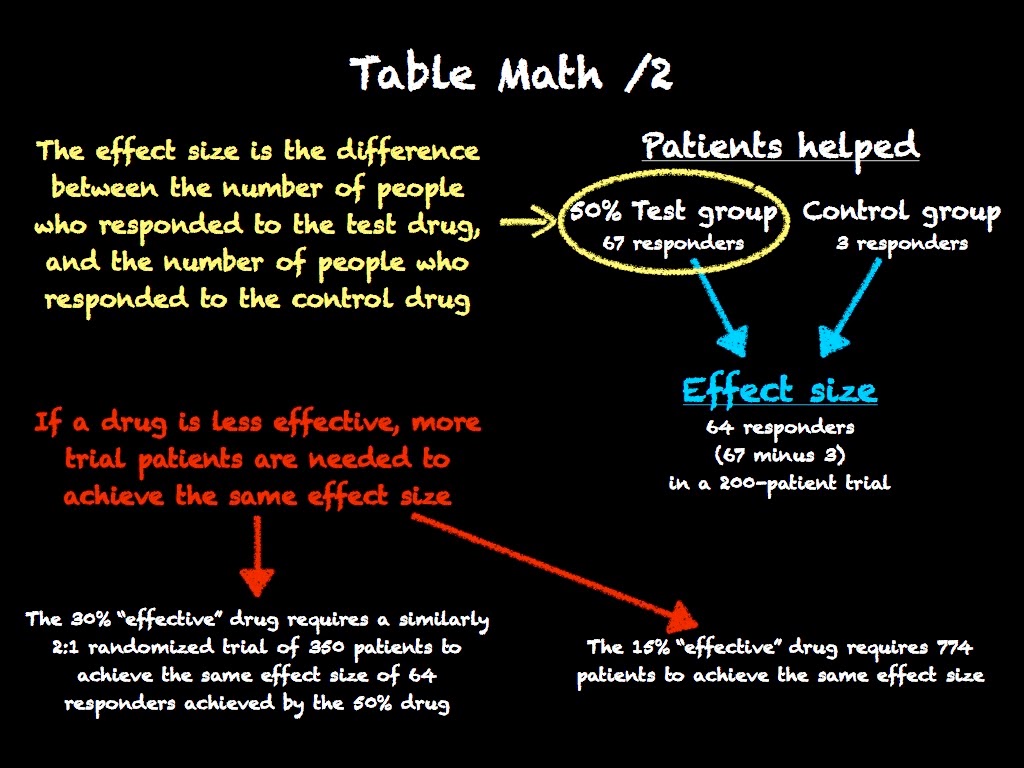
Effect size is a measure of strength (of something over something else). In the context of a clinical trial where the responses of two groups (a control group and a test drug one) are being compared, the difference in response between that of the control group and that of the test drug group is known as the effect size.

Should the control and test (treatment) groups be close in response, and thus the test drug has a small effect (i.e., it is a less efficacious agent), a large or larger number of patients are needed in order for the test drug to distinguish itself; that is, for the confidence interval (say 90% or 95% interval) of the test drug to not overlap or run into the confidence interval of the control. Conversely, if the test drug is very effective, a large effect size may anticipated, and thus a relatively small number of trial patients are needed; that is, the confidence interval of the test arm, in this case, may be large without overlapping the confidence interval of the control arm. The fact Provectus only is utilizing 225 patients in its pivotal Phase 3 trial signals this study assumes a relatively large effect size for PV-10 (i.e., PV-10 is very efficacious). Generally speaking, the more effective a drug is the less patients would be needed (without taking into account other factors that might influence clinical trial design) in a trial.

More effective, less patients needed. Less effective, more patients needed.

Consider the spreadsheet table below, which quantifies the above discussion. In order to generate the same difference of patients helped (64 is between 62-67), the 15% "effective" drug requires a trial of 750-800 patients (774 to be precise) . The 30% "effective" drug, which is better than the 15% drug, needs 350 patients to achieve the same difference of 64 patients. The 50% "effective drug, which is better still, needs an even smaller number of patients in its trial (200).
Click to enlarge.
The math of the above table is below.
Click to enlarge.
Click to enlarge.
Now see a table below I originally posted on the blog in June 2014 (note Provectus' pivotal Phase 3 trial N at the time was 210, which was later increased to 225).
Click to enlarge.
Updating this table to include the approvals in 2014 of immune checkpoint inhibitors Keytruda and Opdivo for advanced melanoma:
  • Keytruda’s efficacy was established in 173 clinical trial participants while its safety was established in 411 (source), and
  • Opdivo's efficacy was demonstrated in 120 patients while its safety was evaluated in 370 (source).