Showing posts with label SEC filings. Show all posts

May 1, 2014

Preparing to list (launch)

On Wednesday, April 30th, Provectus made a number of SEC filings, which you may find here. In the order filed:

1. DEF 14A, the final proxy statement. A final version of the preliminary proxy statement the company filed about two weeks ago. Management is seeking approval at the June 16th annual meeting of:
  • Its slate of board of directors,
  • An increase in the authorized number of common stock share from 250 million to 300 million,
  • A new (2014) equity compensation plan,
  • Executive compensation, and
  • BDO USA as the company's auditor.
I will blog my thoughts and voting intentions later this month.

2. 8-K, a material event. Provectus entered into new employment agreements with each principal/executive officer: Craig (CEO), Tim Scott (President), Eric (CTO) and Peter (CFO/COO). These were first outlined in the preliminary proxy statement. The agreements provide for (i) a five-year term, subject to automatic renewal for successive one-year periods, (ii) an annual gross salary of $500,000; (iii) eligibility for salary increases, annual bonuses and annual equity incentive awards as determined by the compensation committee in its sole discretion, and (iv) non-competition, non-solicitation and confidentiality obligations.

3. 424B3, a prospectus supplement (to the prospectus dated April 16, 2013, and filed pursuant to Rule 424(b)(3)). This prospectus is associated with the Controlled Equity Offering sales agreement with Cantor Fitzgerald & Co. ("Cantor") (see 5 and 6 below).

4. 8-A12G, Registration of Certain Classes of Securities. Also, I imagine, related to Provectus' agreement with Cantor.
  • Useful to know, a (supermajority) voting threshold: "...at least 66-2/3% of the voting power of the then-outstanding shares of the capital stock of the Registrant entitled to vote generally in the election of directors, voting together as a single class." The question for me is to what other provisions does it extend.
  • A typo, perhaps: "On April 17, 2014, the Registrant’s board of directors approved by unanimous written consent an amendment to the Registrant’s certificate of incorporation to increase the authorized number of shares of common stock from 275 Million to 300 Million." I thought the proposal, per the preliminary and final proxy statements, was "...approve and adopt an amendment to our Certificate of Incorporation to increase the number of shares of common stock, par value $.001 per share, that we are authorized to issue from 250,000,000 to 300,000,000 shares..."
Update 5/1/14: According to Peter, it is not a typo, but it is not in effect until shareholders approve it, and just authorization to allow for the relevant proxy filing proposal.
5. 424B5, a prospectus supplement (to the prospectus dated July 20, 2012, filed pursuant to Rule 424(b)(5), and related to this series of filings). Provectus entered into a Cantor branded, $50 million "Controlled Equity Offering" sales agreement, or an at-the-market ("ATM") offering. Adam Feuerstein provided comments about these offerings in a July 2012 article. While I have yet to complete my review of the Cantor agreement, the company entered into similar arrangements (but with at least one noticeable difference, the then counter parties were would-be purchasers of stock rather than agents in the case of Cantor) with Lincoln Park Capital in December 2010 and Alpha Capital Anstalt in July 2013. Provectus did not draw down on these $30 million facilities in the past; however, the share price rarely if ever exceeded their $0.75 price threshold.

This new Cantor facility, larger than prior ones as it is, could be helpful in providing less dilutive financing (common stock), should management elect to use it, than their fund raising manner of choice (or lack thereof) over the last several years (common stock plus generous warrant coverage) from their fund raisers of choice (Network 1, Maxim Group). It also should be cheaper: 3% to Cantor vs. >10-13% to Network 1. As for stealth dilution criticisms of ATMs ("Companies are under no obligation to disclose the sale of stock through ATMs except in customary regulatory filings at the end of each quarter or fiscal year."), it will be interesting to monitor if management's disclosure behavior in this regard changes in the future. Provectus historically has been transparent in its dilution of shareholders, typically making necessary filings (material or immaterial) swiftly, and not just merely in filings at the end of each fiscal quarter or year.

6. 8-K, a material event. Provectus entered into the above mentioned equity offering sales agreement with Cantor, and noted it also filed an application (on January 23rd) to list on the NYSE MKT. I am struck by the date of the application, on which, after two days closing above $3 per share ($3.99 on the 21st and $5.22 on the 22nd), the share price reached a intraday high of $6.03 before closing at $1.87. At the time I was of the belief the company was prepared, ready and paid up, 5 days above $3 pending, to list on the NASDAQ. Thwarted, management apparently quickly reached for and installed its back-up plan/Plan B (NYSE MKT) that shortly could turn into Plan A.

Three months later, presumably after considerable documentation provision to and other due diligence by NYSE Euronext, Provectus may soon up-list. By doing so the company would shed, after twelve years almost to the day, the vestiges of its OTC existence (e.g., a reverse merger into a public shell, a minor exchange, Network 1, Maxim Group, etc.) and hopefully put the bad and ugly but not the good behind it to begin and end life on a major stock exchange (e.g., Roberti+White, Cantor, breakthrough therapy designation, ASCO, etc.).

January 10, 2014

Disfigurement, Discomfort, Death

+273% 1-year stock performance, January 7, 2013 to January 7, 2014, no insider sales

+135% 1-month (roughly) performance, December 9, 2013 to January 7, 2014, no insider sales

-3% 1-week performance, December 31, 2013 to January 7, 2014, no insider sales

There are no sale-related Form 4 filings on the SEC website for Provectus filings through Tuesday, January 7th. For the previously provided link, check the “include” circle under “Ownership?” to bring up stock ownership-related filings. Another way is here, where I searched for filings using "4." I note Tuesday because filings must be made within two business days. It is theoretically possible management sold shares Wednesday or Thursday, with reporting of these transactions made via filings Friday and Monday, respectively. While I cannot write with certainty management have not sold shares, I’m going to go out on a limb and suggest they have not.

Historically, there have been no insider sales by Provectus officers and directors.* There only have been purchases.

You may recall Provectus' stock’s value proposition from my September 22nd investment letter (the closing share price: “The Company’s stock value proposition is very compelling at the current share price. Provectus appears close to achieving regulatory clarity for its lead indication, appears close to consummating regional license transactions for PV-10 in China and India, appears to have as least the interest of Pfizer as well as the attention of other global pharmaceutical companies, has no historical insider selling and plenty of historical insider buying, and has low institutional ownership. The Company, on the other hand, has a stock that until this year was mired in a multi-year downward trend, a capital structure that historically has weighed on the share price, trades on a minor U.S. stock exchange, is led by first-time public company leadership with no prior experience bringing an oncology drug to market and of which Wall Street is very skeptical, and has no institutional or Wall Street sponsor (the lack of playing Wall Street’s game in a highly regulated and capital-intensive industry like biotechnology, together with some shortcomings, has restrained the share price heretofore).”

Buy/sell transactions by directors/ex-directors (chronologically, I believe, Fuchs, McMasters, Koe and Smith) provide information and sometimes knowledge. I believe I am correct in writing only Koe purchased stock as a director (part of the September announced private placements), already having considerable ownership prior to his election as a member of Provectus' board of directors. Fuchs’ ownership, I believe, derived from his early funding involvement with the company, with warrants and possibly stock that also may have come with it. All directors have been awarded stock options over time for their roles.

* With Fuchs' departure from the board in July 2011, thus becoming an ex-director, he may have sold some or all of his shares thereafter.

A tweet from Thursday
I’m more interested, however, in management transactions. More specifically, and more to the point, there have been no sales ever by Craig Dees, Tim Scott, Eric Wachter and Peter Culepper.

Management has told us they await FDA guidance, per their December 18th Provectus Type C Meeting With FDAOncology Division Held December 16, 2013 press release. Presume management knew what went on in the meeting by being and participating in the meeting. Then:
  • If the meeting went “bad,” would they not have sold shares by now? By not selling, are they, along with shareholders, planning to go down with the ship and stock? That's, um, noble...
  • If the meeting (and, potentially, any follow-up**), however, was good or great, would it not make sense to continue to own stock, given now their view into FDA guidance that also might inform their view of PV-10's commercialization timeline. The founding principals and principal no. 4 are playing for tens and tens and tens and … of dollars, having historically eschewed a Wall Street or investment sponsor, and desirous of leading and controlling the company and the solving of a problem of global importance. Management is not playing for tens and tens of cents.
** It's clear from the thousands of pages of administrative and correspondence documents readily available on the Internet for drug approvals that sponsors (applicants) and the FDA routinely and regularly communicate and interact through the drug approval process.

From my investment letter: "PV-10, a novel oncology compound being developed by Knoxville, Tennessee-based Provectus Biopharmaceuticals, Inc., exemplifies innovation over incrementalism, meaningful over marginal, productized technology over hypothetical, and changing the world over accepting the status quo, with not an insignificant amount of serendipity over contrivance. In sum, these form the quintessential essence of a paradigm shift in the treatment of cancer.

This is where my investment thesis begins and ends: a novel drug compound with a pristine safety profile, a treatment well tolerated by and easily administered to patients, a ready made product inexpensively produced at scale, and a vast addressable market of unmet need that should be fully and very profitably met over time." Bold emphasis is mine. No one can call PV-10 a cure (or the Holy Grail), for now. I focus on the drug's ability, it's vast potential, to shift how doctors think about and subsequently act on treating cancer once found.

Cancer causes disfigurement through surgery, often the first solution considered by physicians (for those patients where surgery is a viable option) for many solid tumor cancers once discovered and diagnosed. PV-10’s tissue sparing ability, together with its safety and efficacy, eventually should eliminate the consideration of surgery first.

Cancer causes discomfort of varying degrees, typically adverse to toxic, when chemotherapy, radiotherapy, and many immunotherapies with actual or likely black box warnings or detrimental short- and long-term effects are used. PV-10’s 30-minute “half-life” means the drug is in the patient’s bloodstream for 30 minutes before it is excreted in the bile. Much more effective than other therapies, PV-10’s pristine safety profile and paucity of side effects eventually should eliminate the need for considering chemotherapy, radiotherapy or immunotherapy before first using PV-10.

Cancer causes death, often because the patient’s tumor burden is too great for the immune system to effectively fight back. Cancer wins because it’s discovered too late. It wins because the immune system is overwhelmed by toxic therapies like chemotherapy, radiotherapy and many immunotherapies, rendering it unable to effectively fight back. Can PV-10 mitigate or eliminate death caused by cancer? Time, more study and research, etc. only will tell. In the case of heavily diseased or tumor burdened patients, PV-10 eventually might be injected into as many accessible tumors as possible with the drug, increasing the likelihood of as many antigens as possible being presented to T cells and other immune system components for the immune system to eradicate as many or all vestiges of cancer from the body. For those previously with no hope, patients with very heavily diseased burden and severely compromised immune systems, PV-10 still could be used in combination (to be further examined, strategized, optimized and ultimately decided) with other systemic therapies like chemotherapy, radiotherapy and other immunotherapies to reduce tumor burden sufficiently for PV-10 to then help stimulate the immune system to finish off the cancer.

A paradigm shift in the treatment of cancer
Indeed.

November 14, 2013

And the decision(s) is(are)...

I read through Provectus' recent 3rd quarter 2013 10-Q filing (filed on November 12th) and prospectus supplement (November 12th). The changes in and additions of language from/to the 2nd quarter filing (August 8th) and previous supplement (August 8th) are several and, in my view, notable. See my underlining below.

1. 10-Q: Management's Discussion and Analysis of Financial Condition and Results of Operations
Liquidity and Capital Resources 
We are also considering the global licensure of PV-10 as well since it has come to our attention that this is of interest to potential partners. We have provided data on a confidential basis to both potential global and geographic partners for both PV-10 and PH-10 via a secure electronic data room that is monitored 24 hours a day, seven days a week and houses formal data submissions to the FDA as well as various corporate governance related documents. 
We also expect to continue with the majority stake asset sale and licensure of our non-core assets. However, the primary objective of the Company is to strategically monetize the core value of PV-10 and PH-10 through various transactions, leveraging value creation up to and including an appropriate merger and acquisition transaction that includes upfront cash and acquirer stock in exchange for Company ownership as well as a contingency value right to facilitate potential upside post-acquisition. We believe regulatory clarity is determined by specifying the expected approval pathways of both PV-10 and PH-10. This may include the potential for breakthrough therapy designation for PV-10 to treat metastatic melanoma and an accelerated approval path for PV-10 to treat refractory recurrent melanoma. Such clarity will help facilitate transactions with potential partners. Additionally, the existing and forthcoming mechanism of action related clinical and nonclinical data for both PV-10 and PH-10 will further aid in both regulatory clarity and transactions with potential partners.
2. Prospectus Supplement #3: Cautionary Note Regarding Forward-Looking Statements
Risks and uncertainties that could cause our actual results to materially differ from those described in forward-looking statements include those discussed in our filings with the Securities and Exchange Commission (including those described in Item 1A of our Annual Report on Form 10-K for the year ended December 31, 2012, and elsewhere in this Quarterly Report on Form 10-Q), and the following:
• Our ability to license our dermatology drug product candidate, PH-10, on the basis of our Phase 2 atopic dermatitis and psoriasis results, which are in the process of being further developed;

• Our determination, based on guidance of the Food and Drug Administration (FDA), whether to proceed with or without a partner with a Phase 3 trial of PV-10 to treat recurrent melanoma and the costs associated with such a trial, unless the path to approval of PV-10 is accelerated, and whether Breakthrough Therapy Designation acceptance is viable and enables an accelerated path;

• Our determination whether to license PV-10, our recurrent melanoma drug product candidate, and other solid tumors such as liver cancer and cancers metastatic to the liver, if such licensure is appropriate considering the timing and structure of such a license, or to commercialize PV-10 on our own to treat recurrent and metastatic melanoma and other solid tumors such as liver cancer and cancers metastatic to the liver; and

• Our ability to raise additional capital if we determine to commercialize PH-10 and/or PV-10 on our own, although our expectation is to be acquired by a prospective pharmaceutical or biotech concern prior to commercialization.
3. Prospectus Supplement #3: Management's Discussion and Analysis of Financial Condition and Results of Operations
Liquidity and Capital Resources 
We are also considering the global licensure of PV-10 as well since it has come to our attention that this is of interest to potential partners. We have provided data on a confidential basis to both potential global and geographic partners for both PV-10 and PH-10 via a secure electronic data room that is monitored 24 hours a day, seven days a week and houses formal data submissions to the FDA as well as various corporate governance related documents. 
We also expect to continue with the majority stake asset sale and licensure of our non-core assets. However, the primary objective of the Company is to strategically monetize the core value of PV-10 and PH-10 through various transactions, leveraging value creation up to and including an appropriate merger and acquisition transaction that includes upfront cash and acquirer stock in exchange for Company ownership as well as a contingency value right to facilitate potential upside post-acquisition. We believe regulatory clarity is determined by specifying the expected approval pathways of both PV-10 and PH-10. This may include the potential for breakthrough therapy designation for PV-10 to treat metastatic melanoma and an accelerated approval path for PV-10 to treat refractory recurrent melanoma. Such clarity will help facilitate transactions with potential partners. Additionally, the existing and forthcoming mechanism of action related clinical and nonclinical data for both PV-10 and PH-10 will further aid in both regulatory clarity and transactions with potential partners.
The company provided new, seemingly prospective "bullish" language before. In Provectus' 2nd quarter 2012 filing (August 8), management wrote in the report's MD&A section:
We are seeking to improve our cash flow through both the licensure of PH-10 on the basis of our Phase 2 atopic dermatitis and psoriasis results, and the geographic licensure of PV-10 on the basis of our Phase 2 metastatic melanoma and Phase 1 liver results in certain areas of the world, as well as pursuing a strategic investment strategy, and continuing with the majority stake asset sale and licensure of our OTC products as well as other non-core assets.
These additions reflected the beginning of discussions with potential partners for regional transactions (China, at the time), and [I can only assume] discussions about a minority equity investment from Big Pharma (Pfizer, at the time, I believe, but Johnson & Johnson purportedly was interested too). No deal for China has materialized yet, and Pfizer's investment in the company's PVCTP "IPO" did materialize either. So, while these quarterly filing or prospectus statements neither predict nor portend the future, they do, however, give us insight into management's regulatory affairs, and business and corporate development activities.

Given how careful management and/or their lawyers are with their language (at times, careful borders on unintelligent), the new language in this week's filing and prospectus is striking when taken in the context of what many shareholders expect, which is a regulatory clarity decision from the FDA. Here's what jumps out at me:
  • The reference to the electronic data room. While discussions with global (e.g., AstraZeneca, Amgen) and regional partners (e.g., several in China, India and Japan this year and last) are one thing, entering a data room is another and typically means certain partners have entered into a confidential disclosure agreement ("CDA") with Provectus in order to enter and gain access to substantially more and often very sensitive information. I am not saying any global pharmaceutical company has entered into a CDA with Provectus yet; however, several regional pharmaceutical companies very likely have. The Agency reference likely refers to the kind and amount of data being provided to the FDA in support of whatever the company has asked of it, and thus would be available to prospective partners to review, such as Moffitt pre-clinical (i.e., combination trials involving PV-10 and various checkpoint inhibitors like anti-CTLA4, -PD-1 and -PDL-1 agents) and clinical data in a reporting format acceptable to the FDA, as well as copies of pertinent or germane regulatory communications. It's not lost on me that "formal submission" crops up, as it should be pretty clear by now the company has made an ask(s) of the Agency, for which we wait a decision(s).
  • The reference to acquisition deal structure. Upfront payments and earn-outs paid later, when the company is not fully acquired only for cash, have been used on several transactions in the sector, such as Celgene's acquisition of Abraxis (a favorite example of Peter) or Sanofi-Aventis' of Genzyme. It may not be significant, or it might be, but there is no mention of payments achieved through clinical, regulatory and/or commercial milestones (or more simply, milestone payments). I am struck by the deal structure language only because it was used in this filing, rather than earlier or later. Like with the emergence of the strategic investment strategy in 2012, which I believe was mostly in reference to discussions with Pfizer, this M&A deal language might provide disclosure comfort (for Provectus management and representatives) should acquisition discussions have taken place, however "informal" they may have been (and may be).
  • The specificity of clarity. This specifying of clarity seems like a "staged expansion of labels," with accelerated approval ("AA") or outright approval ("OA") being sought for Stage IIIB-C patients with recurrent melanoma refractory to treatment, and breakthrough therapy designation ("BTD") being sought for metastatic melanoma more broadly with more refinement or definition likely to follow the awarding of it.
  • The reference to cancers metastatic to the liver. The Phase 1 liver trial included successful treatment of colorectal cancer that had metastasized to the liver. In the blog's News tab, I noted in July that compassionate use program ("CUP") sites had treated treated ocular melanoma metastasis to the liver, and a neuroendocrine tumor ("NET") that had metastasized to the liver. Together with data from the expanded Phase 1 liver trial, I wonder if data from these cancers metastatic to the liver might form the basis for a liver cancer BTD application, possibly further advance regional transaction discussions for China, and point to an additional effort by management to raise overall valuation through a second indication and its variants.
Above, management wrote they believe regulatory clarity is determined by specifying the expected approval pathways of both PV-10 and PH-10. They further wrote this clarity may include the potential for BTD for PV-10 to treat metastatic melanoma and an AA path for PV-10 to treat refractory recurrent melanoma. Understood. Shareholders should take note.

While the SPA very likely was granted or made available to the company earlier this year, we now know from the 3rd quarter filing's language Provectus has asked for, generalizing, AA/OA for refractory recurrent melanoma, and BTD for metastatic melanoma. We could surmise with some non-trivial degree of certainty these asks were made in October, and might estimate decision timing as December or January, allowing for some holiday slippage.

Management is holding a special meeting of shareholders on December 16th to seek approval for the change of the company's name from Provectus Pharmaceuticals to Provectus Biopharmaceuticals, and the reincorporation of the company from Nevada to Delaware. There is a good amount of literature that weighs the pros and cons of incorporation in both states, and their comparative merits. There also is perhaps some benefit to the subsequent change in stock CUSIP, the alphanumeric code identifying the company's trading ticker or symbol, as it relates to mitigating short interest. Provectus started life in the early-2000s as a reverse merger into a public Nevada-incorporated shell (a so-called reverse IPO). Reincorporation into/as a "clean" Delaware entity might give both global and regional partners extreme comfort of whom they were buying or from whom they were licensing, as opposed to if the company had begun life as a privately held Nevada- or other state-incorporated company. Why change thing(s) now?

Management dramatically increased the expense of lab supplies and pharmaceutical preparations in this year's 3rd quarter (~$259K), "...the result of securing drug substance and drug product for pivotal clinical studies with the newly patented synthesis of Rose Bengal." The figure was ~$32K for 1Q13 and 2Q13 together. Let's say each 5 ml vial of PV-10 cost a few dollars, like $10, to manufacture its contents. Let's further say the average number of vials used by a melanoma patient or a CUP patient afflicted by melanoma or another indication is 6. In 1H13, ~3,215 vials may have been produced for the equivalent use of ~535 patients. In 3Q13, using the same artificial math, ~26K vials would have been for 4,315 patient equivalents. As an aside, I might be high on cost per vial, and number of vials per patient.

Let's explore if production was for pivotal clinical studies such as a pivotal Phase 3 trial. Assuming a 180-patient trial per the most recent SPA trial parameter slide, the above cost and patient use vial assumptions above, and the purported requirement of 3 production runs (for whatever Agency reason(s)). This would yield an expense of about $32K (3,240 vials, 540 patient equivalents), ~13% of the actual expense in 3Q13, which assumes the company conducted these runs in the 3rd quarter. I'm more inclined to think they did these runs in the 1st and 2nd quarters. Why so much product now?

As I wrote above, it seems to me [now] management often or typically utilizes certain MD&A language to provide a measure of disclosure comfort. Strategic investment strategy or M&A deal structure language are, in my view, some examples of this. Why discuss or reference end-game deal structure now?

The FDA may say "Only a SPA for you," or BTD, or AA and a post-marketing study, and BTD, or OA, and BTD.

The company has asked for AA/OA and BTD, and probably thinks they have a very good chance at attaining both asks. I'm not completely convinced they know what they'll get from the FDA, but I think they're confident of the outcomes based on their interactions with the Agency, the Phase 2 data, Moffitt's data, and the feedback from their regulatory affairs team.

Is "now" because they're prepping for what might happen after now? Anticipation among longtime shareholders who have closely followed Provectus, management and the situation is high, so high one easily could cut it with a proverbial knife. I am open to and prepared for disappointment, where disappointment is a full Phase 3 under an SPA, because that "negative" outcome clearly must exist on a Gaussian-like distribution of potential outcomes if management does not know what they'll get from the Agency. But the "positive" outcomes that populate the same distribution likely comprise much if not nearly all of it -- I assume, having pushed past the SPA for some time, management has delivered substantive datasets from their own work and Moffitt to advocate for something more -- provide the thought, belief and hope of something much, much more.

Boom!

Boom indeed.


August 9, 2013

A Revealing $PVCT 10-Q

Provectus filed its second quarter 10-Q yesterday. Most revealing, in my view, when combined with other recent information, was the following statement from the Management's Discussion and Analysis of Financial Condition and Results of Operations section on page 13:
"We believe that our prescription drug candidates PV-10 and PH-10 provide us with two products in multiple indications, which have been shown in clinical trials to be safe to treat serious cancers and diseases of the skin, and important immunologic data has been corroborated and characterized by institutions such as Moffitt Cancer Center in Tampa, Florida and another leading research facility. We continue to develop clinical trials for these products to show their safety and efficacy, which we believe will continue to be shown based on data in previous studies, and which will result in one or more license transactions with pharmaceutical and or biotech partners. Together with our non-core technologies, which we intend to sell or license in the future, we believe this combination represents the foundation for maximizing shareholder value this year and beyond."
And, later in the same section, on page 14:
"We are also considering the global licensure of PV-10 as well since it has come to our attention that this is of interest to potential partners. We also expect to continue with the majority stake asset sale and licensure of our non-core assets. However, the primary objective of ours is to strategically monetize the core value of PV-10 and PH-10 through various transactions, leveraging value creation up to and including an appropriate Merger and Acquisition transaction. We believe regulatory clarity insofar as the expected approval pathways of both PV-10 and PH-10, including potential for breakthrough therapy designation as appropriate for PV-10, will help facilitate transactions with potential partners."
The bold emphasis, which is mine, is, I think, management being specific and definitive (particularly with the first bolded item). Transaction parties from China, India and Japan are likely waiting for outcome of regulatory clarity, whatever it is. Management is likely waiting, too. Eric's time in New York last week included meeting with Chinese pharmaceutical company folks, which I would assume (guess) are from Hisun-Pfizer. I expect he will be in Shanghai, China at some near-term point to visit with a liver trial location. According to management, interest has been knowledgeable and purportedly high from potential Indian and Japanese partners.

Will one or more regional license transactions be signed immediately after regulatory clarity is attained?

Have deals effectively been penciled, and are discussions about in-country trials and more operationally-focused post-deal items being carried out, in the interim? This feels to be the case for China, where it was remarked in New York that (paraphrasing) "China is a lot farther ahead than most people think."

How does the outcome of clarity -- per the poll question, the SPA, BTD, etc. -- play into whether global license transactions are signed too, or instead? For example, if BTD is achieved and accelerated or outright approval comes with it, does Pfizer move? How does a global player moving for a worldwide license affect, if at all, license transactions with regional players?

I think Provectus is communicating meaning here.

May 10, 2013

$PVCT's 10-Q: Q1 2013

Provectus released its 10-Q filing for Q1 2013 today. See here. Some thoughts...

#1. Quarter-over-quarter ("QoQ") -- Q1 2013-over-Q4 2012 -- monthly cash expenditure appears to have decreased by about 11%. Provectus' quarterly and annual filings since and including Q1 2012, the company appears to suggest an average monthly cash burn of approximately $950K (with a standard deviation of $133K).

#2.  Management expanded on their Q4 2012 MD&A statement via the 10-K of...
"We are seeking to improve our cash flow through both the licensure of PH-10 on the basis of our Phase 2 atopic dermatitis and psoriasis results, and the geographic licensure of PV-10 on the basis of our Phase 2 metastatic melanoma and Phase 1 liver results in certain areas of the world, as well as pursuing a strategic investment strategy, including equity sales to potential pharmaceutical and or biotech partners, and continuing with the majority stake asset sale and licensure of our OTC products as well as other non-core assets. The geographic areas of interest for PV-10 principally include China, India, Japan and Middle East and North Africa (MENA). We are also considering the global licensure of PV-10 as well since it has come to our attention that this is of interest to potential partners."
...with the following in their Q1 2013 statement:
"We are seeking to improve our cash flow through both the licensure of PH-10 on the basis of our Phase 2 atopic dermatitis and psoriasis results, and primarily the geographic licensure of PV-10 on the basis of our Phase 2 metastatic melanoma and Phase 1 liver results in certain areas of the world, as well as pursuing a strategic investment strategy, including equity sales to potential pharmaceutical and/or biotech partners. In addition, the data now available from Moffitt Cancer Center in Tampa, Florida has been particularly helpful in supporting our development plans with both the FDA and prospective partners. The geographic areas of interest for PV-10 principally include China, India, Japan and Middle East and North Africa (MENA). We are also considering the global licensure of PV-10 as well since it has come to our attention that this is of interest to potential partners. We also expect to continue with the majority stake asset sale and licensure of our non-core assets. However, the primary objective of ours is to strategically monetize the core value of PV-10 and PH-10 through various transactions, leveraging value creation up to and including an appropriate Merger and Acquisition transaction."
primarily suggests to me management is prioritizing a series or string of regional/other licenses (e.g., China, India, Japan, PH-10) to boost company valuation towards their end game valuation expectation.

In addition... suggests repetition of the importance of Moffitt to what the FDA and Big Pharma needed regarding PV-10's systemic benefit and potential, and that is very likely crucial to securing and most assuredly dispositive of receiving breakthrough therapy designation for PV-10 for recurrent and metastatic melanoma.

However... suggests focus on smartly, intelligently and thoughtfully protecting valuation to, again, achievement management's end game valuation expectation. Noteworthy to me was the inclusion of the verbiage "an appropriate Merger and Acquisition transaction."

#3.  Noteworthy to me was the issuance of 1.92MM warrants to consultants in exchange for services in the quarter. To whom and why?

April 21, 2013

$PVCT Files Pre-14A (Proxy Statement)

Management filed the company's pre-Form (Schedule) 14A (proxy statement) on Friday.

Regarding proposal number 2, management is seeking shareholder approval for "...an amendment to our Restated Articles of Incorporation...to increase the number of shares of common stock...that we are authorized to issue from 200,000,000 to 250,000,000 shares."

The company, on a fully diluted basis -- common stock + preferred stock + common stock options + common stock warrants -- is nearing its threshold of authorized shares. The proxy counts this figure as about 188 million (see page 29).

I support Proposal No. 2 because it enables management to have sufficient shares of which to use, in part, to raise money so as maintain accounting firm BDO's going concern opinion in the event expected milestones (i.e., SPA, BTD-AA) do not raise the share price sufficiently to utilize the shelf in a less than punitive manner or upfront/cash payments (i.e., China, India, Japan, global, PH-10) from contemplated license deals do not materialize in a suitably soon time frame (i.e., when or should the remaining 12 million units run out or be insufficient).

January 3, 2013

$PVCT: NASDAQ Listing Process, When...

The terminated PVCTP "IPO" remains an incomplete story that has historical interest [to me] to learn more about at some point and make sense of what otherwise was a gray and incomplete picture. I do not think management will re-visit the offering again unless a special situation arises.

Of much more interest is the potential near-term impact (benefit) of the prior process by which management met all NASDAQ compliance requirements to list Provectus (at the time, with the PVCTP "IPO" mostly but not exclusively in mind). The import of completing this process is the common stock can list after 5 consecutive trading days of the share price closing above $2.

As an aside, I also expect the company will take its two $50MM common stock shelf filings off the shelf soon, as the $100MM mixed security shelf filing encompassed them for a while and made them superfluous.

November 23, 2012

Lawyers (update)

My initial post on this topic is here. Provectus made an 8-K filing today in which the company responded to the Levi & Korsinksy's PR regarding the law firm's so-called investigation into compensation provided to certain executive officers. See below.

Click on the figure to enlarge it.
Provectus: "On November 21, 2012, Provectus Pharmaceuticals, Inc., a Nevada corporation (the “Company”), was made aware, after the stock market closed, that the law firm of Levi & Korsinsky, LLP, is seeking information in connection with the compensation paid to the Company’s executive officers. The Company has received no inquiry from the staff of the U.S. Securities and Exchange Commission (the “SEC”) related to this matter. The Company has received no inquiry from Nasdaq or any other self-regulatory organization related to this matter. The Company has never received shareholder proposals related to compensation. The Company held its most recent annual meeting of stockholders on Thursday, June 28, 2012. The Company’s stockholders approved the advisory vote on the compensation of the Company’s named executive officers. The Company may take legal action to recoup expenses relating to this matter and to determine if stock manipulation, including possible shorting in the Company’s stock, has occurred due to the actions of Levi & Korsinsky."

November 9, 2012

10-Q: Q3 2012

Provectus released its 10-Q filing for Q3 2012 today. See here.

Quarter-over-quarter ("QoQ") -- Q3-over-Q2 -- monthly cash expenditure decreased by 23.3% (v. +3.6%  Q2-over-Q1)  to ~$745K per month (v. ~$969K). Ending Q3 cash was $1.8MM. The company raised ~$2MM in October (Q4). I think, based on some assumptions, that Provectus might have $3-$3.3MM of cash as of the filing date. QoQ R&D expenses decreased by 47% (v. +5.6%). QoQ G&A expenses decreased by 7.1% (v. +0.5%). Operating expenses include both cash and non-cash charges.

Click on the figure to enlarge it.
Management noted in the filing's MD&A section: "By managing variable cash expenses due to minimal fixed costs, we believe our cash and cash equivalents on hand at September 30, 2012, together with cash proceeds received during October 2012, will be sufficient to meet our current and planned operating needs until well into 2013 without consideration being given to additional cash inflows that might occur from the exercise of existing warrants or future sales of equity securities, although we may, in our sole discretion, direct Lincoln Park Capital Fund, LLC (the “Fund”) to purchase up to an additional $29,950,000 of our common stock per an existing agreement with the Fund." I would expect the company to continue to do private placements, raising money as necessary to maintain enough cash on hand to satisfy the external auditors, until such time as a dermatology deal or a mini-oncology deal or two are consummated to provide Provectus with the necessary cash to effect the pivotal MM Phase 3 trial. I think the minimum cash figure acceptable to the auditors is around $3-4MM, but this is not a hard floor or range; rather, having the ability to continue to support 12+ months of cash burn should be helpful in Provectus' representations.

The company expanded on their Q2 filing statement related to the strategic investment program: "We are seeking to improve our cash flow through both the licensure of PH-10 on the basis of our Phase 2 atopic dermatitis and psoriasis results, and the geographic licensure of PV-10 on the basis of our Phase 2 metastatic melanoma and Phase 1 liver results in certain areas of the world, as well as pursuing a strategic investment strategy, including equity sales to potential pharmaceutical and or biotech partners, and continuing with the majority stake asset sale and licensure of our OTC products as well as other non-core assets." This refers to the mini-oncology deal transactions the company is exploring in Australia, China, Japan and MENA.

August 9, 2012

10-Q: Q2 2012

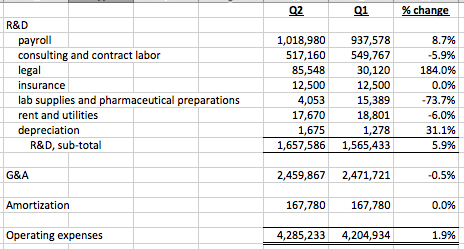
Provectus released its 10-Q filing for Q2 2012 today. See here. A quick 'n dirty analysis suggests:
  • A. Quarter-over-quarter ("QoQ") R&D expenses increased by 5.9%. QoQ G&A expenses decreased by 0.5%. Figures below are in dollars. Operating expense line items include both cash and non-cash charges.
  • B. The QoQ monthly cash expenditure increased by 3.6%.
Should some of the monies raised in the quarter be used to capitalize the spin-off entities, the financing activities figure below would be lower (as spin-off capitalization funds would be segregated on their respective balance sheets), reducing Q2 quarterly and monthly burn figures (where "burn" refers to the burning of cash for strictly operating expenses of the parent corporation).
  • C. The fundraising during the quarter, presumably related to the spin-offs, was completed at, roughly, a pre-money valuation of about $76MM. Shares were sold at $1.12 per share (not including warrant coverage). My original post on this topic is here. Click on the figure to enlarge it.
  • D. I did some basic modeling on monthly cash burn (cash on hand, in dollars, is the Y-axis), understanding that management has significant discretion over cash expenses and the actual fixed [cost] burn is very low. Click on the figure to enlarge it.
Management notes in the filing's MD&A section: "By managing variable cash expenses due to minimal fixed costs, we believe our cash and cash equivalents on hand at June 30, 2012 will be sufficient to meet our current and planned operating needs until well into 2013 without consideration being given to additional cash inflows..." 
I'd hazard a rough guess that "well into" means Q2.
  • E. The company notes, for the first time in a quarterly or annual filing: "...geographic licensure of PV-10 on the basis of...[both]...Phase 2 metastatic melanoma and Phase 1 liver results in certain areas of the world."
Such ongoing discussions could refer to, at a minimum, MM in Australasia and HCC (liver cancer) in China. Previous blog posts on this topic are here, here and here.
  • F. Provectus notes, for the first time also: "...a strategic investment strategy."
This, of course, refers to a minority equity investment by Big Pharma, such as Pfizer.
It's clear those money managers interested in but uncommitted as yet to Provectus (i.e., those on the sidelines) are waiting for, in their estimation, the inevitable dilution to come. From their perspective, the company will have to raise money to run the pivotal MM Phase 3 trial and money for day-to-day operating expenses in 2013 and beyond. Their likely varying beliefs as to the difficulty or ease with which Provectus would raise such funds might be informing their approach to and decision-making over buying shares.

The game Peter Culpepper is playing -- or perhaps put differently the strategy he is working to see unfold from a cash balance perspective but in the context of current and future company valuation -- is, rather obviously, trying very hard to close the dermatology deal, a mini-oncology transaction or two and/or a minority strategic equity investment. The upfront cash component of one or more of these transactions would be sufficient to fully fund company operations through the playing out of the end-game.

July 24, 2012

Quick Hits for July 24

As you know, Provectus is presenting PV-10 data at ESMO 2012 on October 1. ESMO is widely considered to be the most prestigious oncology association in Europe.
  • Why is participation at ESMO a poster presentation, rather than a speaking slot? Typically, Phase 2 and lesser trial data is communicated via poster, while Phase 3 and higher trial data is presented orally. Is it possible the gravity of the immunology-related work by Moffitt, had it been available at the time of submission, might have encouraged reviewers to push the Provectus PIs (and Eric) into the oral category.
  • What will be the nature of the statistical analysis and narrative of the poster presentation?
  • ESMO's prestigiousness and attendance (not disimilar to ASCO) [from the congress' press materials] draw more than 17,000 participants from over 120 different countries, including oncology professionals, healthcare policy makers, patient groups, pharmaceutical industry, cancer foundations and representatives of international media. What kind of event-related splash will Provectus make?
The WebMD videoRose Bengal Dye for Melanoma Cancer, was added to WebMD's website in December 2011. The story originally was produced and aired in July 2011.

The mixed securities shelf registration Provectus filed earlier this month (July 2) was made effective on July 20. Prior to this, the shelf's securities were not available for sale nor could offers to buy securities be accepted until the registration became effective.