Showing posts with label HCC. Show all posts

May 14, 2013

$PVCT CEO Letter: Final MM P2 PV-10 data presented, Systemic immune response shown in multiple cancers


The takeaways appear to be:
  • Final MM Phase 2 data finally was reported in 2012,
  • Murine study data, via Moffitt, showed PV-10's systemic, anti-tumor immune response,
  • This systemic immune response was shown in multiple cancers (i.e., melanoma, lung, breast),
  • Combination therapy complementariness of PV-10 and "ipi," and
  • Potentially year-end completion for the expanded HCC Phase 1 trial.
A question: Will Dr. Rosemurgy be the PI for a pancreas P1 trial?

April 23, 2013

$PVCT: HCC & PV-10

Towards the end of September 2012, Provectus announced it had expanded the protocol for Phase 1 liver cancer study to include "...the assessment of safety and efficacy in up to 24 additional patients with hepatocellular carcinoma ("HCC") or metastatic cancer of the liver (Expansion Cohort 1), as well as the safety and efficacy in up to 12 patients with HCC who are on a stable dose of sorafenib, a standard treatment for HCC (Expansion Cohort 2)." The site at which this study was going to be conducted was the same site for the original Phase 1 trial, Sharp Memorial Hospital in San Diego. The principal investigator was Dr. Paul Goldfarb, MD.

Since then, we've heard no word until recently, a few days ago, when a second site was opened: The Southeastern Center for Digestive Disorders & Pancreatic Cancer. The principal investigator is Dr. Alexander Rosemurgy, MD.

Problematic with running clinical trials, it seems, and among other things, is slowness on the part of the site and investigator to enroll and treat patients. With the opening of a second site, I hope this process is sped up. I imagine Provectus will issue a PR about the site when it enrolls and treats its first patient.

I am curious to understand whether the company has to enroll and treat all of the contemplated patients in the HCC expanded Phase 1 trial, or whether Provectus can enroll and treat a partial number in order to eventually submit an application for breakthrough therapy designation for PV-10 for HCC.

April 8, 2013

Potential for 3 #FDA BTD $PVCT Applications

Earlier today, Pharmacyclics (NASDAQ:PCYC) announced it received a third Breakthrough Therapy Designation for ibrutinib from the FDA. It would seem each successive BTD is easier (or less hard) for PCYC to achieve than the prior one presumably because of the FDA gaining more and more comfort with the drug and more and more of an understanding of the drug's benefit with each submission.

Peter has said for some time Provectus enjoys a very collaborative relationship with the FDA. EOP2, the group within the FDA examining PV-10 for metastatic melanoma, also would examine PV-10 for HCC.

BTD Application #1 With Moffitt's data now in hand (i.e., poster and supporting materials), I think the company should have sufficient information to make a very strong case for BTD for melanoma.

BTD Application #2 Building upon the knowledge gained by the FDA from PV-10 & melanoma, once management has results of Provectus' contemplated expanded HCC Phase 1 trial in hand, I would think they should have sufficient information to make the case to the FDA for BTD for HCC.

BTD Application #3 Building upon the knowledge gained by the FDA from PV-10 & melanoma and PV-10 & HCC, and perhaps once management runs, say, a feasibility study for breast cancer, I would think they would make the case to the FDA for BTD for breast.

November 28, 2012

$PVCT: Liver Cancer Addressable Market in China

Though rare in the west, liver cancer is serious in Asia due to the prevalence of hepatitis B infection, which is as high as 10 percent in China's population of 1.3 billion people. Chronic hepatitis B infection can result in liver cirrhosis and liver cancer later in life..."But in China, even 10 percent of liver cancer patients would be an incredible number," Jiang said. In China, there are about 350,000 new liver cancer cases each year, or half of the world's total.
Full article (from May 2012) here, and below.


November 27, 2012

$PVCT: 地理许可证


Provectus' share price has bounced above, below and around the 60-cent level following last month's terminated PVCTP "IPO." The SPA process has taken a toll on the stock in 2012. The market and life science investors' "certain" view the company will be forced to undergo substantial dilution to raise the necessary money for key and pivotal clinical trials (MM Phase 3, HCC expanded Phase 1 and Phase 2/3, pancreas Phase 1) weighs heavily on the share price too.

While management explored the opportunity to execute an "IPO," quarterly filings for Q2 and Q3 2012 indicated other avenues for seeking cash, such as from outlying geographic licenses (e.g., Australia, China, Japan,   MENA).
2Q12 10-Q Filing -- Click on the figure to enlarge it.
3Q12 10-Q Filing -- Click on the figure to enlarge it.
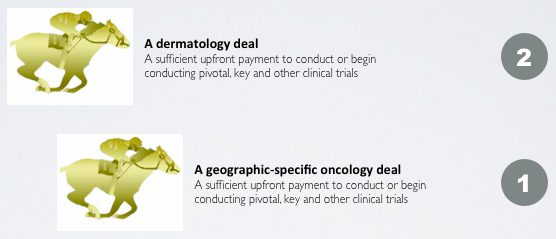
The horse race, which previously had a dermatology transaction and geographic-specific oncology deal in the lead (unless a company-friendly "IPO" could have been had to overtake them; in hindsight, it could not), now might see (for now at least) an outlying geography deal for oncology assume the lead. I am not sure if Provectus is in the homestretch in this regard, but we could shortly see if it is.


November 6, 2012

$PVCT.OB: Mini-Oncology Deal Discussions

I have written on this topic in the past. For example, see here. As I understand the lead indications and potential geographies of current discussions:


November 1, 2012

$PVCT.OB: Blog Reader Questions

Would a repeat of the study with HCC and melanoma cell lines make sense using pancreatic and breast cancer cell lines? If so, would that be significant to Big Pharma when these 4 studies are viewed collectively?
I think there are some technical challenges, especially with breast cancer. Cancers have to be Major Histocompatibility Complex-matched to the host. Cancer, including mouse cancer, should immediately be killed by the immune system. That is why organ transplants have to be matched as closely as possible. Anti-tumor immunity does not reason. It kills what is not identical to the host.

I do not know of mouse breast cancers lines that would match an immuno-competent host. I think Provectus already has successfully treated naturally occurring breast cancers in mice, and killed human breast cancers produced in mice deficient of anti-tumor immunity (nude mice). I recall Craig showing these pictures in past presentations. I think naturally occurring breast cancer has been treated in dogs. Breast and prostate cancer markets are very hard to penetrate except in very late stage disease, which makes success expensive for Provectus to pursue and achieve in small markets at this tine. Target markets like liver cancer are more accessible.

I think management some pancreatic cancer data in mouse models, ablating pancreatic cancer tumors and again observing the bystander effect. Running more mechanism variants in animal models probably would not add value. One real problem with pancreatic cancer is diagnostic, as it often is very widespread when detected. The immune system can be overwhelmed. For now, it is an open question, and one only answered by trials, as to the value for the company for this disease. A combinational therapy approach probably would have the highest chance of success.

As I previously wrote, I think other types of cancer tumors also have been studied by Moffitt. Mechanism of action is not required for FDA licensure, only safety and efficacy. To secure permission to run trials in humans, Provectus has to demonstrate to regulatory authorities that PV-10 appears safe and has potential benefit, not how it works. The company has run most of its studies with that goal in mind. Other goals have included hoping to improve efficacy or expanding into new indication markets.

As for adding value to Big Pharma, the greatest additional value would be demonstrating safety and efficacy in humans. The vast majority of the melanoma market is not very late stage disease. In the melanoma studies, the majority of the market is lies between early stage 4 and earlier, which is where the MM Phase 3 trial was designed to target. A small percentage of the market is very late stage disease.

Part of Provectus' recent presentation at the SITC 27th Annual Meeting clearly was directed at expanding into the very late stage disease market area by using a combined therapy treatment protocol. I think management believes it is the right thing to do for ethical reasons even though it could gain little in market size.

Work with models should be expanded to and published data should be available for other chemo- and immunotherapy agents (e.g., anti-CTLA 4). The goal would be to demonstrate safety and efficacy in these models with the subsequent goal of asking regulatory authorities for permission to test the combined protocols in humans.

A similar path has been followed in expanding the liver studies in people for late stage disease or disease with heavy tumor burden that might be overwhelming the human immune system. Provectus should have data on the combined therapy (PV-10 + sorafenib) in mice and permission to test the combined therapy in humans, which I think would start as soon as the trial site is able to begin the study.