Showing posts with label Australia. Show all posts

November 18, 2014

Provectus notebook

Pilon-Thomas & Moffitt Cancer Center. Frequent medical writer of PV-10 Janet Fricker has an article out in Medical News Today today about Moffitt's poster presentations at SITC 2014 entitled Melanoma shows improved regression with combination of PV-10 and checkpoint inhibitor.

The article has an interesting quote from the cancer center's Dr. Shari Pilon-Thomas, Ph.D. about their work:
"The spirit of our study was to determine whether combining PV-10 with a checkpoint inhibitor would enhance the systematic immune responses of the initial injection of PV-10."
Phrased via slightly different editing: The spirit of the study was to determine whether combining ABC with XYZ would enhance the systematic immune responses of ABC. Not, whether combining XYZ with ABC would help XYZ.

Pfizer. Pfizer announced Monday it had (i) a PD-1 agent and (ii) licensed a PD-L1 agent from Merck KGaA (Germany), thus changing the competitive landscape to look more like the below:
Click to enlarge.
See blog post "Together, these studies support the induction of increased tumor-specific immunity after co-inhibitory blockade in combination with IL PV-10 therapy."
Interestingly and notably, Pfizer immediately guided 2014 and 2015 earnings downward as a result of the transaction and to recognize its upfront payment as a certain significant item.

Some preliminary opinions on the deal include:
Jacob Plieth, EP Vantage: "This disproves the notion that a handful of big names – Merck & Co, Bristol-Myers Squibb and  Roche – had already seized all the early promise in  PD-1/PD-L1 inhibition."
The Deal Pipeline: "Pfizer in May walked away from AstraZeneca after painting itself into a corner by describing a takeover proposal - one of a series - as "final..." The deal would have also given Pfizer access to AstraZeneca's own immuno-oncology treatment, which are known as anti-PD-L1 compounds...The New York company has now found a less contentious way to access the technology." 
Pfizer's view of its immuno-oncology pipeline now, in cancer-immunity cycle terms, is:
Click to enlarge. Pfizer presentation, November 17, 2014.
Merck & Co., (U.S.A.). Merck announced positive results from a Keytruda (PD-1) melanoma trial on Sunday. The comparator for late-stage patients in this trial was systemic chemotherapy, the co-primary endpoints were progression-free survival ("PFS") and overall survival ("OS"), a secondary endpoint was overall response rate ("ORR"), and additional data was collected on duration of OR, patient-reported outcomes (the EORTC QLQ-C30 questionnaire) and safety (adverse events).

Provectus' upcoming melanoma Phase 3 trial of earlier stage patients whose disease has not spread to distant sites (which is not late-stage disease, where the disease indeed has spread) has a comparator of systemic chemotherapy, a primary endpoint of PFS, and secondary endpoints of complete response rate ("CRR"), duration of CR, patient-reported outcomes (the Skindex-16 questionnaire), OS and safety (adverse events).

China. I thought the comments by Sinopharm A-THINK's CEO in Provectus' PR Provectus Biopharmaceuticals Extends Memorandum of Understanding with Sinopharm-China State Institute of Pharmaceutical Industry and Sinopharm A-THINK Pharmaceutical Co., Ltd that "...it is hopeful that a contract will be finalized in the coming weeks" were interesting. They become notable if and when a meaningful and material deal is consummated. I don't doubt part of the deal process is for both parties (Sinopharm and Provectus) to interact with the China Food and Drug Administration.

The Cancer-Immunity Cycle. The Medical News Today article about Moffitt, PV-10 and SITC also noted:
"The mechanism, [Dr. Pilon-Thomas] adds, is thought to be that injection of PV-10 into melanoma lesions results in tumor cells releasing antigens that induce T cell immunity, with the checkpoint inhibitors then "releasing the brakes" on the resulting T cells. Next, the team plans to investigate the types of immune cells released at the tumor site." {Underlined emphasis is mine}
"[T]he types of immune cells released at the tumor site" refers to cycle steps 5 and 6 in Chen & Mellman's (2013) Oncology Meets Immunology: The Cancer-Immunity Cycle:
"In the first step, neoantigens created by oncogenesis are released and captured by dendritic cells (DCs) for processing (step 1). In order for this step to yield an anticancer T cell response, it must be accompanied by signals that specify immunity lest peripheral tolerance to the tumor antigens be induced. Such immunogenic signals might include proinflammatory cytokines and factors released by dying tumor cells or by the gut microbiota (Figure 2, Table 1). Next, DCs present the captured antigens on MHCI and MHCII molecules to T cells (step 2), resulting in the priming and activation of effector T cell responses against the cancer-specific antigens (step 3) that are viewed as foreign or against which central tolerance has been incomplete. The nature of the immune response is determined at this stage, with a critical balance representing the ratio of T effector cells versus T regulatory cells being key to the final outcome. Finally, the activated effector T cells traffic to (step 4) and infiltrate the tumor bed (step 5), specifically recognize and bind to cancer cells through the interaction between its T cell receptor (TCR) and its cognate antigen bound to MHCI (step 6), and kill their target cancer cell (step 7). Killing of the cancer cell releases additional tumor-associated antigens (step 1 again) to increase the breadth and depth of the response in subsequent revolutions of the cycle." {Underlined emphasis is mine}
Click to enlarge. Chen & Mellman, Figure 1, http://www.cell.com/immunity/abstract/S1074-7613(13)00296-3
Australia. In November 2010 Provectus wrote in their press release Provectus Meets with the Therapeutic Goods Administration to Review Path for Approval of PV-10 in Australia:
"The recent meeting focused on manufacturing, characterization and specifications for PV-10, along with a review of clinical data and anticipated Phase 3 study design and endpoints. The proposed primary endpoint of progression free survival, which Provectus proposed to the U.S. Food and Drug Administration (FDA) earlier this year in its first end-of-Phase-2 meeting with FDA, was deemed appropriate for assessment of efficacy in light of established European Medicines Agency (EMEA) standards adopted by TGA. Use of interim data from the first half of Phase 3 study subjects, in conjunction with safety data collected in earlier studies of PV-10 for melanoma, was discussed to allow early evaluation for marketing approval for metastatic melanoma, and TGA agreed that these data should be sufficient for this review if the analysis confirmed efficacy."
I learned from folks in Australia that management will be there around the time of the annual scientific meeting of the Clinical Oncology Society of Australia (December 2nd to 4th). I would think visiting the TGA, Australia's FDA, would be on their trip itinerary.

In addition to sites in Australia for Provectus' melanoma Phase 1 and 2 clinical trials and the company's compassionate use program, and the work therein, investigator-initiated work was and is being done combining PV-10 with radiotherapy. Preliminary work (3 patients) was published in 2010 as A novel treatment for metastatic melanoma with intralesional rose bengal and radiotherapy: a case series in Melanoma Research. Follow-up investigator-initiated work by the same lead (Dr. Matthew Foote, M.D.) appears to be one patient short of full enrollment and treatment (25 patients).
Click to enlarge. Above screenshot taken from a presentation
by Dr. Sanjiv Agarwala, M.D. at the 2nd European Post-Chicago Melanoma Meeting (2010)
The average cost of drug R&D. A study by the Tufts Center for the Study of Drug Development out today said developing a new prescription medicine that gains marketing approval costs $2.6 billion. A related article on the study by FierceBiotech author John Carroll framed Tuft's estimate in the context of an estimate by Doctors Without Borders of $186 million.

Through September 30, 2014, Provectus has spent (balance sheet item Accumulated Deficit) $157 million for multi-indication viable PV-10.

June 17, 2013

Horserace (updated)

In illustrating the horse race, I mean to convey or say "crossing the finish line" implies a funded transaction. So, while it will be interesting to watch if Provectus inks an MOU with Chinese pharmaceutical company Hisun-Pfizer (or another Chinese company) this week, the funding of this transaction might more likely occur within 30-60 days after the MOU is signed/announced.

The current perspective is an Indian company is more likely to consummate (i.e., fund) a regional transaction, and thus deliver the upfront payment to Provectus first, followed by a Japanese pharmaceutical company. At the moment, it would seem the Chinese upfront payment is viewed as arriving third behind the Indian and Japanese payments.


I will review the situation after Peter returns from Japan.

◉       ⦿       ◉       ⦿       ◉       ⦿       ◉       ⦿       ◉       ⦿       ◉

The above written or said, a regional transaction may not occur until the FDA provides regulatory clarity to Provectus. As I wrote in my "$PVCT is Going for BTD. BTD is Tantamount to Approval." post, the company sought this clarity through its original, initial pursuit of accelerated approval ("AA"), followed by initiating a parallel path to pursue a special protocol assessment ("SPA") and eschewing a traditional "non-SPA" MM Phase 3 trial. While both paths, AA and SPA, remain viable, the breakthrough therapy designation ("BTD") arrived last year and now appears the more active or likely path to clarity.

While management certainly could be blown away by the pricing and structure of a regional transaction from an interested party, it is not unreasonable to think these companies, as do potential investors, also are waiting for regulatory clarity before they present Provectus with terms and conditions.

As I wrote in my "#PVCT's #China #Arbitrage Opportunity post," on the one hand, while many Western Big Pharma companies are very interested in the drug, they still desire to understand the story of how and why a very effective local agent can have as comparable systemic and immunologic benefit. Thus, we waited for Moffitt. On the other hand. the Chinese (and the Indians and the Japanese) are much more interested in understanding whether PV-10 works and works cost-effectively. Both hemispheres agree the drug is safe, and both acknowledge PV-10 is effective. It is possible, however, that cultural differences might contribute to each party's thinking and decision-making processes. One wants to know why and how, while the other wants to know how much.

But Moffitt arrived in early-April. So what gives?

It is not unreasonable to think these regional pharmaceutical companies are waiting for regulatory clarity before they present Provectus with terms and conditions. It's also not unreasonable to think management also is waiting for regulatory clarity before they accept any terms and conditions on regional and/or global license transactions.

If the path of clarity is a decision of "better" (a truncated MM P3 trial) or "best" (AA), with "good" (SPA) available but not chosen, it strikes me that all parties -- management, regional pharmaceutical companies, Pfizer and Big Pharma -- have their respective reasons and rationale to wait until regulatory clarity is made transparent.

Wouldn't you think the topic of what "we" (Provectus & Pfizer) do after BTD is attained (and then, more specifically, AA or a truncated trial) might have been discussed?

◉       ⦿       ◉       ⦿       ◉       ⦿       ◉       ⦿       ◉       ⦿       ◉

Take for example the "non-unique" story of a fund that desires to put money into Provectus via an open market purchase of common stock (i.e., the shares you and I own), by dipping its toe in the water to establish an initial position of 1.5 to 4.5 million shares.

Without regulatory clarity, there's no clear exit for the fund and its managers. They cannot and do not buy, but merely wait on the sidelines. As do many others.

To most, including the above mentioned fund, the question of regulatory clarity -- in its mind and most others -- boils down to Provectus attaining the SPA from the FDA and then having to run a $30-$50 million Phase 3 trial. In the minds of this fund, dip its toes in the water now, at 63 cents, and following the clarity of an SPA, suffer 20-40% dilution (roughly) when Provectus raises aforementioned money to fund the trial. Better to wait and buy after the fund raising or, better, participate in it at the lower price with the prospect of warrant coverage too -- a much more attractive risk-reward.

As I previously wrote in my "With the FDA, It's Good, Better, Best for PV-10 and $PVCT," the closer you are to the company, the greater your awareness of Provectus' situation, the higher expectations or anticipation you have of an SPA, BTD or AA. The less familiar you are with the company or situation, the lower your level of expectations. The FDA's decision will validate Provectus and PV-10 in some form and fashion.

The above mentioned fund has done due diligence, but doesn't have the perspective Provectus watchers do. The fund, like its sistren and brethren, invests broadly across a variety of companies, diversifies risk, plays the numbers, is not early, and endeavors to generate alpha (which for the vast majority of such funds merely and actually is beta).

Provectus watchers would tell you they believe the situation now is an outcome between "better" and "best." The consensus view appears to be the company already has submitted a/the BTD application. Opinions vary as to when, from early-May to early-June, which would indicate a result as late as early-August (perhaps early-September if one leaves room for summer vacation and/or the dog days of summer) and as early as "now."

◉       ⦿       ◉       ⦿       ◉       ⦿       ◉       ⦿       ◉       ⦿       ◉

An e-mail from a blog reader:
My PVCT buddies and I have long since learned to take your predictions with a handful of salt BUT - we're sure going to be prepared when that Great Day finally arrives and it will be because you have prepared us so well in advance. I don't think I need to tell you how very much I appreciate all that you put into the Blog. Reading it every day has made hanging on to this losing position this past year and a half almost a pleasure.
Yes, the forecast is always wrong, but I love receiving e-mails like this. Thank you.

January 12, 2013

$PVCT: Horse Race (updated)


Last updated here. For the moment, I returned the first group of horses to all being equally close to the finish line. In the second group, India, since my last update, has pulled ahead of Japan.

January 3, 2013

$PVCT: Horse Race (updated)


Last updated here. The horse race above is a snapshot in time. Horses surge ahead, they fall behind, they come out of nowhere. Sometimes, we don't know the outcome until they cross the wire. I adjusted some of the positions slightly to reflect more nuance and opinion.

December 23, 2012

$PVCT: Horse Race (updated)


Last updated here. The horse race above is a snapshot in time. Horses surge ahead, they fall behind and, sometimes, they come out of nowhere.

December 9, 2012

$PVCT: Horse Race (updated)


The geographies Provectus identified above probably represent the limit of the company's potential oncology end-game partners' disinterest. There likely is no appetite to geographically segment the licensure of PH-10.

December 7, 2012

$PVCT: If Not China, Then What?

In a prior post, I illustrated the then current snapshot of the horserace.
There may be a second geographic region in play (Australia?, India?*). My take on a comparison of license or deal headline numbers is below:

If the company wanted to hold onto oncology longer, a cost breakdown of the contemplated pivotal, key and other trials appears to be:
A China deal (or whatever possible combination of outlying geographic deals) that net a $25-50MM upfront payment goes a long way to providing the necessary funding for Provectus to make even more clinical trial progress.

Could dermatology nose out oncology at the finish line? Sure.

Recall the path Provectus traveled with PV-10 and oncology: clinical trials and regulatory discussions, followed by immunologic mechanism of action characterization work by a world-class institution. The early spadework to demonstrate efficacy, safety and multi-indication viability was followed and enhanced by Moffitt's past and future murine model results (not including, yet, human immunologic work). And while shareholders wished for Big/International Pharma to snap to attention (i.e., license PV-10) because of outstanding early-phase trial results, it now appears the immunology work already presented by Moffitt at SSO and Craig at SITC, followed by forthcoming work to be presented by Moffitt, is accelerating license interest and discussions of both regional and global natures.

Could PH-10 be following a similar path?

The "hang-up" with PV-10 appeared to have been with Big Pharma folks being unable to wrap their heads around how well PV-10 worked. They needed help to understand something they had never seen before. They appear to understand now, or at least are getting closer. As such, license interest and discussions are heating up.

It is not unreasonable to analogize PV-10's path to PH-10's, and thus potentially explain the delay in getting to a dermatology license or sale transaction. Perhaps immunologic mechanism of action characterization work is being done on PH-10 by a world-class institution to complete the understanding of prospective dermatology licensees before they fully commit to jumping into the pool. I think this immunology mechanism of action work is being at The Rockefeller University (the Laboratory for Investigative Dermatology?).
Once this PH-10 immunologic mechanism of action characterization work is completed and provided to prospective partners (I do not know when the work was started and when it and the subsequent analysis was or will be completed), and assuming this knowledge concludes their thinking, dermatology might well beat oncology to the finish line.

In this horse race, however, the more horses that cross the finish line -- Provectus licenses deals -- the better.

* I suspect PV-10's extremely low cost structure, and thus tremendous pricing flexibility, helps facilitate country discussions without fear or risk of patent loss (or too much of it).

November 27, 2012

$PVCT: 地理许可证


Provectus' share price has bounced above, below and around the 60-cent level following last month's terminated PVCTP "IPO." The SPA process has taken a toll on the stock in 2012. The market and life science investors' "certain" view the company will be forced to undergo substantial dilution to raise the necessary money for key and pivotal clinical trials (MM Phase 3, HCC expanded Phase 1 and Phase 2/3, pancreas Phase 1) weighs heavily on the share price too.

While management explored the opportunity to execute an "IPO," quarterly filings for Q2 and Q3 2012 indicated other avenues for seeking cash, such as from outlying geographic licenses (e.g., Australia, China, Japan,   MENA).
2Q12 10-Q Filing -- Click on the figure to enlarge it.
3Q12 10-Q Filing -- Click on the figure to enlarge it.
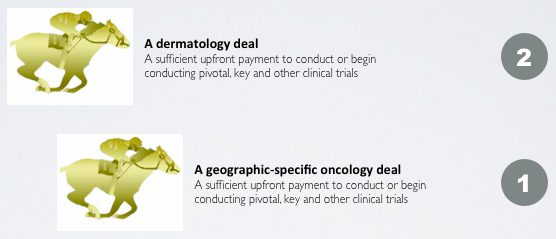
The horse race, which previously had a dermatology transaction and geographic-specific oncology deal in the lead (unless a company-friendly "IPO" could have been had to overtake them; in hindsight, it could not), now might see (for now at least) an outlying geography deal for oncology assume the lead. I am not sure if Provectus is in the homestretch in this regard, but we could shortly see if it is.


November 6, 2012

$PVCT.OB: Mini-Oncology Deal Discussions

I have written on this topic in the past. For example, see here. As I understand the lead indications and potential geographies of current discussions: