Showing posts with label LIVESTRONG. Show all posts
May 29, 2013
May 19, 2013
I Think it's a Good Time to be a $PVCT Shareholder
Shareholders are closer to the end-game for the stock than to their journey's beginning. The company's life sciences technology is head and shoulders above its peers. The lead compound presents a compelling clinical value proposition capable, perhaps, of indeed shifting the paradigm of cancer treatment (and treatment of inflammatory skin disorders). The drug already is productized, with a product business proposition to match that of the underlying technology. Provectus appears to be nearing transparency regarding regulatory clarity for oncology. The company also appears to be nearing certain license deals that will provide initial market validation. In sum, management, Provectus and its shareholders are nearing the end-game.
Provectus' technology is a game changer, productized to effect the change, and can be delivered and scaled to profit from the change to come.
The technology, PV-10 for oncology, is an effective local treatment capable of as effectively treating distant disease and visceral metastases. The drug, through expression of antigens in context in tumors into which PV-10 is injected fortifies the immune system against cancerous agents. Immunization occurs because PV-10's chemoablation causes rapid, complete, durable necrosis of tumor lesions.
"Scientists have been trying for decades to understand why the body's immune system didn't see cancer cells as the enemy and attack them. Recent discoveries revealed that tumors are adept at cloaking themselves by hijacking the body's own mechanism for preventing the system's T-cells, the infection- and disease-fighting cells of the immune system, from running amok against healthy tissue."
The above quote from Wall Street Journal (WSJ) article New Cancer Drugs Harness Power of Immune System (5/15/13) is not quite on-point. Rather, the quote below from Bloomberg article Human Immune-Boosting Cancer Drugs Seen Extending Lives (5/12/13) is more to the point.
"Now many believe that by strengthening the immune system’s ability to identify and kill cancer cells, they can broaden the attack so it will fight any dangerous malignancy. “You’re setting up a fair fight” with the disease, said Nils Lonberg, a senior vice president at Bristol-Myers, in a telephone interview. “The immune system is just as adaptable as the cancer.”"
How do you strengthen the immune system? Medical science has done it before with infectious diseases. Immune systems can be overwhelmed and, thus, are unable to help the human body fight back. Antibiotics themselves do not cure patients of infectious diseases that have afflicted them. Rather, the immune system cures the hosts with the help of antibiotics. Treating infectious diseases requires that antibiotics should have near absolute specificity for the infectious agent. Tough infections require multiple agents.
I think it's a good time to be a Provectus shareholder.
The volume of the conversations about immunotherapy has grown much, much louder. Take Xconomy's Luke Timmerman's article Genentech Follows Fast at ASCO as Cancer Immunotherapy Picks Up (5/15/13) for example.
"Genentech made its name in cancer by creating targeted antibody drugs that zero in on tumor cells while mostly sparing healthy tissue. Now it’s seeking to compete in the next wave of cancer immunotherapies, which are designed to spark the immune system to attack tumors like a virus."
Or take NBC's Nightly News report Immunotherapy targets cancer cells with remarkable results (5/15/13).
"Cancer cells typically put up a chemical shield to protect against the body’s disease-fighting T cells. But immunotherapy can break down the shield and let the T cells get to work."
The more the biopharmaceuticals industry, investing community and general public talk about immunotherapy, the better the environment or atmosphere for PV-10 and Provectus to flourish.
From the same WSJ article above: "More broadly, Leerink [Swann, a middle market investment bank] believes the "immuno-oncology" drug market could amount to a $20 billion category annually, putting it on a par with the cholesterol-lowering statin market at its height."
From dendritic cells (Dendreon's Provenge) to antitumor antibodies (Bristol-Myers' anti-CTLA-4 agent Yervoy) to immune checkpoint blockades (ASCO 2013's anti-PD1 and anti-PDL-1 agents):
"The immunotherapy of cancer has made significant strides in the past few years due to improved understanding of the underlying principles of tumor biology and immunology...[t]he pillars of human cancer therapy have historically been surgery, radiotherapy, and chemotherapy, but a fourth modality of immunotherapy has been well documented since 1890..." (Kirkwood et al.).
Big Pharma is tacking closer to the ultimate goal, but they mostly still are sailing wide of the objective.
"If the new generation of immune therapies lives up to its promise, “this is going to be a paradigm shift for treating cancer,” said Merck senior vice president Gary Gilliland in an interview. “We are pretty good at shrinking tumors, but not good at getting rid of them. Immune therapy is a way to begin to approach that.”"
Yes, Big Pharma is pretty good at shrinking cancerous tumors, but not yet good enough at making them go away.
Craig's postulation that you treat cancer like you treat an infectious disease requires a/the drug treatment to possess near absolute specificity for diseased tissue (spare normal tissue and clear rapidly from it) and induce a host response (combined apoptosis-autophagy of treated targets because intralesional delivery produces a “vaccine-like” systemic effect that enhances normal human body defenses) over a very wide range of activity (broad spectrum antibiotic-like)
PV-10 chemoablation causes rapid, complete, durable necrosis of tumor lesions.
I think it's a good time to be a Provectus shareholder.
The general discourse at the moment about immunotherapies, however, is far from well understood or a consensus. Take last week's exchange on Adam Feuerstein's Twitter feed @adamfeuerstein below.
Feuerstein had been explaining the fundamental bear case for Vical's Allovectin-7, but aside from perhaps some valid trial design questions, his "red flags" included a lack of positive statements by melanoma experts and institutional healthcare investors as well as a lack of immune-related toxicity by Allovectin-7. Church is not a fan of immune-related toxicity because of the long-term dangers of altering the immune system in order to use it. All of this despite the on-point replies of other respondents: directing T-cells to attack tumors rather than a broad uncontrolled response, the beauty of local treatment is limited toxicity, revolutionary if the local treatment works on visceral mets, etc.
Many monoclonal immunotherapies do cause terrible toxicities, which are related not just related to "taking the brakes off" the immune system. Their target antigens are not only on/in the immune cells they wish to suppress. Just like chemotherapy agents, immunotherapy agents also can cause collateral damage with more adverse side effects like cancer and death.
The nature of the conversation Feuerstein, Church and the others need to have has to be deeper and more substantive. It's too simplistic to say Allovectin-7 does or will not work. Whether it's Allovectin-7 or talimogene laherparepvecone (T-Vec, formerly OncoVEX), or PV-10 itself, one has to balance positive effects with side effects. Think of it as a biological signal-to-noise ratio. One can titer up dosages until one sees bad things happen.
I think Pfizer probably refused to do this with its anti-CTLA-4 agent tremelimumab, which is why it has a greater failure record in clinical trials than it's Bristol-Myers' ipilimumab. Bristol-Myers probably had a higher tolerance for "bad things to happen" in order to suss out the optimal or near-optimal signal-to-noise or benefit-to-side-effect ratio.
Remind yourself of Provectus' combination therapy work at AACR 2013 utilizing PV-10 and a systemic anti-CTLA-4 antibody. The highest dose of the latter killed the murine subjects more quickly. Lower doses were less effective but also less dangerous. Interestingly, the results the company concluded that while PV-10 is highly effective when all existing tumor is accessible for injection, for visceral or other inaccessible disease the combination of PV-10 with CTLA-4 blockade has important potential synergy. Nevertheless, the apparent toxicity at high doses of the anti-CTLA-4 antibody markedly reduced the effect of the antibody alone and the combination of PV-10 and the antibody.
If an immunotherapy is working, there has to be some response (e.g., inflamation, redness, blistering, itching, etc.). These "side effects" come with the territory, and merely are signs the immune system is now in the game. So, while one indeed is generating a toxic response by recruiting the immune system, the key is focusing this toxicity as much as possible.
The problem with Yervoy, and perhaps immunotherapies like anti-PD-1, anti-PDL-1 agents and other treatments, is the collateral damage they cause to the body. PV-10's great strength has been and is its ability to the target only what it kills and kill only what it targets. Another strength is the drug's ability to generate a very specific, targeted, immune response with very little collateral damage to anything but the tumor itself. So, some blistering occurs, body temperature rises, etc. Nothing more.
I think it's a good time to be a Provectus shareholder.
Still, regulatory clarity has to become transparent. Is it an MM Phase 3 trial under SPA powered for for a 6-month progressional free survival for PV-10 vs. 2-month plus PFS for the comparator DTIC?Or is it breakthrough designation therapy and accelerated approval or another accelerated pathway?
Further still, commercial validation through one or more meaningful license transactions (global, regional, dermatology) is required. For example, will it be Hisun-Pfizer Pharmaceuticals in China? Or another company or entity? The Hisun-Pfizer joint venture was established in 2012 to sell off-patent medicines in China and other emerging markets. But economics are economics. Pfizer's 49% equity ownership and thus 49% ownership of any PV-10 sales in China would be a strong inducement to widening the entity's mandate through a license deal with Provectus.
Who will it be in India? In Japan? When will PH-10 be licensed, and to whom?
Provectus is squarely in the eye of key cancer patient advocates. The company participated in Melanoma Research Alliances' (MRA's) Fifth Annual Scientific Retreat in February. In April Peter joined MRA's President and CEO Wendy Selig, LiveSTRONG's President and CEO and Provectus corporate advisory board member Doug Ulman, Moffitt Cancer Research Center's Dr. Shari Pilon-Thomas and some media for dinner.
Key opinion leaders like Moffitt's Dr. Jeff Weber and Dr. Vernon Sondak and Pfizer's Dr. Craig Eagle are enthused about PV-10 as both a monotherapy and combination therapy.
More data is on the way. And data is driving and will drive the deals.
Yes, I think it's a good time to be a Provectus shareholder.
Provectus' technology is a game changer, productized to effect the change, and can be delivered and scaled to profit from the change to come.
The technology, PV-10 for oncology, is an effective local treatment capable of as effectively treating distant disease and visceral metastases. The drug, through expression of antigens in context in tumors into which PV-10 is injected fortifies the immune system against cancerous agents. Immunization occurs because PV-10's chemoablation causes rapid, complete, durable necrosis of tumor lesions.
"Scientists have been trying for decades to understand why the body's immune system didn't see cancer cells as the enemy and attack them. Recent discoveries revealed that tumors are adept at cloaking themselves by hijacking the body's own mechanism for preventing the system's T-cells, the infection- and disease-fighting cells of the immune system, from running amok against healthy tissue."
The above quote from Wall Street Journal (WSJ) article New Cancer Drugs Harness Power of Immune System (5/15/13) is not quite on-point. Rather, the quote below from Bloomberg article Human Immune-Boosting Cancer Drugs Seen Extending Lives (5/12/13) is more to the point.
"Now many believe that by strengthening the immune system’s ability to identify and kill cancer cells, they can broaden the attack so it will fight any dangerous malignancy. “You’re setting up a fair fight” with the disease, said Nils Lonberg, a senior vice president at Bristol-Myers, in a telephone interview. “The immune system is just as adaptable as the cancer.”"
How do you strengthen the immune system? Medical science has done it before with infectious diseases. Immune systems can be overwhelmed and, thus, are unable to help the human body fight back. Antibiotics themselves do not cure patients of infectious diseases that have afflicted them. Rather, the immune system cures the hosts with the help of antibiotics. Treating infectious diseases requires that antibiotics should have near absolute specificity for the infectious agent. Tough infections require multiple agents.
I think it's a good time to be a Provectus shareholder.
The volume of the conversations about immunotherapy has grown much, much louder. Take Xconomy's Luke Timmerman's article Genentech Follows Fast at ASCO as Cancer Immunotherapy Picks Up (5/15/13) for example.
"Genentech made its name in cancer by creating targeted antibody drugs that zero in on tumor cells while mostly sparing healthy tissue. Now it’s seeking to compete in the next wave of cancer immunotherapies, which are designed to spark the immune system to attack tumors like a virus."
Or take NBC's Nightly News report Immunotherapy targets cancer cells with remarkable results (5/15/13).
"Cancer cells typically put up a chemical shield to protect against the body’s disease-fighting T cells. But immunotherapy can break down the shield and let the T cells get to work."
The more the biopharmaceuticals industry, investing community and general public talk about immunotherapy, the better the environment or atmosphere for PV-10 and Provectus to flourish.
From the same WSJ article above: "More broadly, Leerink [Swann, a middle market investment bank] believes the "immuno-oncology" drug market could amount to a $20 billion category annually, putting it on a par with the cholesterol-lowering statin market at its height."
From dendritic cells (Dendreon's Provenge) to antitumor antibodies (Bristol-Myers' anti-CTLA-4 agent Yervoy) to immune checkpoint blockades (ASCO 2013's anti-PD1 and anti-PDL-1 agents):
"The immunotherapy of cancer has made significant strides in the past few years due to improved understanding of the underlying principles of tumor biology and immunology...[t]he pillars of human cancer therapy have historically been surgery, radiotherapy, and chemotherapy, but a fourth modality of immunotherapy has been well documented since 1890..." (Kirkwood et al.).
Big Pharma is tacking closer to the ultimate goal, but they mostly still are sailing wide of the objective.
"If the new generation of immune therapies lives up to its promise, “this is going to be a paradigm shift for treating cancer,” said Merck senior vice president Gary Gilliland in an interview. “We are pretty good at shrinking tumors, but not good at getting rid of them. Immune therapy is a way to begin to approach that.”"
Yes, Big Pharma is pretty good at shrinking cancerous tumors, but not yet good enough at making them go away.
Craig's postulation that you treat cancer like you treat an infectious disease requires a/the drug treatment to possess near absolute specificity for diseased tissue (spare normal tissue and clear rapidly from it) and induce a host response (combined apoptosis-autophagy of treated targets because intralesional delivery produces a “vaccine-like” systemic effect that enhances normal human body defenses) over a very wide range of activity (broad spectrum antibiotic-like)
PV-10 chemoablation causes rapid, complete, durable necrosis of tumor lesions.
I think it's a good time to be a Provectus shareholder.
The general discourse at the moment about immunotherapies, however, is far from well understood or a consensus. Take last week's exchange on Adam Feuerstein's Twitter feed @adamfeuerstein below.
Feuerstein had been explaining the fundamental bear case for Vical's Allovectin-7, but aside from perhaps some valid trial design questions, his "red flags" included a lack of positive statements by melanoma experts and institutional healthcare investors as well as a lack of immune-related toxicity by Allovectin-7. Church is not a fan of immune-related toxicity because of the long-term dangers of altering the immune system in order to use it. All of this despite the on-point replies of other respondents: directing T-cells to attack tumors rather than a broad uncontrolled response, the beauty of local treatment is limited toxicity, revolutionary if the local treatment works on visceral mets, etc.
Many monoclonal immunotherapies do cause terrible toxicities, which are related not just related to "taking the brakes off" the immune system. Their target antigens are not only on/in the immune cells they wish to suppress. Just like chemotherapy agents, immunotherapy agents also can cause collateral damage with more adverse side effects like cancer and death.
The nature of the conversation Feuerstein, Church and the others need to have has to be deeper and more substantive. It's too simplistic to say Allovectin-7 does or will not work. Whether it's Allovectin-7 or talimogene laherparepvecone (T-Vec, formerly OncoVEX), or PV-10 itself, one has to balance positive effects with side effects. Think of it as a biological signal-to-noise ratio. One can titer up dosages until one sees bad things happen.
I think Pfizer probably refused to do this with its anti-CTLA-4 agent tremelimumab, which is why it has a greater failure record in clinical trials than it's Bristol-Myers' ipilimumab. Bristol-Myers probably had a higher tolerance for "bad things to happen" in order to suss out the optimal or near-optimal signal-to-noise or benefit-to-side-effect ratio.
Remind yourself of Provectus' combination therapy work at AACR 2013 utilizing PV-10 and a systemic anti-CTLA-4 antibody. The highest dose of the latter killed the murine subjects more quickly. Lower doses were less effective but also less dangerous. Interestingly, the results the company concluded that while PV-10 is highly effective when all existing tumor is accessible for injection, for visceral or other inaccessible disease the combination of PV-10 with CTLA-4 blockade has important potential synergy. Nevertheless, the apparent toxicity at high doses of the anti-CTLA-4 antibody markedly reduced the effect of the antibody alone and the combination of PV-10 and the antibody.
If an immunotherapy is working, there has to be some response (e.g., inflamation, redness, blistering, itching, etc.). These "side effects" come with the territory, and merely are signs the immune system is now in the game. So, while one indeed is generating a toxic response by recruiting the immune system, the key is focusing this toxicity as much as possible.
The problem with Yervoy, and perhaps immunotherapies like anti-PD-1, anti-PDL-1 agents and other treatments, is the collateral damage they cause to the body. PV-10's great strength has been and is its ability to the target only what it kills and kill only what it targets. Another strength is the drug's ability to generate a very specific, targeted, immune response with very little collateral damage to anything but the tumor itself. So, some blistering occurs, body temperature rises, etc. Nothing more.
I think it's a good time to be a Provectus shareholder.
Still, regulatory clarity has to become transparent. Is it an MM Phase 3 trial under SPA powered for for a 6-month progressional free survival for PV-10 vs. 2-month plus PFS for the comparator DTIC?Or is it breakthrough designation therapy and accelerated approval or another accelerated pathway?
Further still, commercial validation through one or more meaningful license transactions (global, regional, dermatology) is required. For example, will it be Hisun-Pfizer Pharmaceuticals in China? Or another company or entity? The Hisun-Pfizer joint venture was established in 2012 to sell off-patent medicines in China and other emerging markets. But economics are economics. Pfizer's 49% equity ownership and thus 49% ownership of any PV-10 sales in China would be a strong inducement to widening the entity's mandate through a license deal with Provectus.
Who will it be in India? In Japan? When will PH-10 be licensed, and to whom?
Provectus is squarely in the eye of key cancer patient advocates. The company participated in Melanoma Research Alliances' (MRA's) Fifth Annual Scientific Retreat in February. In April Peter joined MRA's President and CEO Wendy Selig, LiveSTRONG's President and CEO and Provectus corporate advisory board member Doug Ulman, Moffitt Cancer Research Center's Dr. Shari Pilon-Thomas and some media for dinner.
Key opinion leaders like Moffitt's Dr. Jeff Weber and Dr. Vernon Sondak and Pfizer's Dr. Craig Eagle are enthused about PV-10 as both a monotherapy and combination therapy.
More data is on the way. And data is driving and will drive the deals.
Yes, I think it's a good time to be a Provectus shareholder.
November 16, 2012
$PVCT.OB: The First Anniversary of This Blog
I wrote my first blog post on November 16, 2011. At the time of that post: "The share price is $0.88. 14,700 shares have traded." Today, it closed at approximately $0.53, down about 40%, and traded about 54,000 shares.
![]() |
| Click on the figure to enlarge it. |
- October 29, 2012: Provectus Presents Nonclinical Data on Antitumor Immune Response to PV-10 Immuno-Chemoablation (very key),
- October 17, 2012: Provectus Pharmaceuticals Terminates Proposed Convertible Preferred Stock Offering (the failed IPO),
- October 2, 2012: Provectus Pharmaceuticals Presents Final Phase 2 Melanoma Data at ESMO 2012 (key),
- September 28, 2012: Provectus Pharmaceuticals' Patent Application Published for Combining Local and Systemic Therapies for Enhanced Treatment of Cancer (the joint Pfizer-Provectus patent app),
- September 27, 2012: Provectus Expands Protocol for Phase 1 Liver Cancer Study (important),
- June 26, 2012: Provectus Pharmaceuticals Presents Final Phase 2 on PV-10 At 2nd European Post-Chicago Melanoma Meeting 2012 on June 22, 2012 (visibility),
- May 30, 2012: Doug Ulman, National Cancer Survivorship Advocate, Joins Provectus Pharmaceuticals' Corporate Advisory Board (a great get),
- May 14, 2012: Provectus Pharmaceuticals Forms Independent Board to Meet Corporate Governance Requirements (an important corporate governance advance),
- April 10, 2012: Phase 2 Data on Provectus's PV-10 to Be Presented at the HemOnc Today - Melanoma and Cutaneous Malignancies Conference on April 13, 2012 (visibility),
- March 26, 2012: Intralesional PV-10 Treatment Leads to the Induction of Anti-Tumor Immunity (very key),
- March 23, 2012: Mechanism of Action Data On PV-10 Demonstrates Therapy Induces Immunologic Response (very key),
- March 19, 2012: Provectus Announces Top Line Phase 2 Data For PH-10 in Its First Randomized Controlled Psoriasis Study (important), and
- January 18, 2012: Provectus Receives Guidance From FDA On Pathway to Approval for Phase 3 Trial of PV-10 For Metastatic Melanoma (important regulatory step).
![]() |
| Click on the figure to enlarge it. |
Thank you for visiting and reading!
Labels:
$PFE,
$PVCT.OB,
$PVCTP,
common stock,
Dermatology,
Doug Ulman,
Immunology,
Intellectual Property,
IPO,
Key Opinion Leaders,
Liver,
LIVESTRONG,
Management,
Melanoma,
Moffitt,
Pfizer,
PH-10,
PV-10,
Valuation
November 15, 2012
$PVCT.OB: Provectus Corporate Advisory Board Member Doug Ulman of the LIVESTRONG Foundation
Getting Doug Ulman of the LIVESTRONG Foundation (formerly The Lance Armstrong Foundation) as a corporate advisory board was a great get for Provectus.
At the time I had and, until recently, still wondered what would happen to the LIVESTRONG Foundation and brand were Lance Armstrong to fall. What happens to iconic brands when something happens to the icon: e.g., LIVESTRONG and Lance Armstrong, Apple and Steve Jobs, Berkshire Hathaway and Warren Buffett, Microsoft and Bill Gates, etc.?
The Foundation has been quick to change some name-related things.
Other things may take more time.
With Lance Armstrong stepping off the Foundation's board of directors, the brand likely will evolve as an entity unto itself, with Mr. Ulman increasing his leadership role, own brand and brand association.
He certainly appears to be paying attention to Provectus. As an aside, for now, social media, in time, should be key to spreading of awareness of PV-10 within the community of cancer patients, survivors and their family members, and far beyond.
Mr. Ulman joined Provectus' CAB nearly 6 months ago. At the time, I wrote he filled or provided the role of patient advocate on the advisory board as:
I am told activity in this regard is inbound. I, like you, will keep an eye out for all things Provectus-and-Ulman.
At the time I had and, until recently, still wondered what would happen to the LIVESTRONG Foundation and brand were Lance Armstrong to fall. What happens to iconic brands when something happens to the icon: e.g., LIVESTRONG and Lance Armstrong, Apple and Steve Jobs, Berkshire Hathaway and Warren Buffett, Microsoft and Bill Gates, etc.?
The Foundation has been quick to change some name-related things.
| Click on the figure to enlarge it. |
![]() |
| Click on the figure to enlarge it. |
![]() |
| Click on the figure to enlarge it. |
![]() |
| Click on the figure to enlarge it. |
- A three-time cancer survivor,
- Someone who already is recognized nationally and globally (growing) as a cancer advocate, and
- Chief executive of a global organization and brand.
I am told activity in this regard is inbound. I, like you, will keep an eye out for all things Provectus-and-Ulman.
May 30, 2012
Corporate Advisory Board Member Doug Ulman Tweets
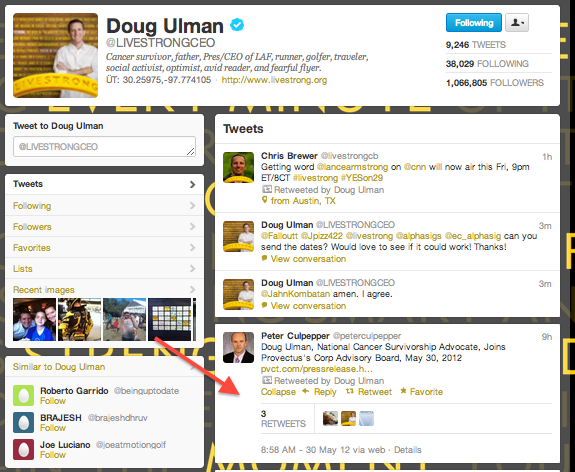
Actually, Doug Ulman retweeted Pete's tweet about adding Doug to Provectus' corporate advisory board.
I retweeted Pete's tweet. You can follow me on Twitter here and @PVCTinvestor.
Doug Ulman, National Cancer Survivorship Advocate, Joins Provectus Pharmaceuticals’ Corporate Advisory Board
Provectus announced today that LIVESTRONG's President and CEO Doug Ulman joined its corporate advisory board. LIVESTRONG is the Lance Armstrong Foundation.
Doug Ulman is a great add for several reasons. I think is quite a coup for management. Come to think of it, "quite" is an understatement.
Mr. Ulman fills or provides the role of patient advocate on the advisory board as (i) a three-time cancer survivor, (ii) someone who already is recognized nationally as a cancer advocate, and (iii) chief executive of the global LIVESTRONG organization and brand.
You can follow Doug's tweets here. As you can see from the screenshot below, he has more than a million followers on Twitter.
His addition dramatically raises Provectus' awareness among several groups of people, including (i) cancer patients and survivors, and their families, (ii) the cancer research community (Doug served a four-year term as the Chairman of the National Cancer Institute Director's Consumer Liaison Group), (iii) the national media, and (iv) charitable and philanthropic organizations.
LIVESTRONG and Doug's use of social media and other Internet-based tools to foster communities of cancer sufferers and their families and serve as a model for other non-profit organizations is well known. See here.
Speaking of brand, Provectus now is associated with Lance Armstrong's global brand, and vice versa.
While its $50.4 million in annual revenue is less than what the 97-year-old American Cancer Society raises in a month, Livestrong has been a catalyst for better cancer care and education across the globe. "It's a force to be reckoned with," says Leslie Lenkowsky, a professor at Indiana University's Center on Philanthropy. Livestrong's help line, guidebooks, and website helped more than 400,000 people last year. Its social-media efforts reach about 3 million supporters. It has pioneered programs here and abroad for survivors; worked to unify the fractured cancer community; and instigated a worldwide crusade, which includes the United Nations and the Clinton Global Initiative, to make the world's No. 1 killer a health-care priority. "I can't think of an organization with the breadth of activity that the foundation has," says Dr. Larry Shulman, chief medical officer at the renowned Dana-Farber Cancer Institute in Boston, "and that includes the American Cancer Society." (source of October 2010 quote here).
LIVESTRONG's board members appear to be as or more prominent, influential and connected as well.
I had the good fortune many years ago to hear a keynote speech by Hamilton Jordan. It takes reminding, by oneself and others around you: There is no such thing as a bad day.
Management has been working on gaining this key opinion leader relationship for more than a year. Note Doug's tweet last April:
Let's put ourselves in Doug's shoes for a moment as he diligenced the company in order to determine whether he would or should accept Provectus' invitation to join the corporate advisory board. If you were him, what questions might you pose to management and its references? Perhaps these:
- How well does PV-10 work? How safe is it?
- What do physicians and the medical community think about PV-10?
- What does the FDA think about PV-10?
- Where is the drug in the regulatory approval process?
- How soon could PV-10 be available to patients?
- How did PV-10 come about? Is it unique? If so, why?
- How does PV-10 compare to other kinds and types of treatment?
- Who are the founders and management team? What is their background, history, and success and failures?
- Who are the members of the board of directors and advisory board?
Doug Ulman joining Provectus' advisory board speaks (shouts) volumes about PV-10, the company and management. I think it speaks to the veracity of management as well.
Subscribe to:
Posts (Atom)