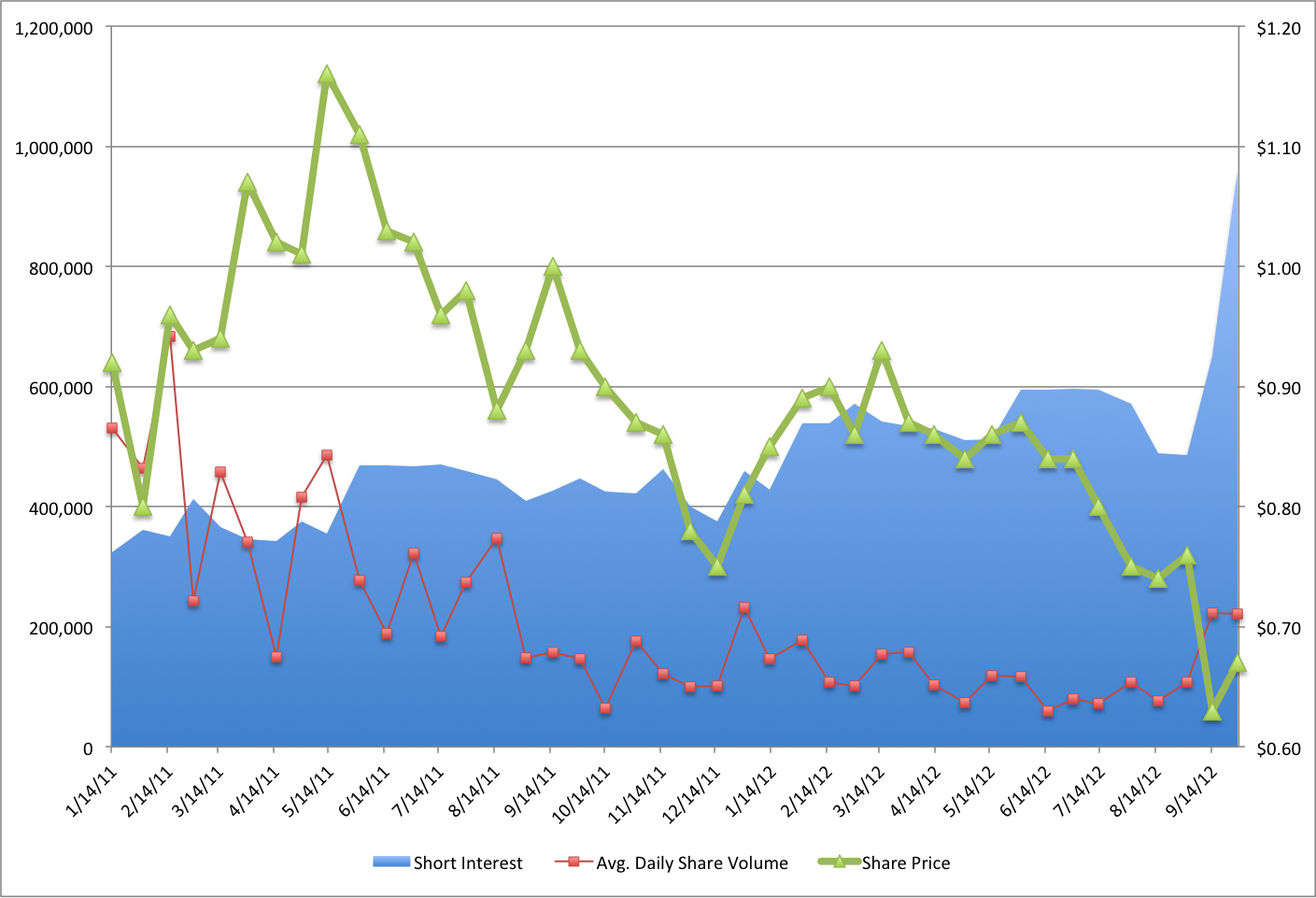
Certain brokers called certain Provectus shareholders late last week -- that is, the brokerage firms (or "brokers") where these shareholders have their shares of Provectus held -- to see if they, the shareholders, would loan any of their PVCT shares to be used to cover short interests. Although it varied, shareholders were offered low double-digit (annualized) interest on shares.
This information clearly indicates firms/funds/traders are planning to/should/will short Provectus stock in front of what news if any the company may issue next week. This market behavior and potential activity is not unexpected. The share price has run-up considerably, and the company telegraphed it will say something next week (you'll recall the date of January 15th was a byline in the company's December 18th PR).
As a shareholder, you may instruct your broker to not permit your shares in Provectus, or the stock of any public company you also may hold, to be borrowed.
Let's say the interest rate offered to the above mentioned Provectus shareholders was 10%, 11%, etc. This is an annualized rate, which means it's effectively or should be considered having a one-year or 12-month return on investment for the shareholders receiving it (assuming they agree to lend their shares). U.S Treasury interest rates, see below taken from Bloomberg today (these rates are reflective of market rates as of Friday, January 10th), show 12-month or one-year rates are effectively zero percent.
The upshot is that folks who want to short Provectus stock next week think they will be able to make much more than the 10% or 11% or higher they are offering to shareholders to borrow their stock. A 10-11% annualized return for "doing nothing" might seem pretty good to shareholders. It's a very large "risk free rate," in the finance theory sense of the word, when the current, comparable risk free rate is the 12-month Treasury bill rate of effectively 0%.
Why do they think they'll make >>10-11% or more shorting Provectus stock? Because they believe Craig, Tim, Eric and Peter will say nothing or very little next week.
Updated 1/23/14: A reader noted my dates below were incorrect. I have revised them accordingly. Thank you.
Updated 1/11/14 (I previously had written 1/11/13): Blog reader question: Does the potential shorting make you nervous at all? I am worried that the PR will be as subdued as always. Though I think they have no choice but to give an accurate rendition of the minutes...Perhaps the shorts are planning to short an exuberant run-up that runs too high?
No, potential or actual shorting does not make me nervous. I'm comfortable with my investment thesis, which likely is a much longer-termed one than prospective short-oriented traders would have. Yes, such traders also may be preparing to short if exuberance in the stock pushes the share price "too high." I would expect management to say what they can or want to say in any press release issued next week. Whether or not an FDA guidance-related PR is subdued, it would not change the substance of the progress I think they've made as it relates to working towards the approval of PV-10 for melanoma.
Updated 1/11/14 (I previously had written 1/11/13): The brokers are Fidelity.
Showing posts with label Short Interest. Show all posts
January 11, 2014
June 20, 2013
Comparing the 10 Most-Shorted Biotech Stocks of 2013 to $PVCT's Short Interest
Adam Feuerstein provided a list of 10 bio-pharma stocks with the highest short interest, according to S&P Capital IQ. The figures range from 22% of float for no. 10 InterMune (NASDAQ: ITMN) to 37.5% for no. 1 Sarepta Therapeutics (NASDAQ: SRPT).
With 1. 3 million shares of short interest at May 31 and a float of 115 million at March 31, short interest for Provectus is 1.1% of float.
I include the year-to-date stock chart of PVCT and the Nasdaq Biotechnology Index to be consistent with the illustrations provided in Feuerstein's article.
With 1. 3 million shares of short interest at May 31 and a float of 115 million at March 31, short interest for Provectus is 1.1% of float.
I include the year-to-date stock chart of PVCT and the Nasdaq Biotechnology Index to be consistent with the illustrations provided in Feuerstein's article.
May 10, 2013
Get Shorty (update)
Short interest at 4/30/13 (~1.29 million) decreased by ~34% over 3/15/13 (~1.96 million), since it was last reported on the blog, and increased ~69% since 12/13/12 (766K).
April 9, 2013
A $PVCT Snippet
Management was focused on the reaction from the FDA and Big Pharma to Moffitt's poster at AACR, rather than the immediate attention (or lack thereof) of life sciences investors. Short interest for the period ending 3/28/13 fell 26%. I am traveling out of the country through the end of the week, and may blog sporadically until I return home.
March 26, 2013
$PVCT: @adamfeuerstein "says I'm in trouble," and "don't become obsessed w/ risky biotech stock"
Of course, he didn't say I'm in trouble. I'm trying to drive eyeballs to the blog :)
But he did write about obsession. I could be in trouble, however, because I am obsessed with a risky biotechnology stock. Written with a heaping dose of sarcasm, but not without a bit of "what am I missing" (although I ask myself this question with less and less frequency).
I encourage you to read his follow-up on the failure of Ziopharm Oncology (ZIOP) (palifosfamide), in which you will find his write-up on the short thesis for this company. Feuerstein also has written about the short theses for Clovis Oncology (CLVS) (CO-101) and Celsion (CLSN) (Thermodox). They are useful reads.
One of his key points, for those who are long a stock (and this is true in all trading and investing), is to understand the other side of the trade (or debate).
Near Las Vegas is Nellis Air Force Base, which is home to an aggressor squadron, the concept of which was made famous to most everyone not in the military by the Navy's aggressor squadron in the movie Top Gun (the Navy Fighter Weapons School at Naval Air Station Miramar).
What does the other side think? What's the rationale behind its strategy? Why does it think the way it thinks? Why does it act the way it does?
I think management understands there is little or nothing they can do about growing short interest without news. I also think they understand what the capital markets (broadly speaking) think about them, to the extent the markets even think about Provectus (which I think management also understands).
It is very easy to short this stock.
As a prospective short seller (aggressor squadron), what's not to like about a tiny biotechnology company in Phase 2 trials? Play the numbers (i.e., a high failure rate of these types of companies, as well as Phase 3 trial small biotechs) and in sum you should run a profitable trading book.
As a prospective short seller, what's not to like about tiny biotechnology company Provectus? No SPA after announcing FDA guidance regarding it on January 18, 2012. No news, thus bad news. Something's wrong. Upcoming financing. Inexperienced management. Management without a track record. Knoxville. Local agent with no proof of systemic benefit. Insufficient available information about the drug, the trials, etc. This merely is more rationale to short a company with a more likely failure outcome, per the probabilities.
What say you Viper? Jester?
It's also "very easy" to buy this stock, because there indeed is a lot to like about it (but, that's for another blog post). Right, Maverick?
Get Shorty (update)
Short interest at 3/15/13 (~1.96 million) increased by ~15% over 2/28/13 (~1.70 million) and ~157% since 12/13/12 (964K).
It is quite possible short interest will increase again when the results of the 3/29/13 period are released on April 9th, barring any sharp increase in share price between now and the end of the month (quarter).
Some shareholders think management is unaware of the growing short interest, or that management believes it is fully or mostly due to preferred share conversions (recall my last short interest-related blog post here) or other reasons save for simple, direct, unabashed and understandable shorting of Provectus stock. It might be hard to fathom why anyone would short PVCT, especially given the cost of the borrow. Some very experienced and savvy capital markets folks who also are shareholders have held the view for sometime the stock indeed is being shorted and the short is accelerating/will accelerate (almost pegging today's number). I've been listening to them for a while.
Management has appeared loathe to overtly discuss such speculation. Until recently.
I think management has had a very quantitative sense short interest has been growing steadily over time. I think they understand, however, there is little or nothing they can do about it without news (e.g., SPA, China, Moffitt, etc.), and perhaps thus don't (won't) discuss it much or at all.
It is very easy to both short and not buy this stock.
That management is acknowledging the situation is good. Perhaps they are adding the short squeeze and cover to the list of news they hope to deliver in the coming weeks and months to propel the share price upwards.
It is quite possible short interest will increase again when the results of the 3/29/13 period are released on April 9th, barring any sharp increase in share price between now and the end of the month (quarter).
Some shareholders think management is unaware of the growing short interest, or that management believes it is fully or mostly due to preferred share conversions (recall my last short interest-related blog post here) or other reasons save for simple, direct, unabashed and understandable shorting of Provectus stock. It might be hard to fathom why anyone would short PVCT, especially given the cost of the borrow. Some very experienced and savvy capital markets folks who also are shareholders have held the view for sometime the stock indeed is being shorted and the short is accelerating/will accelerate (almost pegging today's number). I've been listening to them for a while.
Management has appeared loathe to overtly discuss such speculation. Until recently.
I think management has had a very quantitative sense short interest has been growing steadily over time. I think they understand, however, there is little or nothing they can do about it without news (e.g., SPA, China, Moffitt, etc.), and perhaps thus don't (won't) discuss it much or at all.
It is very easy to both short and not buy this stock.
That management is acknowledging the situation is good. Perhaps they are adding the short squeeze and cover to the list of news they hope to deliver in the coming weeks and months to propel the share price upwards.
March 11, 2013
$PVCT: Get Shorty (Update)
Did short interest drop from the February 15 reporting period? No. Short interest at 2/28/13 (~1.70 million) increased by ~8% over 2/15/13 (1.58 million). The closing share price, over the same period, increased ~27% from $0.62 to $0.79.
Volume has definitely ticked up of late. Regardless of which numbers you use for trading data, the trend line is upward sloping. Note the average monthly volume from Yahoo! Finance (and other monthly numbers) below since January 2012. The closing share price is approaching that last seen in June. Average daily volume is nearly to more than 3 times that of the last several months.
With very limited data, volume has picked up since the release of Moffitt's AACR abstract, which was released about midway through the trading day.
At 9/30/12, the last 10-Q identified 2,941,665 of convertible preferred stock. Revelation ended 2012 with 816,134 shares of such stock (I think the figure reported in the firm's Form 13G is unconverted preferred stock; thus, it must be converted into common stock before it can be sold).
In speaking with Peter last year, and also with equity traders, it seems an "artificial short" is created by the process of convertible preferred shareholders converting their holdings of this security into common stock (which they ultimately or immediately sell). Last year, short interest rose when Revelation was converting much of their preferred stock. Depending on the share certificate transfer process, the quality of the transfer agent, etc., the duration of the artificial short can be swift or lengthy.
One usually associates rising short interest with a falling share price. Short interest and share price are rising together. Is the increasing short interest artificially high because more of the convertible preferred stock issued in March 2010 was converted? The next short interest reporting period of 3/15/13 will be reported March 26. The 10-Q share balances for 1Q13 will be reported around mid-May. By then, all of this navel gazing may and probably will result simply in more fuzz.
Shouldn't the conversion and sale of preferred stock push the price down? For all that selling, there has been buying. And at some point, these preferred stock shareholders run out of stock to sell. Nevertheless, we sadly bid farewell to these preferred stock folks: "Alpha Mike Foxtrot."
Who's buying? Volume, of late, the last few days to be more specific, look more like institutional buying. I speculate a life sciences fund has stepped off the sideline and dipped a toe in the water; however, I cannot confirm such speculation with either Porter, Levay & Rose or Peter. Peter said understanding PV-10's clinical relevance was critical to life sciences investors. Let's see how the rest of this week turns out.
It sounds like progress is continuing to be made towards a China deal, with serious interest I think being drawn from between 5 and 10 partners; however, I think the earliest we can expect to learn about exactly where things stand should be the week of March 18.
Volume has definitely ticked up of late. Regardless of which numbers you use for trading data, the trend line is upward sloping. Note the average monthly volume from Yahoo! Finance (and other monthly numbers) below since January 2012. The closing share price is approaching that last seen in June. Average daily volume is nearly to more than 3 times that of the last several months.
With very limited data, volume has picked up since the release of Moffitt's AACR abstract, which was released about midway through the trading day.
At 9/30/12, the last 10-Q identified 2,941,665 of convertible preferred stock. Revelation ended 2012 with 816,134 shares of such stock (I think the figure reported in the firm's Form 13G is unconverted preferred stock; thus, it must be converted into common stock before it can be sold).
In speaking with Peter last year, and also with equity traders, it seems an "artificial short" is created by the process of convertible preferred shareholders converting their holdings of this security into common stock (which they ultimately or immediately sell). Last year, short interest rose when Revelation was converting much of their preferred stock. Depending on the share certificate transfer process, the quality of the transfer agent, etc., the duration of the artificial short can be swift or lengthy.
One usually associates rising short interest with a falling share price. Short interest and share price are rising together. Is the increasing short interest artificially high because more of the convertible preferred stock issued in March 2010 was converted? The next short interest reporting period of 3/15/13 will be reported March 26. The 10-Q share balances for 1Q13 will be reported around mid-May. By then, all of this navel gazing may and probably will result simply in more fuzz.
Shouldn't the conversion and sale of preferred stock push the price down? For all that selling, there has been buying. And at some point, these preferred stock shareholders run out of stock to sell. Nevertheless, we sadly bid farewell to these preferred stock folks: "Alpha Mike Foxtrot."
Who's buying? Volume, of late, the last few days to be more specific, look more like institutional buying. I speculate a life sciences fund has stepped off the sideline and dipped a toe in the water; however, I cannot confirm such speculation with either Porter, Levay & Rose or Peter. Peter said understanding PV-10's clinical relevance was critical to life sciences investors. Let's see how the rest of this week turns out.
It sounds like progress is continuing to be made towards a China deal, with serious interest I think being drawn from between 5 and 10 partners; however, I think the earliest we can expect to learn about exactly where things stand should be the week of March 18.
February 27, 2013
$PVCT: Get Shorty (Update)
Short interest at 2/15/13 (~1.58 million) increased by ~11% over 1/31/13 (1.42 million). Since January 14, 2011:
Since January 14, 2012:
Volume since the last reporting period (through today's market session) has been 1.8 million shares (assuming this OTC reporting from Yahoo! Finance indeed is accurate; as a reminder, I obtain the short interest figure from the OTC website):
Did short interest drop significantly this week? To the extent it may matter, we'll find out the result of the period ending February 28 on March 11.
The rumor mill has started churning. You would figure it was getting close enough to the likely event outcome that it had to start in ernest at some point. I heard several.
The first rumor purports Peter will return with an agreement (but no cash yet) with a Chinese pharmaceutical partner. The agreement -- call it what you wish (e.g., an MOU, an LOI, etc.) -- thus would allow Provectus to issue a PR (because the agreement would be a material event) revealing the name of the Chinese firm and key provisions of the anticipated license agreement that would form the basis for a definitive contract, which likely would be consummated and funded within 30 to 60 days.
The second, which I won't go into any detail, would lead one to think the Chinese partner is Hisun.
Maxim Group's Dr. Echo Yinghui He, MD PhD, a Senior Analyst who also covers Provectus, purportedly accompanied Peter on his China trip.
Finally, a large Hong Kong-based Provectus shareholder purportedly also joined Peter. From what I gathered, the shareholder's purpose was Reaganesque.
Peters returns Saturday. A PR next week? Maybe...
Since January 14, 2012:
Volume since the last reporting period (through today's market session) has been 1.8 million shares (assuming this OTC reporting from Yahoo! Finance indeed is accurate; as a reminder, I obtain the short interest figure from the OTC website):
Did short interest drop significantly this week? To the extent it may matter, we'll find out the result of the period ending February 28 on March 11.
The rumor mill has started churning. You would figure it was getting close enough to the likely event outcome that it had to start in ernest at some point. I heard several.
The first rumor purports Peter will return with an agreement (but no cash yet) with a Chinese pharmaceutical partner. The agreement -- call it what you wish (e.g., an MOU, an LOI, etc.) -- thus would allow Provectus to issue a PR (because the agreement would be a material event) revealing the name of the Chinese firm and key provisions of the anticipated license agreement that would form the basis for a definitive contract, which likely would be consummated and funded within 30 to 60 days.
The second, which I won't go into any detail, would lead one to think the Chinese partner is Hisun.
Maxim Group's Dr. Echo Yinghui He, MD PhD, a Senior Analyst who also covers Provectus, purportedly accompanied Peter on his China trip.
Finally, a large Hong Kong-based Provectus shareholder purportedly also joined Peter. From what I gathered, the shareholder's purpose was Reaganesque.
Peters returns Saturday. A PR next week? Maybe...
February 26, 2013
Did An #Institutional #Investor in $PVCT Close Its Shop?
Funds blow up and/or close down all the time. Natural selection. Darwinian evolution. Call it what you want. The recent depression in certain commodity prices was attributed by some to the blow up of a couple of funds and the liquidation of their positions.
Many commodity markets are deep (i.e., very liquid), like certain U.S. large cap equity names for example, and closing of positions (more often long, thus liquidation means selling) don't usually move prices much unless those positions were large to very large. Market participants in the know about such closings/liquidations often step out of the way until the fund(s) is(are) done.
Sizable positions in less liquid or illiquid assets or stocks can move prices much more. And knowledgeable market participants do the same thing. They wait, and then they act (if they desire to act at all).
I have written about Revelation, a formerly large shareholder of Provectus stock, converting its preferred shares into common and selling them. The firm's latest Form 13G filing indicated a dramatic reduction in beneficial ownership. Sometimes investors decide they've had enough and throw in the towel. It happens to institutional and retail investors alike.
Rumors are circulating about Revelation sold its Provectus warrants too. Sometimes investors sell because their closing down, and their selling has nothing to do with their investment thesis related to a particular holding. A hedge fund doesn't sell its warrants, digging around for the very last scrap in its larder, if it's throwing in the towel on its thesis. The situation arises because the fund and perhaps the firm itself are closing down.
A graph of Revelation's quarter-end 13F SEC filings from 12/31/11 to 12/31/12 is below.
The number of holdings (13F entries) and amount of assets under management related to these holdings (cash is not reported) for the period or quarter ending 12/31/12 are down considerably from, say, the last quarter-end of 9/30/12, let alone year-over-year.
We obviously don't know Revelation's fund terms and conditions (e.g., redemption notices, gates, etc.), but it is very possible the fund and maybe the firm is closing.
Short interest for the period ending February 15 is reported tomorrow. The large spike in short interest, perhaps attributed to the "fake short" caused by converting preferred shares into common shares, might fall and confirm Revelation was responsible for it. Rear-view mirror stuff.
If the Big Seller has been Revelation liquidating its Provectus holding, the loss of this downward pressure on the stock may permit natural buying interest to push the share up dramatically more.
Many commodity markets are deep (i.e., very liquid), like certain U.S. large cap equity names for example, and closing of positions (more often long, thus liquidation means selling) don't usually move prices much unless those positions were large to very large. Market participants in the know about such closings/liquidations often step out of the way until the fund(s) is(are) done.
Sizable positions in less liquid or illiquid assets or stocks can move prices much more. And knowledgeable market participants do the same thing. They wait, and then they act (if they desire to act at all).
I have written about Revelation, a formerly large shareholder of Provectus stock, converting its preferred shares into common and selling them. The firm's latest Form 13G filing indicated a dramatic reduction in beneficial ownership. Sometimes investors decide they've had enough and throw in the towel. It happens to institutional and retail investors alike.
Rumors are circulating about Revelation sold its Provectus warrants too. Sometimes investors sell because their closing down, and their selling has nothing to do with their investment thesis related to a particular holding. A hedge fund doesn't sell its warrants, digging around for the very last scrap in its larder, if it's throwing in the towel on its thesis. The situation arises because the fund and perhaps the firm itself are closing down.
A graph of Revelation's quarter-end 13F SEC filings from 12/31/11 to 12/31/12 is below.
The number of holdings (13F entries) and amount of assets under management related to these holdings (cash is not reported) for the period or quarter ending 12/31/12 are down considerably from, say, the last quarter-end of 9/30/12, let alone year-over-year.
We obviously don't know Revelation's fund terms and conditions (e.g., redemption notices, gates, etc.), but it is very possible the fund and maybe the firm is closing.
Short interest for the period ending February 15 is reported tomorrow. The large spike in short interest, perhaps attributed to the "fake short" caused by converting preferred shares into common shares, might fall and confirm Revelation was responsible for it. Rear-view mirror stuff.
If the Big Seller has been Revelation liquidating its Provectus holding, the loss of this downward pressure on the stock may permit natural buying interest to push the share up dramatically more.
February 12, 2013
$PVCT: Source of the Short and the Selling?
From a Form 13-G filing today by Revelation Special Situations Fund, the fund's position dropped from 5.21% reported in February 2012:
To 2.22% reported in February 2013:
This activity may be the source of the short reported 1/31/13 and what seems as relentless selling of the stock.
To 2.22% reported in February 2013:
This activity may be the source of the short reported 1/31/13 and what seems as relentless selling of the stock.
February 11, 2013
$PVCT: Get Shorty (Update)
Short interest at 1/31/13 (1.4MM) increased by ~47% over 1/15/13 (964K), the highest it's been in 2 years.
January 25, 2013
$PVCT: Get Shorty (Update)
Short interest at 1/15/13 (964K) increased by ~26% over
12/31/12 (766K), and was last seen two months ago at 11/15/13 (966K), the
aftermath of the now terminated PVCTP “IPO,” and three-and-half months ago at
9/28/12 (959K), the beginning of the “IPO” chaos.
I am a little surprised, yet perhaps not surprised, by the
uptick in short interest. I can understand why it is happening. There
probably is some modest shorting of the stock (why one would short a penny
stock mystifies me at a very low level; it's like rubber necking in some regard), say a couple of hundred
thousand shares, because of the share price run-up through January 11. It also
could be the balance of the short interest, above the historically
innocuous 400-500K level, is related to the continued conversion of
the preferred shares (hundreds of thousands of shares?) by funds like
Revelation and others.
These funds probably have sold more of their
since-converted-into-common shares earlier in the month and late last month (as
they look to complete their departure from the stock) when buyers from two
locales (one domestic, one international) bought shares. They probably also further
knocked the share price down to current levels, which were of course last seen
before the late-December/early-January share price run-up.
Despite management’s efforts to bring so-called “serious”
life sciences investors into the stock, these folks remain firmly on the
sidelines. I appreciate Peter’s tenacity and persistence.
What will it take to bring the life sciences folks in and
the generalist funds in and/or back? A
little more time: say, a month or two.
For the former, it is looking more and more like what is necessary is the revelation
of the highly anticipated Moffitt data (combined with profound statements like
“…the nearest thing to a cure for cancer we’ve seen.”) A China regional
oncology deal and the SPA will of course help a lot, too. Ironically, both of
these should arrive [very] roughly around the same time as Moffitt’s data, conclusions
and declarative statements begin to be and are fully unveiled.
For the latter, it will take more mass awareness and an
upward moving share price whose momentum-based vortex subsequently draws these
investor types into and back into the stock.
January 11, 2013
$PVCT: Numbers
Short interest has fallen (currently available: the period ending December 31, 2012).
Today's trading volume seems true to recent form.
Let's see what next week brings.
![]() |
| Click figure to enlarge it. |
![]() |
| Click figure to enlarge it. |
November 27, 2012
$PVCT: Get Shorty (Update)
Short interest as at October 31, reported today, was 965,742 shares -- down 10% from the October 31 reporting period (1,072,941). See the graph below.
![]() |
| Click on the figure to enlarge it. |
November 9, 2012
$PVCT.OB: Get Shorty (Update)
Short interest as at October 31, reported today, was 1,072,941 shares -- down 13% from the October 15 reporting period (1,230,229), which was up 28% from the September 28 reporting period (959,298), which was up 48% from the September 14 period (650,550), which was up 34% from the August 31 period (486,559). See the graph below.
There is a pernicious inter-period short of 250-270K in October. You may recall I presented what I thought was a structural period-to-period short figure of 470-480K. The balance of 490K during the October 15 period could be related to the conversion of the preferred stock into common stock. 490K of preferred shares were converted in Q3 per the filing.
October 24, 2012
$PVCT.OB: Hey Shorty, Come Out, Come Out, Where Ever You Are...
Short interest as at October 15, reported today, was 1,230,229 shares -- up 28% from the September 28 reporting period (959,298), which was up 48% from the September 14 period (650,550), which was up 34% from the August 31 period (486,559). I hope, in a few paragraphs, you will understand why I am framing the short interest this way. See the graph below.
I there there has been a historical "structural short" (i.e., closer to the beginning of the measurement period) of about 400K, give or take, resulting from or necessary for market making activities. The float of the company increased, from about 97MM (12/31/10) shares to 115MM shares (6/30/12) over this time, an increase of about 20%. The structural short figure should have increased in some similar proportion, which I will estimate at 480K.
Management tells shareholders it watches short interest very closely, utilizing a variety of tools including (i) various reports from Provectus' transfer agent, (ii) the SHO list (the Threshold Security List), (iii) FINRA-reported short interest, (iv) DTCC reports and, periodically (v) market intelligence consultants. While they cannot track intra-period period shorting, other than from trade, price and volume behavior, management says it has a very good handle on inter-period shorting when it occurs (i.e., I think they know who's shorting the stock and holding the short when it occurs).
Why has short interest increased since the end of August? Note: The "IPO" supplemental prospectus was made available on September 4.
If you agree with me my assertion of some amount of market maker structural shorting or short interest, an amount equal to or about the amount of short interest at the end of August (i.e., 480K shares), then "active" short of one reason or another should be:
I there there has been a historical "structural short" (i.e., closer to the beginning of the measurement period) of about 400K, give or take, resulting from or necessary for market making activities. The float of the company increased, from about 97MM (12/31/10) shares to 115MM shares (6/30/12) over this time, an increase of about 20%. The structural short figure should have increased in some similar proportion, which I will estimate at 480K.
Management tells shareholders it watches short interest very closely, utilizing a variety of tools including (i) various reports from Provectus' transfer agent, (ii) the SHO list (the Threshold Security List), (iii) FINRA-reported short interest, (iv) DTCC reports and, periodically (v) market intelligence consultants. While they cannot track intra-period period shorting, other than from trade, price and volume behavior, management says it has a very good handle on inter-period shorting when it occurs (i.e., I think they know who's shorting the stock and holding the short when it occurs).
Why has short interest increased since the end of August? Note: The "IPO" supplemental prospectus was made available on September 4.
If you agree with me my assertion of some amount of market maker structural shorting or short interest, an amount equal to or about the amount of short interest at the end of August (i.e., 480K shares), then "active" short of one reason or another should be:
- 164K shares as at 9/14,
- 472K shares as at 9/28, and
- 744K shares as at 10/15.
When asked about short interest as at 9/28 (959K shares), management replied they had a good handle on the reason(s) for this increase -- 472K above the structural short threshold -- but needed 1 (10/15) or 2 (10/31) reporting periods to confirm their expectation(s).
One reporting period has come and gone, and short interest has increased to 744K above the structural short threshold. This represents 270K above the reason(s) management thinks to be the cause(s) of the 9/28 increase.
The "IPO" was terminated on 10/17, with a heavy volume day on 10/18 very likely involving some inter- and intra-period short covering, but we will not have a better perspective until the 10/31 reporting period. There likely will be more, as time moves on and the market understands the company does not need money save to commence pivotal, key and other clinical trial work.
There is a market adage that "dumb money" buys and sells in the morning, and "smart money" buys and sells at the end of the day. Take yesterday, for example. Was yesterday's end-of-day pop short covering? The lack of price action for most or much of the day, combined with the pop at the end, puts into perspective the supposed disgruntled shareholder buyout "rumor." More rumors over the next few days, eh?
I think we will get some additional short covering, but I am not sure how much. If management is right about their thought(s), then true outstanding (or unclosed) shorting is perhaps a few hundred thousand shares (i.e., 270K). If management is incorrect in their initial assertion(s), true shorting probably is much higher (i.e., 744K). Either way, those amounts should be enough to move the share price a few to 10 cents or so.
The 10/31 reporting period will publish on November 9.
October 17, 2012
$PVCT.OB: The Morning After
So, what might tomorrow hold after management terminated the PVCTP "IPO," the proposed convertible preferred stock offering?
After discussing this with a large shareholder whose opinion I respect and often seek, I think the share price should move at least into the $0.70s tomorrow and perhaps as high as the $0.80s. The latter price level is where the stock resided in late-spring and early-summer.
We should see short covering specifically related to the driving down of the share price in anticipation of an at market conversion ratio for the "IPO." I do not think short interest is as high as many folks think when adjusted for historical shorts positons related to market makers and a temporary or structural short in September that should go away in October. Short interest related to the "IPO" likely is in the 500K to 1MM share range.
There also may be some sellers remorse (i.e., those who sold because of the share decline might buy back some or all of their holdings).
After discussing this with a large shareholder whose opinion I respect and often seek, I think the share price should move at least into the $0.70s tomorrow and perhaps as high as the $0.80s. The latter price level is where the stock resided in late-spring and early-summer.
We should see short covering specifically related to the driving down of the share price in anticipation of an at market conversion ratio for the "IPO." I do not think short interest is as high as many folks think when adjusted for historical shorts positons related to market makers and a temporary or structural short in September that should go away in October. Short interest related to the "IPO" likely is in the 500K to 1MM share range.
There also may be some sellers remorse (i.e., those who sold because of the share decline might buy back some or all of their holdings).
There's got to be a morning after
If we can hold on through the night
We have a chance to find the sunshine
Let's keep on lookin' for the light
October 9, 2012
$PVCT.OB: Get Shorty (update)
Short interest through September month-end (click on the chart to enlarge it) is below. Short interest is up nearly 100% month-over-month (i.e., September month-end over August month-end). The prospectus supplement related to the PVCTP "IPO" was filed with the SEC on September 4. There would appear to be some shorting in advance of the preferred stock offering.
"Lucy...you got some 'splainin' to do!"
September 25, 2012
$PVCT.OB Short Interest
In context, short interest is not a big percent of float, but a 35% period-over-period increase to a new high is notable.
September 1, 2012
Labor Day Weekend Navel Gazing
Monthly trading volume has ticked up: 2.2MM shares traded in August, +13% month-over-month vs. July and +51% vs. June.
Short interest fell, again, -18% vs. the June 29 peak. Short interest has not been this low since January 13.
Blog readership continues to grow: nearly 18,500 visits from 595 U.S. cities and 58 countries. Of course, a few visits and visitors are accidental.
Monthly visits and monthly unique visitors are at historical highs. History, mind you, is 10 months old.
The number of unique monthly visitors is trending towards 600. Nearly 2,750 people have visited the blog. Of course, a few of them are accidental.
Despite the navel gazing, awareness of the company has undoubtedly risen, a lot.
Short interest fell, again, -18% vs. the June 29 peak. Short interest has not been this low since January 13.
Blog readership continues to grow: nearly 18,500 visits from 595 U.S. cities and 58 countries. Of course, a few visits and visitors are accidental.
Monthly visits and monthly unique visitors are at historical highs. History, mind you, is 10 months old.
The number of unique monthly visitors is trending towards 600. Nearly 2,750 people have visited the blog. Of course, a few of them are accidental.
Despite the navel gazing, awareness of the company has undoubtedly risen, a lot.
Subscribe to:
Posts (Atom)