Showing posts with label Blog readers. Show all posts

December 1, 2014

November Blog Stats, and other bits and bobs

Bits and Bobs.
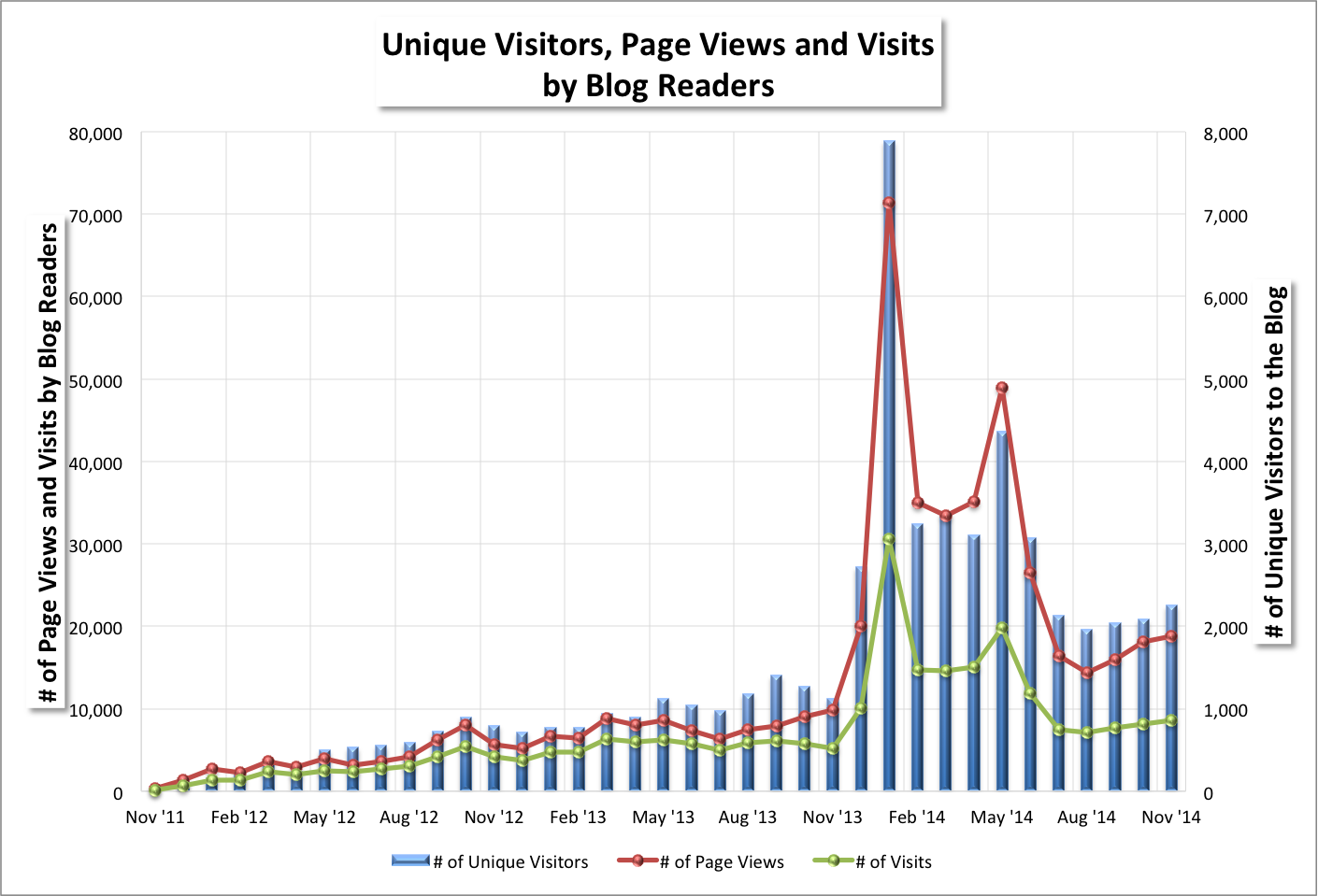
Blog readership mostly rose from October depending on the statistic. I wrote 22 blog posts (7) and news items (15) in November, versus 22 during the previous month (5 and 17, respectively). November month-over-month changes were:
  • +8% for the number of unique visitors (2,255 v. 2,085),
  • +4% for page views (18,851 v. 18,106),
  • +5% for visits (8,591 v. 8,173),
  • -10% for U.S. cities [from where visitors came] (584 v. 649),
  • -16% for world cities (137 v. 163), and
  • No change for countries (51 v. 51).
Click to enlarge.
Click to enlarge.
Click to enlarge.
 Roche's Genentech's Dr. Daniel Chen, M.D., Ph.D., PD-L1 Global Development Leader, noted in May 2014 that:
"One theory about immunotherapies is that they could work for everyone, with any type of cancer. The data to date show that this isn’t the case. Even though everyone has an immune system, not all patients will respond to the same medicine in the same way. 
Our immunotherapy program at Genentech has a large biomarker and diagnostic focus so we can find those who are most likely to experience a meaningful benefit. 
But what about those who do respond, but not well enough? 
Perhaps those people with a small to moderate response should be candidates for combination trials. Some immunotherapies may be more effective if they are combined with different types of medicines, including chemotherapies, personalized medicines and even other immunotherapies. 
In this way, biomarkers for cancer immunotherapy don’t just tell us who will or will not respond. Rather, they could help guide treatment strategies involving one or more medicines."
I recently asked Eric about this. He commented (paraphrasing):
Biomarker (i.e., targeted) therapies have proven quite successful in a number of cases, such as vemurafenib (trade name Zelboraf) and imatinib (trade name Gleevec). But these generally have limited time before escape* occurs since they target one or a few mutations, and cancer cells, which are generally highly adept at mutating, mutate to circumvent the therapy. 
Our understanding of immune targets relevant to cancer is still very primitive along with our ability to devise drugs specific to unique targets. Part of the problem is that "unique" targets are generally conserved**, just as molecular pathways are, in other kinds of cells and thus we get "off-target" effects (e.g., cholitis, secondary tumors, etc). 
Craig would say that PV-10 works by training our very sophisticated immune system to recognize complex patterns of targets that are expressed but sequestered by cancers. This is a bit like grabbing a very carefully selected handful of biomarkers and deploying them simultaneously.
* "Time before escape" is akin to survival time.
** "Conserved" means similar or identical.

 Peter updated Provectus' website to include information about the number and diversity of people and vendors working for the company. See About Us, Management, and scroll to the bottom of the page. It is a competent first step that provides some useful, basic insight into company operations.
Click to enlarge.
Of the 50 FTE figure in the bottom left hand corner, Eric's consultants and contract labor (see "consulting and contract labor" in Provectus' quarterly and annual SEC filings) comprise 36 FTEs (not including himself). The balance of 14 FTEs comprise Provectus' four principals and employees, and 10 FTEs that Peter characterizes as the full-time equivalents of the 134 people servicing and supporting his "corporate infrastructure."

 I recently asked Peter about the possible impact of a potential approval (i.e., a speculative PDUFA date of April 2015) of Amgen's intralesional oncology agent talimogene laherparepvec ("T-Vec") as a monotherapy for metastatic melanoma. He commented (paraphrasing):
People seem to like the idea of intralesional agents becoming appropriate to treat disease, and it is believed both T-Vec and PV-10 are helping to establish the relevancy of and build the intralesional agent category. People like having options as well, so two intralesional agents are better than one, in general. No matter what happens with T-Vec as a monotherapy, it is already believed T-Vec used in combination with ipilimumab is synergistic, and further builds the intralesional agent category.
 According to Neuroscience For Kids, the blood-brain barrier is semi-permeable, allowing some materials to cross, but preventing others from crossing. Further:
"More than 100 years ago it was discovered that if blue dye was injected into the bloodstream of an animal, that tissues of the whole body EXCEPT the brain and spinal cord would turn blue. To explain this, scientists thought that a "Blood-Brain-Barrier" (BBB) which prevents materials from the blood from entering the brain existed."
According to BrainFacts.org:
"The brain is the only organ known to have its own security system, a network of blood vessels that allows the entry of essential nutrients while blocking other substances. Unfortunately, this barrier is so effective at protecting against the passage of foreign substances that it often prevents life-saving drugs from being able to repair the injured or diseased brain."
Very small amounts of rose bengal cross the blood-brain barrier. See, for example, Table 3 of Klaassen's Pharmacokinetics of rose bengal in the rat, rabbit, dog and guinea pig (October 1976).
Click to enlarge.
Some patients in Provectus' melanoma Phase 2 trial had visceral disease, including brain metastases. How many patients with brain mets is unclear. Provectus has publicly discussed one such patient at medical conferences (Subject 0907 with Stage IV M1c disease), noting "“Near complete resolution” of pulmonary nodules observed at Week 12" during an ASCO 2010 clinical development update presentation.

If the brain is on the other side of the blood-brain barrier (and the immune system is on the other, so to speak), and PV-10 is injected into visible lesions on the skin, how were these brain tumors (nodules) positively impacted?

Blood Brain Barrier, Margaret Reece, Ph.D. (November 2013):
"The blood brain barrier is designed to exclude both pathogens and the cells of the immune system. It also excludes large proteins including immune system antibodies. It is only after viruses and bacteria are able to trigger a breakdown of the blood brain barrier that immune system responders gain entrance. And, when it occurs, it seldom turns out well."
The small amounts of rose bengal that may permeate the barrier are very unlikely to be able to reduce or destroy tumors, and the drug was not systemically administered (just injected into the skin at the location of a cutaneous or subcutaneous lesion). As Craig would say, Mother Nature's immune system knows how to get to brain tumors without destroying the normal brain tissue. But how?
"The brain has often been considered an immunologically privileged organ. This was based on early studies that found few antigen-presenting cells in the central nervous system. In addition, there was a perceived lack of a lymphatic system within the brain to carry immunogenic material in the central nervous system to lymph nodes where a humoral immune response could be initiated. And finally, the presence of the blood-brain barrier (BBB) was thought to prevent the entry of immune cells from the peripheral circulation into the brain. However, there is increasing evidence to suggest that the brain is under immunological surveillance." (Miller, Immunobiology of the blood-brain barrier, December 1999)

September 2, 2014

A China Tale, and Process

From the traditional folksong of Tiger Woman,
adapted by Laurence Yep
From Peter's first trip to China in November 2012 when he began to engage Chinese pharmaceutical companies for a regional partnership, to Eric and Peter's recent trip in August 2014 (the former's first) to sign a memorandum of understanding ("MOU") with one of them, Provectus principals have made five trips to China. These also include February, September and December 2013. 

The November 2012 trip comprised introductory meetings with companies of varying size and geographic scope. Subsequent follow-ups with some additional initial get-togethers too, essentially trips in 2013, comprised gradually more serious meetings with a short-list of more interested companies and increasing senior levels of their leadership. These introductions were facilitated by a number of individuals, agents and third parties that included strategic advisory board members, Network 1 Financial, and Maxim Group. Potential partners have interacted with Provectus in the interim via e-mail and phone, and conducted due diligence via the company's electronic data room. The culmination of these efforts and trips resulted in a first MOU for a China regional partnership with two subsidiaries of Sinopharm Group in August.

Generally speaking, an MOU is to a licensing deal or business relationship what a term sheet is to a venture capital investment and a letter of intent ("LOI") is to an acquisition: formalizations and acknowledgements of serious discussions towards the above mentioned ends, frameworks or outlines of business-investment-acquisition terms, conditions, rights, etc., and lists or mentions of other customary and perfunctory ifs, ands or buts.

Provectus noted in their press release:
During the next three months, the parties will seek to enter into a definitive licensing contract, subject to additional negotiation, due diligence, and any required regulatory and corporate approvals. The parties will further address the details of the license; the use of the technology from Provectus to Sinopharm A-THINK in China; the process for commercialization; and payments to Provectus (upfront, milestone and royalties). Provectus intends to manufacture PV-10 in the USA and Sinopharm A-THINK will distribute PV-10 in China. {Underlined emphasis is mine}
I'm reminded of our corporate venture capital process back in the day (our process flow is below), which I believe is a reasonable facsimile of Provectus' process and the process from Sinopharm's perspective in this situation.
Click to enlarge.
Preliminary analysis/assessment. Prior to Peter's trip, third parties introducers would have pre-submitted information about Provectus, PV-10, summary and previously public information about pre-clinical and clinical data, regulatory interactions, etc. to potential Chinese pharmaceutical company partners for their analysis and assessment, and to gauge any interest to learn more.

Management team meeting(s). The parties would have had an initial meeting, and potentially or eventually other more serious ones.

Due diligence. Although the graph above is linear and discrete in its steps, some actions are undertaken in parallel and are continuous, like due diligence, even after engagement is formalized. The potential licensee-investor-acquirer conducts due diligence in advance of and after the initial management team meeting, and as more meetings are conducted. As Provectus mentioned on several of its conference calls this year, Chinese companies (among others) have visited the electronic data room to review the various different types of documents stored there.

Due diligence of course goes beyond reading introductory collateral material, meeting management, and visiting data rooms. It extends to on-site visits of the business (Provectus), where clinical work is carried out (e.g., St. Luke’s Cancer Network, Moffitt Cancer Center) and with the people carrying this work out (e.g., Dr. Sanjiv Agarwala, M.D., Moffitt personnel), and other relevant and germane people, companies and institutions, and places. I imagine these due diligence activities are to come.

Term sheet negotiations. At some point, interest rises to a level where the parties can discuss price expectations and their associated structure, terms and conditions. If the parties can reach sufficient preliminary consensus they feel could ultimately lead to a transaction (but with no certainty nor obligation [unless they elect to bind themselves] to do so), they enter into or agree to an MOU-term sheet-LOI. As the jargon goes, MOUs are agreed to by the parties, while term sheets and LOIs are extended by one party to the other.

Negotiations of definitive agreements. When continuing due diligence is satisfactorily wrapped up, should the consensus remains the consensus, and if the broad and not so broad strokes of the MOU-term sheet-LOI are conveyed to definitive agreements, a definitive license-investment-purchase agreement may be struck for signing.

Deal closing. Documents are signed. Signatures are swapped. Money, securities, licenses, etc. change hands.

The process.

MOUs can be serious documents, and they can be far from serious. Sometimes also known as "Barney agreements" (i.e., "I love you, you love me") during the dot com era, Internet companies would enter into them with more established companies or other like venture-backed firms in hopes of demonstrating or simply giving the illusion of progress, business value creation, and rationale for increased valuation.

In the past management has garnered license and acquisition interest, in hand or through conversation, but nothing that rose to the level of both seriousness (met price expectations) and tangibleness (was on paper). For example*:
  • Galderma's rumored 2010 interest in Provectus' dermatology business (on paper, but not serious),
  • A Big Pharma's rumored 2011 interest to buy the intralesional drug compound company (not serious, and not on paper),
  • Orbimed and Domain Associates-backed Eddingpharm's rumored 2013 interest to license PV-10 for sale in China and its territories (on paper, but not serious), and
  • The above Big Pharma's rumored 2014 interest to acquire Provectus for twice its 2011 bid (still not serious enough, and still not on paper).
Provectus' MOU with Sinopharm is the first serious commercial interest the company has tangibly garnered. Tangibly serious because (i) it met management's price expectations as translated into potential payments to Provectus (i.e., upfront, milestone and royalties) and (ii) it was on paper.

To what, if anything, will/could the MOU between Provectus and the Sinopharm subsidiaries lead? The easiest way to answer this question of course is to wait and see if/when a license deal transaction is consummated between the parties. In the interim, I look at the situation this way: Provectus agreed to sign a document that formalized their discussions with Sinopharm towards the end of consummating a license deal and business relationship with the Chinese healthcare company under a framework of financial and business terms and conditions that may good to great [for Provectus], and we should know by mid-November or earlier if the parties ultimately do something together.

Finally, I wanted to comment on some of the verbiage in the MOU PR:
The MOU contains customary provisions regarding confidential information, publicity, and intellectual property, and is non-binding upon the parties (except for certain non-material provisions). The MOU shall continue in effect until the earliest of the replacement of the MOU with a definitive agreement, one month prior written notice by either Provectus or Sinopharm, or ninety days from the signing of the MOU.
In order to facilitate my comments, I also provided a sample or model venture capital investment term sheet below, which I utilized during my corporate venture capital investment days.


Click to enlarge. Sample venture capital investment term sheet, page 1.
Click to enlarge. Sample venture capital investment term sheet, page 2.
Click to enlarge. Sample venture capital investment term sheet, page 3.
Click to enlarge. Sample venture capital investment term sheet, page 4.
Click to enlarge. Sample venture capital investment term sheet, page 5.
Click to enlarge. Sample venture capital investment term sheet, page 6.
Click to enlarge. Sample venture capital investment term sheet, page 7. 
Click to enlarge. Sample venture capital investment term sheet, page 8.
Click to enlarge. Sample venture capital investment term sheet, page 9 (of 9).
Provectus' MOU PR naturally did not discuss "price," or payments to Provectus (upfront, milestone and royalties). Management would not have signed an MOU if those elements were neither to their liking nor codified (summarily or specifically) in the document. The first page of a term sheet (i.e., page 1 above) or the first paragraph of an LOI, aside from pleasantries, typically addresses the headline numbers of a prospective deal. I previously have commented on this blog about Provectus' price expectations for a China partnership. One wouldn't have expected the company to detail price agreements with Sinopharm in either the PR or the associated 8-K filing. Additional MOUs maybe forthcoming, and there may be competitive interest. Then again, there may not be dueling interest that pushes price upwards, and I would presume Provectus then would be comfortable with price as outlined in the Sinopharm MOU (with perhaps some further wrangling to finalize agreement on the timing of payments).

The MOU PR discussed "customary provisions regarding confidential information, publicity, and intellectual property," some of which find commonality with the venture capital investment term sheet (i.e., page 7, Confidentiality). Later versions of my terms sheets included sections dealing with publicity, and intellectual property (of the target company) as and when appropriate.

MOUs, term sheets and LOIs are broadly binding (i.e., material and non-material provisions) when the parties agree to be so bound, or when one party wants the other party to be bound and the other party agrees to such binding. Usually, as illustrated by the sample or model term sheet above, these relationship documents generally aren't binding in any meaningful way (to allow an out for either party, but many times the the one wanting to partner, invest or purchase). For non-material binding provisions see page 8, Binding Provisions. For outs, see page 7, Conditions to Closing.

As the MOU PR noted, the term sheet often references the definitive investment (or securities purchase) agreement that replaces the MOU or term sheet. See page 7, Purchase Agreement or page 1, introduction, for example.

Term sheets often include a target closing date (see page 7, Closing Date) by which time the parties hope or seek to complete their negotiations to consummate a transaction (i.e., finalize definitive agreements, sign them, exchange whatever). The parties mutually agree on a timeframe; however, the closing date is not set in stone and can be mutually modified through subsequent revisions to the term sheet (in large part to maintain exclusivity until a transaction is done). Provectus MOU PR noted a ninety-day period, which should be the target or contemplated closing date.

Exclusivity clauses almost always are part of terms sheets and LOIs to provide sufficient timing for the parties (especially the motivated one) to consummate a transaction. They may be part of an MOU in terms of the transaction (i.e., Sinopharm may exclusively negotiate with Provectus until such time as a deal is done, or the parties part ways). I imagine if the MOU had an exclusivity clause, the MOU PR would have mentioned it (not saying anything about it says something too). Exclusivity certainly may be part of the business terms; in this case it is: "Sinopharm-CSIPI and Sinopharm A-THINK desire to obtain an exclusive license to commercialize PV-10 within [the People's Republic of] China territory, and PVCT is willing to grant such license to Sinopharm."

* Listen to Provectus' echo chamber long enough, do some due diligence and, pardon the pun, connect some dots, and you eventually make out what the original voice that started the echo said or meant to convey. And while it doesn't mean a hill of beans if it's not translated into share price, the sound nevertheless is informative and instructive.

January 10, 2014

No insider/ex-insider sales, ever

Earlier, I wrote in my Disfigurement, Discomfort, Death post: "Historically, there have been no insider sales by Provectus officers and directors.* There only have been purchases...Buy/sell transactions by directors/ex-directors (chronologically, I believe, Fuchs, McMasters, Koe and Smith) provide information and sometimes knowledge. I believe I am correct in writing only Koe purchased stock as a director (part of the September announced private placements), already having considerable ownership prior to his election as a member of Provectus' board of directors. Fuchs’ ownership, I believe, derived from his early funding involvement with the company, with warrants and possibly stock that also may have come with it. All directors have been awarded stock options over time for their roles...* With Fuchs' departure from the board in July 2011, thus becoming an ex-director, he may have sold some or all of his shares thereafter."

Having left the board, I did not know whether Fuchs had sold shares, either personally or from his firm/fund Gryffindor Capital Partners. In response to this blog post Stuart reached out to me to address the topic. Since he is not bound, I believe, by SEC reporting requirements regarding buy/sale transactions like management and current directors are, some could feel there is room for skepticism.

I take the gentleman at his word.

From Stuart to me on 1/10/14: "FYI, Gryffindor Capital Partners, the private equity fund that I co-founded in 1999, was the very first institution to declare its confidence in the unique potential in PV-10 as a safe and effective alternative to traditional treatments of cancer, the benefits of which were all too often accompanied by serious adverse events. In November 2002, we invested $1,000,000 in Provectus by purchasing its Secured Convertible Note. We subsequently exchanged that note for common stock of Provectus. In response to your most recent posting, I wanted to inform you that to date I have never sold a single share of PVCT owned either directly or indirectly by me or my family prior to, during, or after my service as Director of the Company, and more recently as a member of its Corporate Advisory Board. By the way, neither has Gryffindor.  Like you, we believe that our patience will soon be rewarded." Bold underlined emphasis is mine.

No insider sales by management to date.

No insider sales by current directors to date.

No insider sales by a former director, and his firm/fund to date.

January 5, 2014

Navigating Connecting the dots...Provectus Biopharmaceuticals

Updated September 9, 2014.

The blog has several pages.
Disclosures. These, of mine, can be found here. Additions, changes and/or revisions, if any, are updated as of the end of each month.

About Provectus. This is an information tab about the company and related topics, which you may find here.

PVCT. An overview presentation on Provectus' lead oncology drug PV-10 is here.

The Blog. My posts can be found here.

News.
 I blog shorter snippets here.

Archived News. News items dating from July 21, 2013 to May 28, 2014 can be found here.

Why I'm Long Provectus Biopharmaceuticals. My investment letter written September 22, 2013 is here.

A View on Worth. An estimate of my views of the company’s intrinsic value may be found here.

PV-10, and the Cancer Immunity Cycle. Positioning PV-10 in Chen & Mellman's 2013 view of the cancer immunity cycle may be found here.

Blog Readership Statistics. I use Google Analytics to measure blog visitation and readership statistics, which you may find here. Stats are updated as of the end of each calendar quarter.

About the Blogger. A brief bio can be found here.

Popular posts (the top 10) are listed on the right-hand side.
Prior posts are archived here on the right-hand side bar.
You may search the blog using this tool on the right-hand side bar.
You may subscribe and receive blog posts using this tool on the right-hand side bar.

Thank you for visiting!

January 1, 2014

Provectus’ Worth

When I’m asked the question “What do you think Provectus is worth,” more often than not the person asking wants to know at what price do I plan to sell our shares. Much less often does the person ask the question with the intent of wanting to understand my view of the company’s value, and share his or hers (and their underlying thinking and rationale) with me.

In the past I’ve written, albeit sparingly, about my view of Provectus’ worth. On the Silicon Investor stock board several years ago I wrote (under the handle pvct investor) the company was worth, generically speaking, about $15-20 per share. At the time the math worked out to a billion dollar value. Back then a simplified version of my investment thesis was management had created at least a billion dollar company when sufficient regulatory clarity was achieved and a commercialization timeline was set forth. Since then I’ve used the same per share figure in rare conversations on the topic, irrespective of increased dilution (i.e., more shares times the same dollar range) over time.

I think Provectus is worth a lot.

A lot more than its December 31, 2013 share price of $2.41. The company now sports a small cap valuation of $337 million (enterprise value is $197 million, per Yahoo! Finance). Think about that for a moment. Entering 2014 the company is a small cap one; "...a company with a market capitalization of between $300 million and $2 billion." 12 months ago, the share price entered 2013 at $0.56, making Provectus a micro cap company ($50-300 million), barely.
2013. What a year for the company, and for the stock. A one-year stock performance of +314%.
Click to enlarge the figure.
Some perspective: A five-year stock performance of +150%.
Click to enlarge the figure.
More perspective: The share price began to move in ernest in August (still, it was green throughout), going parabolic in December.
Click to enlarge the figure.
August 22nd: Single Injection May Revolutionize Melanoma Treatment, Moffitt Study Shows

December 18th: Provectus Type C Meeting With FDA Oncology Division Held December 16, 2013

To value, or not to value. Up until this point I’ve been circumspect about blogging detailed posts about my views on Provectus’ value, valuation, per share price, worth, etc. The time has not been right. Although I have commented from time to time about relative valuation, such as the company’s market capitalization at a point in time compared to where I thought it might or should be (i.e., Provectus’ valuation at/compared to the so-called biotech valuation curve), the blog to date has been focused on the drug’s clinical and business value propositions, and market awareness and validation of them. Market in this instance speaks to a large set of constituents: the FDA, Big Pharma, medical community key opinion leaders, physicians, patients, life sciences investors, the generalist investment community, retail investors, media, etc.

All of this changed with Moffitt's August 22nd PR and Provectus' December 18th one; public declarations by the respective parties of important, milestone-like steps or achievements on the way to an eventual regulatory conclusion and accomplishment. It felt like two simple questions finally were being answered: Would the FDA acknowledge a local therapy could be a treatment for cancer? Would the Agency consider PV-10 for approval?

This time its different. Now, December 2013 entering January 2014, does have a different feel to it. Like the share price, awareness measured by blog visitation and readership statistics went parabolic in December, and correlated unsurprisingly with visitation to and readership of Provectus' website, www.pvct.com.
Click to enlarge the figure.
December 2013. January 2014. 2,720 unique visitors (94% over the previous high), 10,040 visits (58%) and 20,085 page views (103%) from 50 U.S. states and the District of Columbia (11%), 894 U.S. cities (99%), 70 countries (59%) including the U.S., and  173 international (non-U.S.) cities (41%).
Click to enlarge the table.
Click to enlarge the figure.
I present these blog statistics merely to reinforce the seeming phase change in the stock and company awareness that appears to have taken place last month. More eyes than ever are turned towards Provectus. With their December 18th PR, management clearly is setting the table for and the market up for a key announcement about or much more insight into regulatory clarity. The signs appear to be there: "Official minutes expected by January 15, 2014," "The purpose of the meeting was to determine which of the available paths that Provectus' novel oncology drug PV-10 will take in pursuit of FDA approval and commercialization," "The minutes will clarify the available regulatory paths and, therefore, allow the Company to better estimate a time-line to commercialization of PV-10," no mention of a Phase 3 trial or the special protocol assessment that consumed shareholders' thinking (guessing) about regulatory clarity in 2012, and "This meeting with the FDA is a significant step forward in establishing a pathway to initial U.S. approval of PV-10 for the treatment of melanoma. There are different possible routes to approval of PV-10 such as a breakthrough therapy designation or accelerated approval, and each of these has different requirements and time lines."

Breakthrough therapy designation ("BTD") is not a pathway or route to approval. Past BTD grants have led to further steps in the processes of the respective grantees in regards to their own drug approval pathways. Accelerated approval ("AA") is a pathway, often comprising release of the drug, and some post-marketing requirement(s) by the FDA and post-marketing commitment(s) by the sponsor. There is no certainty with the Agency, as drug candidate evaluation for approval can be a long, arduous, shifting, intense, substantive, uncertain, persistent, collaborative process.

It's easy to treat January 15th (more generally, the week of January 13th) with skepticism or not the least amount of doubt, even as a blogger about Provectus, long-time shareholder, long-term investor like myself. It would disingenuous to say I have no trepidation about that date or week. What will the outcome be? What if anything will management say? How will what they do or do not say, via PR, affect my investment thesis? I admit to a little trepidation, but much more excitement. The December 18th PR, adjusting for there-are-no-certainties, appears to suggest two potential outcomes, A or B, and the always present but likely improbable [note, not impossible] outcome C.

You can't handle the truth! Today Adam Feuerstein is out with an article entitled Biotech 2013 By the Numbers: A Blockbuster Year, noting: "In a year where the markets outperformed, the biotech sector performed even better, posting returns not seen since 1999. Phenomenal. No wonder we saw a huge influx of generalist investors into healthcare stocks in 2013." Putting Provectus' 2013 stock performance in more perspective, Feuerstein also writes: "A single biotech and drug stock (Lannett) posted a six-fold bump in share price this year. Nine stocks increased in value by five times, 3 stocks quadrupled in value and 26 stocks tripled in value, according to S&P CapitalIQ."

A blog reader recently wrote to me: "Does it scare you that Adam Feuerstein tweeted this? I'm stunned he would make such an arrogant statement. He does have a lot of influence." 'This' refers to the tweet below on December 17th, following the company's PR Provectus Announces Name Change to Provectus Biopharmaceuticals, Inc. and Reincorporates in Delaware. No, it does not scare me. I also don't feel he is being arrogant but rather just superficial, cursory or dismissive in a passing way.

Feuerstein's business model is one of a skeptical, truth-telling, snarky, biotech journalist. I follow him on Twitter and regularly read his columns as part of my ongoing, situational due diligence of Provectus (my only biotech investment). As I've written a few times, and he routinely reminds his readers, it's important to thoughtfully and actively engage skeptics and the "other side of the trade" in order to ensure one's investment thesis, long or short, remains sound and relevant.

I'm not troubled by the essence of Adam's tweet's snark. It's not unreasonable to criticize management for a name change and a name change PR, however "better" the potential for future branding, when information releases about a host of other substantive topics and issues (reasonably within their control of or decision making for comment) go unaddressed, such as updates on or discussions about:
  • The publication of the final metastatic melanoma Phase 2 trial in a high impact cancer-focused journal or periodical,
  • The compassionate use program (HIPAA compliance notwithstanding),
  • The status of PH-10 (Rockefeller study progress or results related to completing additional research into the unique properties of PH-10 regarding its mechanism and lack of toxicity, so as to schedule an End-of-Phase 2 meeting with the FDA to review PH-10 for psoriasis and atopic dermatitis and plan a transition to Phase 3 testing, and to complete discussions with potential licensees, hire a financial advisor and sign a licensing agreement that covers dermatological indications for PH-10),
  • The expanded Phase 1 liver trial (in order to meeting with the Agency and begin Phase 2/3 clinical trials of PV-10 for liver carcinoma),
  • Investigating new oncology indications for PV-10, such as bladder cancer (what about pancreatic cancer?), and
  • Additional immunology studies at Moffitt Cancer Center regarding PV-10's mechanism of action.
I think the re-jurisdiction, while not overly crucial in my mind (Nevada and Delaware attorneys can agree to disagree), was an important signal from management, who remain very clinical in the legal dimension of their business practices and process (of which I am not critical for the most part, and do appreciate). A skeptic might dismiss the 8-K filing associated with the December 18th PR as nothing or next to nothing. I would not.

To Feuerstein's other comment about Provectus' crappy drugs, I take it as more general snark than specific opining on PV-10 (or PH-10). Even the most cursory evaluation of the publicly available pre-clinical and clinical data from the company and various third parties (e.g., Moffitt, other researchers in the U.S., the Middle East, Australia, etc.) should elicit at least an "interesting-but-I-need-to see/know-more" comment from an intellectually honest, industry savvy skeptic. Feuerstein's business model requires him to be aware of or superficially cover a lot of companies (more than a hundred?), approach tens of companies with some depth and, from time to time as the situation presents itself, focus on a handful of companies in great detail. Like other analysts (good journalist equals good analyst), including myself, he employs pattern recognition to discern good from bad (his pattern recognition is different from mine because of our respective professional experiences). If one doesn't have or take or require the time to diligence Provectus, it's not unreasonable to arrive at the same skeptical-flavored conclusion: PV-10 is or might be snake oil upon first impression (because it is so improbable with respect to conventional wisdom). Crappy, not so much. That the drug is too good to be true or snake oil was a nearly universal impression among the medical oncology community until recently (or at best that PV-10 was solely a local ablative agent), because no ablative agent had ever elicited significant systemic effect.


I’ve been loath to encourage blog readers only to focus or anchor themselves on share price when visiting and reading the blog. As I wrote under the blog's Disclosure tab, I of course “talk my book” by expounding on the merits of Provectus, the drug, management and the stock. The difference between what you may read elsewhere on the Web (mostly, but not exclusively) and “Connecting the dots…Provectus Biopharmaceuticals” is that I’ve told you who I am. I’m open to being corrected, and to being wrong (even though I don’t think or believe I am). I've not been able to incur transparent (i.e., not anonymous) debate and discussion on the pros and cons of the drug and stock sufficient enough yet to push back on my investment thesis, or make me re-think its core. That may well come in time with even more awareness. What makes a market are buyers and sellers. Stating the very, very obvious: If buyers are right, price goes and stays up. If sellers are right, price goes and stays down.

Revisiting the Feuerstein-Ratain rule, its essence (while constructed from the premise of the likelihood of success of large and small companies undertaking Phase 3 clinical trials) is this: "The stock market is known to anticipate future events, as opposed to reacting to the past. Thus, it is not surprising that sophisticated investors are able to judge the probability of success, which is reflected in the share price." For the longest time, as Provectus lay mired as a nano or micro cap company, the market spoke that it judged management not to be successful, and not having a high probability of success. Moffitt's August 22nd PR changed some minds (the valuation went higher). Provectus' December 18th PR (give or take the actual date itself) changed many more minds (the valuation went even higher). The story is not over, and those minds are free to change them back again. Which leads us once more to January 15th (more generally, the week of January 13th).

China. Dalam Disember 18 PR, Craig mengulas "Di samping itu, perbincangan kami dengan beberapa rakan pelesenan antarabangsa yang berpotensi tidak terjejas dalam apa jua cara." Terdapat khabar angin dalam proses mencapai transaksi lesen serantau bagi China telah datang ke penghujungnya, dan kita dapat belajar lebih minggu depan.

A not-so-final word on worth. My estimation of Provectus’ worth is a large number. To what you’re asking of me? Assuming I am right (which, in truth, means if management is right) I hope to and think I will sell my shares for a very high price. Inevitably you take what the market or buyer gives you. More on this as the new year unfolds.

As I wrote in my September 22nd investment letter about why I'm long Provectus Biopharmaceuticals, the key downside risk (as for any investment, understanding risk and reward) at this point is management being unable to monetize the company at a valuation commensurate with their innovation. There undoubtedly are other risks, as I highlighted in the Seeking Alpha version of my investment letter: "There are common risks most if not all biotechnology company stocks face: dealing with the FDA can be at times a complex and opaque process, clinical trials fail, seeking funding can be a long, arduous and dilutive process, and the industry itself is prone to bubbles and busts that contribute to generically rising and falling share prices."

2014.

December 28, 2013

Phase Change

Noun1.phase change - a change from one state (solid or liquid or gas) to another without a change in chemical composition

Today, notwithstanding the swoosh from the open through (blue rectangle below), the stock, measured by several metrics, has changed phases in December (particularly since about mid-December), compared to previous months as well as the company's past. From active pre-market trading to a share price above $2 to daily multi-million share trading volume to much more blog visitation, it seems clear the situation has changed from one state to another.

Yesterday, we traded 50,000 shares in the pre-market, nearly 2 million by 10 am EST, and had more visitors to and readership of the blog before 10 am EST than it normally receives in a day before December. Phase change.
Click to enlarge the figure.
I updated readers through the blog's News tab about growing visitation and readership. The share price closed at $0.94 on December 2nd.
  • On December 8th I wrote blog readership, on a weekly basis, reached new highs for the period December 1st to 7th (e.g., 544 unique visitors, versus the last high of 502 for the week September 15th to 21st when on September 13th the closing price of $0.80 increased to $1.14 on September 20th before closing at $1.04 on the same day); the share price closed at $0.99 on December 6th,
  • Weekly readership set a new high for the period December 8th to 14th (e.g., 771 unique visitors); the share price closed at $1.54 on December 13th (the special shareholder meeting was held on December 16th),
  • A third new high for the period December 15th to 21st (e.g., 799 unique visitors); the share price closed at $1.50 on December 20th (Provectus issued two press releases, Provectus Announces Name Change to Provectus Biopharmaceuticals, Inc. and Reincorporates in Delaware on December 17th and Provectus Type C Meeting With FDA Oncology Division Held December 16, 2013 on December 18th), and
  • A fourth consecutive new high for the as yet not completed the period December 22nd to 28th (e.g., 1,002 unique visitors as of this writing, with a day to go); the share price closed at $2.18 on December 27th (no press releases or news).
Click to enlarge the figure.
Click to enlarge the table.
Yes, share price has increased dramatically in the month over previous months and years. Volume, however, increased as dramatically. Eight of the top ten highest daily volume days have been in December, including the top seven. The last four days ranked #6 (23rd), #3 (24th), #4 (26th) and #1 (27th), respectively. Eleven of the last twelve days have seen daily volume exceed one million shares. Volume exceeded two million shares for each of the last four days. three million shares for each of the last three days.

Daily "dollar volume," where I multiplied the daily volume by the closing price [that day] has increased dramatically for the month of December, too, when compared to prior months.
Click to enlarge the figure.
To put the explosion in blog visitation and readership (a proxy for company/drug/stock awareness, interest in the company/drug/stock, etc.) in perspective, as of this writing, blog stats for # of Unique Visitors, # of Page Views, # of Visits, # of U.S. States (from where visitors came), # of U.S. Cities, # of World Cities, # of Countries, and Total # of Cities increased anywhere from 11% to 70% over their respective previous high.

December, with four days to go: 2,326 unique visitors, 16,778 page views and 8,467 visits from 51 U.S. states and the District of Columbia,  807 U.S. cities, 136 non-U.S. or international cities and 59 countries.
Click to enlarge the figure.
More awareness of the company, drug and stock.

Sure, there are more day and momentum traders (reflected in an increasing price, and larger price swings). Price increases, price above certain levels, volume increases, etc. have drawn attention to the company on stock screeners and filters. There are also more buyers (investors) too (reflected in a higher share price). PVCT's one-year stock performance of 294.21% (Yahoo! Finance, 12/27/12-12/27/13) would rank it ninth (Finviz stock screener) on a biotechnology company list.
Click to enlarge the figure.
In truth, with the recent increase in the share price, Provectus' market capitalization, as a post-Phase 2/pre-Phase 3 is beginning to reflect where its valuation might be along the so-called biotech valuation curve. I cannot locate the source now (it's lost somewhere in mounds of written and digital notes), although I can reference a prior stock chat room post of mine from March 2010, but there was a "rule of thumb" (n.b. the market has a way of cutting your thumbs off when you're wrong) regarding valuation and phase of trial:
  • Phase 1: <$50 million (including research, preclinical)
  • Phase 2: $100-250 million
  • Phase 3: $500 million-$1 billion (risk-reward inflects between Phase 2 & Phase 3)
  • Approval: >$1 billion (including launch)
Yesterday's close yields a market capitalization of about $305MM (an enterprise value of about $249MM). Provectus' intrinsic value, I believe, is much, much higher, but at current public company valuation levels it's not unreasonable to think the company is not unreasonably valued.

All manner of low life, high life, and lives in between are looking at, buying and/or shorting the stock. More so than ever before. That much is clear.

To be sure, Craig, Tim, Eric and Peter have set some expectations with the company's December 18th press release Provectus Type C Meeting With FDA Oncology Division Held December 16, 2013 (linked above): "The minutes will clarify the available regulatory paths and, therefore, allow the Company to better estimate a time-line to commercialization of PV-10." Not to mention a capitalized (why is management shouting?), "line in the sand" byline: "OFFICIAL MINUTES EXPECTED BY JANUARY 15, 2014." What they're saying seems pretty clear to me.

Which brings me back to yesterday's morning swoosh. I've long believed there would be a significant, if not dramatic, turnover in the share holder base between $2 and $3 per share. I think some of the volatility over the last few days reflects this, in part. Large buyers moved in. Earlier in the morning, from the open through about 10 am, Citadel (broker) stepped back from the bid, allowing the price to collapse, before buying it back up (blue rectangle above). There is a belief Citadel was facilitating a large buyer's activity. From there, for 6 hours until the close, the share price range traded as volume steadily increased to an all-time high of 4.5 million shares. Some 14 million shares over the last four days.

As I note under the blog's disclosure tab, I have not sold any of the shares we have accumulated thus far.

Peter confirmed earlier today, directly from his NASDAQ listing agent contacts, that the exchange's listing standards are 90 days/$2 and 5 days/$3 (so, no change since last year when it relaxed their listing standards to the current ones).

More buying interest in advance of a January 15th (or 16th/17th) press release regarding regulatory path and commercialization timeline may take the stock onto the NASDAQ. Announcement of inbound (received) term sheets from China and/or India, let alone a consummated transaction, may do so as well. Other assorted news (e.g., a new member of the board of directors, a liver trial update, a PH-10 update, more Moffitt words about revolutionizing, etc.) may contribute, too.

After reading thousands of pages of administrative and correspondence documents between the FDA and applicants in regards to the latter's drug approvals, it's not a surprise how the process generally works. The specifics vary, but the process is the process. Minutes...are the instant written record of a meeting or hearing. Reading the aforementioned documents, you'll easily understand the nature, construct, purpose, review, revision, use, etc. of Agency meeting minutes.

In my June 2013 post For $PVCT, it's the FDA's move I wrote about Peter's Provectus' game theory "rules:"
  • No one moves unless they have to move.
  • Everyone moves when somebody moves.
"No one" and "everyone" includes Big Pharma, life sciences investors and, as importantly, Provectus. If we're then waiting for the FDA to move -- to provide regulatory clarity -- then why would global players, regional players and Provectus itself all not simply wait until the FDA moves by making a decision (all potential outcomes being positive), whatever that decision turns out to be?

January 15th, or thereabouts (i.e., whenever Eric can finalize the press released based on what the minutes say, and what the company wishes to say about them), is a "binary" event. Rather than a 1 or 0, win or loss, success or failure, etc., its more of a 1 or 0.75, best or better, AA or BTD (plus a pathway); otherwise known as "it's all good." It is quite possible we hear about the regulatory path and commercialization timeline from management before the 15th.

Deals often crystallize before such events.

I wonder about Pfizer in all of this; the Big Pharma company with the biggest nose under the tent for the longest time.

The FDA has moved. Its move clearly will affect regional, worldwide and end-game transactions. No one (global players, regional players) moved because they did not have to move. The FDA moved, so everyone (global players, regional players) now must move.

July 8, 2013

$PVCT: A Slow, Hot, Smoky Summer Monday

I appreciate the comments and e-mails from blog readers I received over the last week. Thank you. I realize some of you would visit once or a couple of times a day, while others would visit 15-20 times during their daily waking hours. I'm still blogging, but not nearly as much as I used to (as I transition the blog per my "$PVCT: Moving On, Moving Up" post).

A blog reader commented, in regard to my "For $PVCT, it's the FDA's move" post, that although I wrote the ball is now in the FDA's court, Craig's recent remarks, including his letter to shareholders (May 13) and reported comments at the annual general meeting (June 27), suggest Provectus has not yet made an application to the FDA for some process that would result in an approval, whether for an special protocol assessment or breakthrough therapy designation ("BTD"). The reader went on to write: So, in a sense, the ball in is the company's court to first file [some application] with the Agency. I say it's the FDA's move because regulatory clarity is what is needed by Provectus, and I think the company has provided answers to all of the Agency's questions. Of course, the FDA cannot move if the company has not submitted an actual application for which a decision from the Agency is required. A consensus of opinions I solicited over the last couple of months pointed to the belief management had submitted an application for BTD sometime during that period. Recent information purports to suggest that, as late as last week, more time was needed to submit the application.

I've been trying to wrap my head around the role(s) Maxim Group's Dr. Echo Yinghui He, MD, PhD is playing for/with the company. Her position with Maxim is as an equity research analyst, and she provides coverage of Provectus. Dr. He's last company update note was dated January 29, and she is expected to provide another one after Moffitt's peer-reviewed article is published. It appears she has an additional role of some sort with the company as it relates to Provectus' efforts to seek and secure a regional transaction in China.