Showing posts with label T-Vec. Show all posts

September 5, 2015

Trendwatching

[In no particular (including chronological) order:]

September 2, 2015 / The undifferentiation of immune checkpoint inhibitors? Incyte Corporation (Nasdaq: INCY), a nearly $21 billion biopharmaceutical company as of a 9/4/15 share price close, announced a global license and collaboration agreement with China's Jiangsu Hengrui Medicine to develop and commercialize the latter's investigational anti-PD-1 agent (SHR-1210). Under the agreement, Incyte would have exclusive worldwide rights to SHR-1210 except for mainland China, Hong Kong, Macau and Taiwan.

Possible or potential item takeaway: For the deal structured and money paid by Incyte, it didn't want or couldn't get from Jiangsu Hengrui Medicine China and SARs.

According to the Incyte press release "SHR-1210 is expected to enter proof-of-concept studies for the treatment of patients with advanced solid tumors in the coming months." {Italicized emphasis is mine}

As backdrop, as FierceBiotech's John Carroll writes, "[a] little more than a year ago Incyte swiftly lined up combination deals that matched its IDO1 inhibitor, epacadostat (INCB24360), with PD-1 and PD-L1 drugs from Bristol-Myers Squibb ($BMY), Merck ($MRK), Roche ($RHHBY) and AstraZeneca ($AZN). INCB24360 is an immunotherapy designed to amp up an immune system attack on cancer, while the checkpoint programs are designed to dismantle cancer cells' cloaking mechanism that prevents an assault from happening." The idea of the combination therapy approach above is/was the use of an immune system amper upper — Incyte's IDO1 inhibitor epacadostat (INCB24360) — to help/assist/partner with the back-end — immune checkpoint inhibitors or co-inhibitory blockade agents like anti-PD-1 and anti-PD-L1 agents from the above mentioned companies.

Last year, for example, Roche partnered up with NewLink and its IDO inhibitor (NLG919). Later, in 2015, Roche partnered with India's Curadev Pharma and its IDO inhibitor.

According to Chen and Mellman's 2010's Oncology Meets Immunology: The Cancer-Immunity Cycle, IDO inhibitors do not appear to be front-ends or immune system accelerators or amper uppers or stimulatory factors or agonists or co-stims but rather back-ends or inhibitors or antagonists.
Click to enlarge. Image source (Figure 2)
Possible or potential item takeaway: Incyte brought an immune checkpoint inhibitor in-house because...
  • Combination therapies [of some sort] will become standard of care for advanced-stage cancer (eschewing [making obsolete] monotherapeutic use of immune checkpoint inhibitors)?
  • It is better to own both parts of the pairing for various clinical and/or business reasons?
  • If it is better to own both parts, differentiation of co-inhibitory blockade is more business (or marketing) than clinical?
  • Win or lose, Bristol-Myers PD-1-related lawsuit against Merck is irrelevant (or its outcome de minimis)? "Every" biopharmaceutical company, including Chinese companies for their own domestic (as well as for international collaboration purposes), has or will have an immune checkpoint inhibitor?
September 1 / A new class of immunotherapy.
Image source
If/when PV-10 stands on the cusp of approval (in T-Vec's case, while not certain, probable approval would occur by or before the drug's October 27, 2015 PDUFA date), it would be a new class of immunotherapy. And St. Luke’s University Health Network's Dr. Sanjiv Agarwala would be PV-10's Dr. Howard Kaufman, MD. See Assessing Provectus' Pivotal Melanoma Phase 3 Trial, Part I (July 13, 2015) on the blog's Current News page.

Possible or potential item takeaway: What is PV-10? An ablative immunotherapy? An autologous vaccine? An oncolytic immunotherapy? PV-10 has no specific target, receptor or pathway; however, this item cannot be properly discussed at the current time because knowledge and discussion presumably definitively relies on the presentation/publications of the results of Moffitt Cancer Center's mechanism(s) of action study due later this year. See August 29, 2015 blog post PV-10 has much better gas mileage.

September 1, 3 and 4, 2015 / Tinkering with Mother Nature. The official blog of AACR posted a 9/1 entry by Dr. Srivani Ravoori, PhD entitled Advances in Immunotherapy: Fine-tuning CAR T Cells. On 9/3 FierceBiotech's Carroll wrote an article entitled Novartis team tracks remissions of 4-plus years in a pioneering CAR-T study. In The Pipeline's Dr. Derek Lowe, PhD blogged CAR-T Follow Up on 9/4.

Ravoori wrote about scientists from the University of Pennsylvania and The University of Texas MD Anderson Cancer Center tinkering with the target-binding end of CAR T cells to make them safe for patients with solid tumors:
"CAR T cells designed to target CD19 in B-cell cancers are not selective. They cannot distinguish cancerous B cells that have high levels of CD19 from normal B cells that have physiological (lower) levels of the same protein. But this does not severely impede treating B-cell malignancies because a patient’s immune system can function even when normal B cells are depleted. This form of immunotherapy, however, is not readily adaptable to solid tumors because targetable proteins present on the cancer cells of solid tumors, such as ErbB2 and EGFR, are also present on normal cells that form the vital organs of the body. While losing normal B cells when treated with CD19 CAR T-cell therapy poses manageable side effects in a patient, loss of normal cells that are part of vital organs when treating solid tumors with CAR T-cell therapy can damage these vital organs, which has serious consequences. In fact, in a case report, CAR T cells designed to target ErbB2 present in metastatic colon cancer cells also attacked cells in the patient’s lungs that had low levels of ErbB2, resulting in severe toxicity and death. So, it became evident that if CAR T-cell therapy were to work for solid tumors, engineering T cells that can selectively target cancer cells and spare normal cells is inevitable." {Underlined emphasis is mine}
But, according to Ravoori:
Enter scientists from the University of Pennsylvania and The University of Texas MD Anderson Cancer Center, two teams that used different approaches to answer the same question: Will lowering the affinity of CAR T cells to the target protein make them selective to cancer cells that have high levels of the protein and spare normal cells that have low levels of the same protein? Based on the data the two teams published independently in the AACR’s journal Cancer Research, it appears the answer is “Yes.”
Carroll wrote:
Five years after the University of Pennsylvania began recruiting a small group of 14 patients with hard-to-treat chronic lymphocytic leukemia, researchers are still tracking three of them who are still alive with no signs of their cancer returning after being treated with a first-generation CAR-T therapy...Out of the 14, four experienced complete remissions, meaning their cancer was no longer detectable. One of those four later died of other causes. Four patients had partial responses, with two of them dying after 10 months and 27 months of therapy. One of the partial-response patients died from a pulmonary embolism, and the other was switched to a different therapy after 13 months and died after three years.
But, according to Carroll:
All of the patients who responded to the therapy experienced a potentially life-threatening case of cytokine release syndrome, sometimes called a cytokine storm, with the drug triggering high fevers and in several cases difficulty with breathing and low blood pressure. Doctors responded with the antibody drug tocilizumab and steroids, and all of the patients survived...In a small study like this, investigators can learn as much from failure as they can from success. Testing the 6 patients who did not respond, the scientists said that their customized T cell populations did not expand as aggressively as in the patients who were first flattened by a cytokine storm in their first response to the solo treatment. 
Finally, Lower wrote (about the Novartis study):
"So there’s definitely something major here, and definitely room to improve it. That’s what Novartis, and Juno, and Kite (and who knows who else) are frantically working to do right now. The biggest prizes are to extend this idea to more tumor classes, and to make it scalable to larger numbers of patients. The second one is a big challenge, and the first is even bigger. People have been antigen-hunting for quite a while now, looking for something that’s fit to turn the immune system on in other types of tumors, and it’s slow going. But you have to be sure, because if the immune system can strip a couple of pounds of aberrant white blood cells out of your system, so vigorously that it nearly overloads your kidneys, then it can do the same with lots of other tissues, too, some of which you might prefer to keep. Ripping out a couple of pounds of motor neurons or Kupffer cells would be suboptimal, to say the least."
Possible or potential item takeaway: Safety, specificity, durability? Questions UPenn/Novartis and MD Anderson are a long, long way from fully answering.

September 4, 2015 / A Rumsfeldian Perspective. Lowe, in his 9/4 blog post, wrote "People have been antigen-hunting for quite a while now, looking for something that’s fit to turn the immune system on in other types of tumors, and it’s slow going."

US Secretary of Defense Donald Rumsfeld was once quoted as saying"...because as we know, there are known knowns; there are things we know we know. We also know there are known unknowns; that is to say we know there are some things we do not know. But there are also unknown unknowns – the ones we don't know we don't know."

As Provectus' Chairman and CEO Dr. Craig Dees, PhD has discussed with me almost from the beginning of my due diligence and share ownership (paraphrasing in Rumsfeldian), there antigens we know, antigens we don't know, and antigens we don't know we don't know.

And this knowledge or lack of knowledge (crucially relevant in the treatment of cancer because antigens equal targets) is but one aspect of Dees, President Dr. Tim Scott, PhD and CTO Dr. Eric Wachter's belief that killing cancer tumors in the correct way held the key to successful medical treatment because a proper approach could enable the immune system to stimulate cancer-killing cells throughout the body.

Properly destroying cancer tumors means killing only tumors and doing so completely, quickly and, very importantly, safely (that is, leaving healthy tissue unharmed). They believe this approach is the only effective way of sustainably stimulating a person’s natural anti-cancer defenses. Instead of bathing the entire body or even parts of it with radiation, or filling the bloodstream with oral or intravenous chemotherapies or present-day immunotherapies, Dees et al. firmly hold the position that stimulating the immune system is best achieved through treating tumor tissue by injecting into it a drug capable of destroying the entire tumor as quickly as possible without damaging surrounding healthy cells. Completely also means everything from visible tumor tissue to occult or hidden cells in and immediately around the injection site. Quickly means having the drug processed through and excreted from the body in short order. Antigens generated from the tumor destruction caused by drug injection then can be presented to the body’s cells responsible for selecting the best and most relevant antigens in order to encourage cancer-killing cells to replicate themselves throughout the body. Importantly, tumor antigens have to be viewed in context; physical tumor destruction techniques such as heating or freezing tissue destroyed fragile antigens and disrupted their relevant contextual structures. Disruption of cell membranes and removal of lipids, proteins, and complex carbohydrates destroy the antigens’ context, which is to what immune system cells respond. Thermal destruction denatures potential antigens, changing their chemical structure so that they were no longer representative of the tumor cell. In order to work rapid destruction of tumors has to preserve both antigenic structure and biological context. (Paragraph source, with slight edits by me for verb tense: MicroCap Review, pp. 6-8, September 2015)

Possible or potential item takeaway: For Craig et al. to have PV-10, and themselves, more fully recognized, all constituents of the biopharmaceutical ecosystem are going to have to embrace the above.

August 15, 2015

Clinical & Business Value Proposition Pillar #5

Image source
On Provectus' August 6th 2Q15 business update conference call, the company's COO/CFO Peter Culpepper introduced five clinical and business value proposition pillars for PV-10:
  1. Intellectual property
  2. Drug supply chain (both substance and product)
  3. Regulatory support
  4. Mechanisms of action
  5. Rational clinical study designs for randomized data generation
Blog post takeaway
  • The focus of this post is pillar no. 5, more data generation, and specifically data generation related to the combination of PV-10 and an immune checkpoint inhibitor (pembrolizumab, and maybe other co-inhibitory blockade agents) in patients with advanced melanoma (Stage IV).
  • Randomized data generation is a process, which starts with a dose escalation component (in this case, the escalation of PV-10's dose in context given the approved Keytruda dose).
  • I'm looking to Provectus' 3Q15 business update conference call potentially in early-November (e.g., Thursday, November 5th) for the company's CTO Dr. Eric Wachter, PhD to discuss and/or have filed the combination therapy Phase 1b and 2 trial protocols. Whether one refers to it as a Phase 1b/2 (as was the case for T-Vec + ipilimumab) or a Phase 1b/3 (T-Vec + pembrolizumab), the second part of the clinical study process is a randomized controlled trial (RCT).
We assume generating randomized clinical data already has started with the commencement of the company's pivotal Phase 3 trial of PV-10 versus systemic chemotherapy in patients with unresectable locally advanced cutaneous melanoma (Stage III). More data is more than likely required to potentially further increase company value.

For advanced melanoma (Stage IV), step #2 of randomized data generation — the RCT component of the melanoma combination therapy two-step clinical study process — starts with step #1, single-arm data generation from a dosing (of the intralesional agent [IL]), safety and response rate evaluation of a pairing of compounds.

On Provectus' March 13th 4Q14 business update conference call Eric said:
"Throughout our consultations with key clinical opinion leaders, we’ve also been attuned to the need to address the needs of patients with more advanced disease. With enrollment now complete in the mechanism of action study of PV-10 of Moffitt Cancer Center, and initial results reported on that study and on the companion nonclinical study to assess combination of PV-10 with immune checkpoint inhibition, we are making progress on design of our proposed study to assess PV-10 in combination with immune checkpoint inhibition in patients with advanced melanoma. 
We continue to expect this to be structured as a Phase 1b/2 study with a modest sized single arm Phase 1b component and expedited safety and efficacy endpoints supporting expansion to a larger randomized Phase 2 component. Endpoints for Phase 1b are likely to comprise acute safety as a combination regimen and objective response rate at three to four months. For Phase 2, we anticipate endpoints of progression free survival at overall survival. With three agents now approved in the US and also available in other key locations abroad, I expect to have very concrete details on this work to discuss at our next quarterly conference call. Importantly now that we have options for this systemic agent, this study can commence with or without the assistance of a partner." {Underlined emphasis is mine}
On the company's May 7th 1Q15 call he said:
And in addition to the progress on the combination therapy patent front that Pete mentioned, we've also made substantial progress towards commencement of our proposed clinical study of PV-10 in combination with immune checkpoint inhibition. We have identified the investigators who will lead this work, the agent to be used in conjunction with PV-10, the patient population and the dosing schedule for both agents along with the study end-point. To assess potential benefit of PV-10 for patients with advance melanoma, this phase 1b/2 study will incorporate a modest sized single arm Phase 1b component with expedited safety and efficacy end point supporting expansion to a larger randomized Phase 2 component. 
End points for phase 1b are expected to comprise assessment of acute safety of the combination regimen and objective response rate at three to four months. For the Phase 2 portion, end points will be progression-free survival and overall survival. 
Once the protocol addressing each of these areas is complete, we believe the pieces are in place to commence clinical work on this important second development path for PV-10 and melanoma. Since the checkpoint inhibitor we expect to use is licensed in the U.S., we can commence this study with or without the systems or a partner." {Underlined emphasis is mine}
By protocol I think Eric means both Phase 1b and RCT protocols (whether one refers to the latter as a Phase 2 or Phase 3 trial).

On the company's August 6th 1Q15 call he said:
"Turning to the other primary component of our development plan for melanoma, we've continued to move towards commencement of a post-clinical study of PV-10 in combination with a new checkpoint inhibition in patients with advanced metastatic melanoma. After thorough consultation with leading investigators who will conduct this work, we have a study design that is undergoing final investigator review and anticipate completing the protocol before the end of the present quarter. 
This includes comprehensive definition of patient population, dosing schedule for both agents, and the study endpoints. As I've indicated previously, to assess potential benefit of PV-10 for patients with advanced melanoma, this Phase Ib/II study will incorporate a modest-sized single arm Phase I key--Phase Ib component of 24 patients with expedited safety and efficacy endpoints. 
Completion of this initial phase is expected to support expansion to a larger randomized Phase II component having an estimated 120 patients. The actual size of the Phase II component will be determined by modeling and response data among Phase Ib participants, that is the socalled observed effect size. 
Endpoints for Phase Ib will comprise assessment of acute safety of the combination regimen and objective response rate at three to four months. For the Phase II portion, endpoints will be overall survival, progression-free survival, and objective response rate. 
We anticipate using the anti-PD1 drug pembrolizumab, also known as Keytruda, as the checkpoint inhibitor. This class of drug has been shown to work favorably with PV-10 in mouse models with melanoma, as presented by our colleagues at Moffitt last November at the Annual Meeting of the Society for Immunotherapy Cancer, and as anticipated in our allowed drug patent application with Pfizer, the two drugs have largely unrelated or orthogonal side effect profiles. 
These factors provide justification for conducting the study. Also, since pembro is standard of care for the study of patient population, it is standard practice to conduct these kinds of studies in an add-on mode where all patients receive standard of care. 
We're optimistic that we can leverage existing investigator and site relationships to commence this study by the end of the calendar year. And since pembrolizumab is licensed in the US, we can commence this study with or without the assistance of a partner. If ongoing negotiations with prospective corporate partners lead to interest in testing PV-10 with a different checkpoint inhibitor, the study is designed to facilitate use with other drugs to enable such testing in a straightforward manner. {Underlined emphasis is mine}
With the Phase 1b and Phase 2 protocols not ready (and thus fileable on ClinicalTrials.gov) all Eric could say was the above. When filed on the .gov site both the T-Vec + ipilimumab and T-Vec + pembrolizumab protocols were two-step ones, as shown below, respectively:
Click to enlarge. Image source. Fuzzy purple emphasis is mine
In extending my door analogy from August 12th blog post The Door, Eric would have to had to design and construct the first door, design as well as perhaps mostly construct the second in consultation with the FDA (with emphasis on the second door, a presumably pivotal study). There would be placeholders (specifically the size of Phase 2 trial N) for the second door that would be modified pending the outcome of the initial Phase 1b study: "The actual size of the Phase II component will be determined by modeling and response data among Phase Ib participants, that is the socalled observed effect size." (Eric's comments, August 6th business update call).

Securing the keys to the doors from the regulator would require reaching the threshold of each door. I would wonder if yet assume Eric has discussed the path to and through the first door and the path to the second with the FDA. Maybe it's the [paths'] the utilization of a portion of the data (a fraction of the trial N) from the Phase 1b trial — if successful and appropriate — to apply for breakthrough therapy designation, followed by commencing the pivotal study, and the utilization of a portion of the data (a fraction of the trial N1) to be considered for accelerated approval — if successful and appropriate. Of course, maybe that's not entirely or actually the process.

And discussing cost and how to fund these paths (i.e., pros and cons of available and potential options) in the greater context of the company and its overall burn rate is an important matter for another discussion and post.

April 29, 2015

The first guy through the wall

Image source
Today's joint meeting of the Cellular, Tissue and Gene Therapies Advisory Committee ("CTGTAC") and Oncologic Drugs Advisory Committee ("ODAC") voted by an overwhelming 22-to-1 margin in favor (i.e., yes to the question) of talimogene laherparepvec ("T-Vec") having an overall favorable benefit-risk profile for the treatment of injectable regionally or distantly metastatic melanoma, and thus supporting traditional approval of the drug.

The meeting's positive outcome for T-Vec and Amgen also is a positive for PV-10 and Provectus. Both T-Vec and PV-10 are investigational intralesional ("IL") therapies, often referenced together, and share existing and potential clinical trial investigators and/or paid consultants such as MD Anderson Cancer Center's Dr. Merrick Ross, MD, St. Luke's Cancer Center's Dr. Sanjiv Agarwala, MD, Hunstman Cancer Institute's Dr. Robert Andtbacka, MD, and Moffitt Cancer Center's Dr. Vernon Sondak, MD and Dr. Jonathan Zager, MD.

Two great sources of meeting coverage, with both insightful and observational tweet comments and commentary, were Jamie Singer (@JSwatercooler) and SAC Tracker (@FDAadcomm). Jamie is a consultant to Provectus. Tarius SAC Tracker provides global regulatory intelligence to the healthcare industry, and later wrote a summary of the meeting entitled US FDA Advisory Committee Supports Amgen’s T-Vec to Treat Metastatic Melanoma.

Amgen is seeking approval of T-Vec for the treatment of injectable regionally or distantly metastatic melanoma (side note: unresected or unresectable was not included in Big Biotech's proposed indication). FierceBiotech's John Carroll noted in his article about today's meeting: "The final decision is being left in the hands of the FDA, though today's vote would make T-Vec an odds-on favorite for approval." T-Vec's PDUFA date is October 27th (it previously was July 28th, and pushed back for Amgen to submit additional information.

My takeaways about the meeting's outcome as it relates to PV-10 include:

1. Today's decision was a very big win for IL agents for cancer.
Click to enlarge.
It bears repeating. The panel concluded that the reduction of injected tumors equates to/is clinical benefit.
Click to enlarge.
Hwu is MD Anderson Cancer Center's Dr. Patrick, MD (medical oncology), chair of Melanoma Medical Oncology and Sarcoma Medical Oncology, and recently named division head of Cancer Medicine.

Fierce further observed "[a] number of the experts noted that the more "arrows" they had in their therapeutic quiver, the better off patients would be," although Jamie tweeted:
Click to enlarge.
2. There is more work to do for IL agents to better clarify and demonstrate their role in treating late-stage cancer and patients with heavy disease burden and visceral disease — i.e., an IL agent like T-Vec or PV-10 (a stimulatory agent, co-stimulatory, start the engine, step on the gas pedal) plus an immune checkpoint inhibitor (an inhibitory agent, co-inhibitory, release the brakes).

Nevertheless, today's decision, assuming it is accompanied by FDA approval of T-Vec later this year, first opens the door for IL agents to metastatic or advanced melanoma. Approval would place T-Vec in the same group of approved agents for advanced melanoma that includes ipilimumab (approved in 2011), peginterferon alfa-2b (2011), vemurafenib (2011), dabrafenib (2013), trametinib (2013), pembrolizumab (2014) and nivolumab (2014). All of the nibs and mabs are systemic agents. Peginterferon is systemically administered.

More than likely, use of IL agents for advanced melanoma as monotherapies will be limited to Stage IV M1a.
Click to enlarge. Amgen CTGTAC / ODAC Meeting Briefing Document, page 53. Purple emphasis is mine.
Click to enlarge. FDA CTGTAC / ODAC Meeting Briefing Document, page 14. Purple emphasis is mine.
Even more likely is the treatment of Stage IV M1a to M1c (especially) with the combination therapy of an IL agent and immune checkpoint blockade. Amgen currently has T-Vec in trials with ipilimumab and pembrolizumab for advanced melanoma (i.e., Stage IIIb to IVM1c Melanoma).

3. Today's decision reaffirmed the value of good IL agents for the treatment of earlier stages of disease (i.e., Stage 3), when all of the disease is accessible for injection, and for use first or second before other treatment options are considered, when the immune system is not overwhelmed by tumor burden and spread (as it is for most Stage 4 patients).
Click to enlarge.
PV-10's upcoming pivotal Phase 3 trial is for locally advanced cutaneous melanoma, and will be exclusively comprised of Stage IIIb-c patients (although it would appear 50% of the patients in the treatment arm must have failed at least one systemic immunotherapy or not be a candidate for them).

While members of the panel wanted to distinguish T-Vec's use between non-visceral (e.g., Stage IIIb-c and IVM1a) and visceral (IVM1b-c), rather than an overly broad distinction between Stage 3 and 4, one of hypotheses of PV-10's Phase 3 trial is that if the drug make lesions go away it will forestall progression of the patient's disease (which would be shown via the trial's progression free survival primary endpoint.)
Click to enlarge.
Amgen is pushing further to the left (i.e., earlier use) with T-Vec, comparing T-Vec and surgery to surgery alone in completely resectable Stage 3b-c and IVM1a melanoma: Efficacy and Safety of Talimogene Laherparepvec Neoadjuvant Treatment Plus Surgery Versus Surgery Alone for Melanoma.

4. PV-10 is of course a competitor to T-Vec.

From a 2012 presentation by Huntsman Cancer Center and lead T-Vec Phase 3 trial investigator Dr. Robert Andtbacka, MD (and now paid Provectus consultant and likely PV-10 Phase 3 trial investigator):
Click to enlarge.
Andtbacka recently said of T-Vec: “Our patients are living longer, and we’re able for the first time in melanoma to potentially talk about a cure, which is something we have not been able to talk about before,” said Dr. Robert Andtbacka, who is a surgical oncologist. Andtbacka said the new treatment teaches the body to heal itself. See Familiarity (April 7, 2015) on the blog's News Page.

Johns Hopkins University's Dr. Suzanne Topalian, MD referred to the drug as an autologous tumor vaccine (along with T-Vec and Allovectin-7). See Keep talking (and keep doing) (January 29, 2015) on the News Page.
Click to enlarge.
5. PV-10 is a much better IL agent than T-Vec.

Moffitt's Dr. Sondak (again, a paid consultant to both Amgen and Provectus) noted last year at the 4th European Post-Chicago Melanoma Meeting:
Click to enlarge. 
Click to enlarge.
Click to enlarge.
Hunstman's Dr. Andtbacka historically has compared Phase 2 trial results of T-Vec and PV-10, the version below from 2012:
Click to enlarge.
My comparison (a sampling):
Click to enlarge.
Click to enlarge. 
Click to enlarge. Footnote 6 of above table.
T cells in the peripheral blood mononuclear cell ("PBMC") of melanoma patients

March 3, 2015

They ARE out to get me...

My reading of Frank David's March 2nd Forbes article entitled Only The Paranoid Biotechs Will Survive converged interestingly with Peter's presentation at the 8th Annual European Life Science CEO Forum & Exhibition. David wrote:
"The drug industry is surely at a similar “strategic inflection point”. Sales forces are less effective, prices are under constant and increasing assault, and physicians and patients alike are raising the bar for how they define clinical value. (My prior takes here, here, here and here.) High prices and huge sales forces used to prop up even minimally differentiated drugs, especially in big markets like hypercholesterolemia and depression. But today, something is changing: commercial muscle no longer guarantees success unless you also have a compelling clinical benefit. 
But I’d argue we’re in the midst of a “strategic inflection point” that threatens many biotechs’ ability to secure Pharma deals. Whereas the biggest hazard to biotechs in the past was moving too slowly or running out of funds, it’s hard to deny that today, the risk of not demonstrating clinical differentiation is far greater." {Underlined emphasis is mine}
Pembrolizumab. In his presentation Peter noted Merck & Co.'s approved anti-PD-1 therapeutic pembrolizumab (Keytruda) as the control in a planned Phase 1b/2 combination study of PV-10 + immune checkpoint blockade — see Updated presentation slides (March 3, 2015) on the blog's News page.
Click to enlarge.
Peter has a somewhat "annoying" (because I have to regularly and carefully read, search and sometimes parse them) but mostly helpful (because there often are relevant or germane regulatory, clinical development and commercial bits and bobs in them) habit of placing Easter Eggs of a sort in Provectus' corporate website/investor presentations.

This particular egg referenced Merck's PD-1 drug as the other drug and control in a pairing with PV-10. The "trial" title then would be Pembrolizumab With or Without PV-10 in Unresected Melanoma.

For comparison, Amgen and Merck announced their collaboration and combining of T-Vec and pembrolizumab (MK-3475 at the time) in February 2014 — Amgen's press release is here. The trial protocol of this pairing was filed on ClinicalTrials. gov in September. Recruitment began in December.

If one assumes this egg is not spurious, then Peter's placement was purposefully communicative. While I'm not in a position to opine on whether or not Bristol-Myers will prevail in its lawsuit against Merck U.S. over each other's anti-PD-1 agent, I imagine Craig et al. would not consider doing a trial — with Merck, or by themselves (since the trial size of oncology Phase 1bs can range from 20-25 patients — in a potential future scenario where Bristol-Myers prevails over Merck.

First-in-class. I chuckled when I saw the cover slide of Peter's presentation read "first-in-class halogenated xanthene dye." Before I explain my snorting, it would appear first-in-class means to the FDA (or is defined by the Agency) "...drugs which...use a new and unique mechanism of action for treating a medical condition." Is this another Easter Egg? I believe it is, presumably emanating from further discussions with the FDA.
Click to enlarge.
Can Drug A be called first-in-class [with its associated mechanism of action ("MOA")] if it is approved for Indication X? If Drug B is approved second for X, is it second-in-class? Or, if A is approved before B, is A then just first-in-class [with MOA]. By this fragile, inexperienced logic, pembrolizumab is a first-in-class PD-1 inhibitor or anti-PD-1 antibody. Is nivolumab second-in-class?

I laughed at the non-FDA contextual use of the entire phrase — first-in-class halogenated xanthene dye — because while pembrolizumab is owned by Merck US, and nivolumab is owned by Bristol-Myers, and Pfizer has a PD-1 inhibitor, and AstraZeneca's for now is labelled MEDI0680, etc., Provectus owns Rose Bengal and related xanthenes (e.g., first-in-class, second-in-class, etc.).

Competition? Amgen will have its FDA PDUFA completion date for T-Vec in October 2015, but the Agency will meet to hold an AdComm meeting in April. In this instance T-Vec is being considered as a monotherapy for advanced melanoma (i.e., the the treatment of patients with injectable regionally or distantly metastatic melanoma).

Interestingly, Amgen filed a trial protocol on ClinicalTrials.gov in November 2014 entitled Phase 2, Open-Label, Single-arm Trial to Evaluate the Correlation Between ORR and Baseline Intratumoral CD8+ Cell Density in Subjects With Unresected Stage IIIB to IVM1c Melanoma With Talimogene Laherparepvec. The trial appears to be taking place in Spain, and may soon begin recruiting. The purpose of the study is to evaluate the correlation between CD8+ cell density and response rate. Cell density (the number of cells per unit volume, such as cells per microliter) presumably plays an important role in immunotherapy effectiveness (i.e., the higher the density, the better the effectiveness). I do wonder whether this density figure, which measures quantity or concentration, also includes a measure of quality too.

In a February 2013 Cancer Watch article entitled Back to Phase 1: Understanding Systemic Effects of PV-10, it was written:
While adoptive cell transfer offers the advantage that enough T cells can be obtained for infusion in all patients, the T-cell receptors transfected into the T cells have a limited antigen-specificity. The strategy works, Dr. Sarnaik said, only about half the time. “We generate large numbers of T-lymphocytes, but we don’t have control over their quality. We think one of the limitations is that the T cells you get out of the tumor just aren’t good enough.” PV-10, however, does cause an immune response, suggesting that a combination treatment may improve the quality of the T-lymphocytes and have a greater impact on the disease. 
When Shari Pilon-Thomas, PhD, also a Moffitt researcher, demonstrated that T-lymphocytes recovered from mice treated with PV-10 do appear to be of a higher quality, as evidenced by stronger tumor reactivity, the stage was set for Dr. Sarnaik’s current 15-patient pilot study. In it, one of two resectable melanoma tumors is injected with PV-10. Both are removed several weeks later. Serum is assessed before and after treatment to look for changes in the infiltration of immune cells. In patients with an immune response, PV-10 therapy can be continued. 
“This is a straightforward study that will give a yes or no answer,” Dr. Sarnaik said. 
Bristol-Myers/Amgen's combination trial that paired ipilimumab and T-Vec. Ipi with or without T-Vec) provided germane information on immunologic signaling (see below, on the right), where PBMC stands for peripheral blood mononuclear cell. PBMCs "...are the populations of immune cells that remain at the less dense, upper interface of the Ficoll layer...PBMCs include lymphocytes (T cells, B cells, and NK cells), monocytes, and dendritic cells."
Click to enlarge.
My takeaway for this blog post, by returning to David's article, is, again, risk-reward. The potentially vast reward opportunity for Provectus is to effectively demonstrate and communicate that compelling clinical benefit and differentiation.

January 18, 2015

Dr. Weber

An interview of Moffitt Cancer Center's Dr. Jeffrey Weber, M.D., Ph.D. by OncLive's Andrew Roth, Expert Discusses Integration of PD-1 Inhibitors Into Clinical Practice, was published last week. I found several of Weber's answers to Roth's questions separately notable by themselves and germane to PV-10 (when viewed in the context of his involvement with the drug).

Dr. Weber's public positions on intralesional therapies and PV-10 are interesting, as has been his work with Provectus' drug when one considers his other clinical work. I have not been able to find disclosure statements for him that included Provectus—if you find any, let me know. Into November 2014 sample Weber disclosures included:
Click to enlarge. ESMO 2014-related (i.e., September)

Click to enlarge. November 6, 2014
Moffitt and Dr. Weber's work with PD-1s pembrolizumab and nivolumab are:
  • Moffitt Cancer Center Plays Pivotal Role in FDA Approval of New Anti-PD-1 Inhibitor Keytruda for Metastatic Melanoma (Moffitt press release, September 2014): "Jeffrey S. Weber, M.D., Ph.D., director of the Donald A. Adam Comprehensive Melanoma Research Center of Excellence at Moffitt Cancer Center, was one of the lead investigators of the PD-1 clinical trial which led to the drug receiving breakthrough status from the FDA. “Pembrolizumab is the first PD-1 drug to be approved by the FDA, and it is a clearly effective drug that will prolong survival for many patients with metastatic melanoma.  This approval is a real advance, and a major milestone in the treatment of the disease,” Weber said."
  • Bristol-Myers Squibb Receives Accelerated Approval of Opdivo (nivolumab) from the U.S. Food and Drug Administration (Bristol-Myers press release, December 2014): "“The approval of Opdivo gives patients and physicians an important new treatment option for a population where they were once very limited,” said Jeffrey S. Weber, MD, Ph.D., director of the Donald A. Adam Comprehensive Melanoma Research Center at Moffitt Cancer Center. “For the first time, a PD-1 blocking antibody has shown a response rate of 32% in a Phase 3 randomized clinical trial of patients with unresectable or metastatic melanoma, who have progressed following first line therapy.”"
Click to enlarge. Source link
Moffitt and Dr. Weber also have been involved in three other melanoma approvals, ipilimumab, vemurafenib, and the combination of dabrafenib and trametinib:
  • (2011) "Researchers at several NCI-designated cancer centers were lead investigators in the pivotal phase III clinical trial that ultimately led to FDA approval in March 2011of ipilimumab as a treatment for advanced melanoma. These researchers included Dr. F. Stephen Hodi Exit Disclaimer of the Dana-Farber/Harvard Cancer Center, Dr. Jeffrey A. Sosman Exit Disclaimer of the Vanderbilt-Ingram Cancer Center, Dr. Jedd D. Wolchok Exit Disclaimer of the Memorial Sloan-Kettering Cancer Center, and Dr. Jeffrey S. Weber Exit Disclaimer of the Moffitt Cancer Center and Research Institute."
  • FDA Approves Personalized Medicine Drug For Melanoma (Moffitt press release, August 2011): From Moffitt's website, "Jeffrey S. Weber, M.D., Ph.D., and others at Moffitt contributed significantly to the approval and testing of the melanoma drug Vemurafenib, including important laboratory work in developing an inhibitor to overcome resistance to the drug that has led to improved outcomes."
  • Moffitt Cancer Center Instrumental in FDA Approval of Revolutionary Two-Drug Combo to Treat Advanced Melanoma (Moffitt press release, January 2014): "“Melanoma is the most aggressive type of skin cancer and the leading cause of death from skin disease,” said Jeffrey S. Weber, M.D., Ph.D., director of Moffitt’s Melanoma Research Center of Excellence. “This new combination therapy is a huge step in the right direction for the treatment of melanoma, and our researchers played a large role in bringing this treatment option to patients.”"
Of seven drugs the FDA has approved for melanoma since 2011, according to Moffitt and Dr. Weber, they have been instrumental or significantly participated in six approvals.

To date Dr. Weber has publicly associated himself (so to speak) with PV-10 two times, both around ASCO 2014 (June).
To add context to the above, however, he:
  • Does not believe intralesional ("IL") therapies have a singular role in treating late-stage melanoma with heavy tumor burden and spread of the disease to visceral organs. See Debating Systemic Intralesional Therapies (April 16, 2014) on the blog's Archived News I, and
In the moment, as it relates to Provectus' upcoming pivotal Phase 3 trial for locally cutaneous advanced melanoma, the company has an initial pathway to licensure. When they finally start their trial, management finally would have advanced their drug candidate to the final clinical stage prior to approval (pending of course a positive outcome for the trial). A "fully FDA-approved" and fully operational Phase 3 protocol should be tantamount to a prospective drug label; that is, who to treat and how to treat them.

Returning to Dr. Weber's OncLive interview:
OncLive interview, Figure 1
Takeaway: He notes three approved drugs (ipi, pembro and nivo), and the IL agent (T-Vec) that has begun testing in combination with ipi and will be combined with pembro. Anti-CTLA-4 and PD-1 drugs do not sufficiently work singularly for late-stage patients. Combinations now are the order of the day for this patient population where drug permutations would be graded based on a combination of safety ("keep toxicity down") and efficacy ("boost the response rate). Combining two checkpoint inhibitors, or drugs that release the brakes of the immune system, does not make sense (you're further releasing the brake?) from safety, efficacy and cost perspectives. Combining a stimulatory agent (starting the engine) with an inhibitory one (i.e., a checkpoint blockade agent) makes more sense in order to garner a better grade.
OncLive interview, Figure 2
Takeaway: The role of chemotherapy is being diminished and presumably eventually eliminated as drugs are approved for different melanoma patient populations as safer and more effective alternatives to chemo. He notes three approved immunotherapies (ipi, pembro and nivo). IL-2, also an immunotherapy, was approved in 1998. If and when T-Vec is approved (for metastatic melanoma), it would be an alternative for certain patients. If and when PV-10 is approved (for locally advanced cutaneous melanoma), it would be an option for another segment of melanoma patients.
OncLive interview, Figure 3
Takeaway: I found this answer interesting because Provectus principal investigator and St. Luke's University Health Network medical oncologist Dr. Sanjiv Agarwala said at ECC 2013, "[d]iscussing the interest in the use of PV-10 by his surgical colleagues, Dr. Agarwala added other potential benefits of pre-surgical intralesional injection—turning unresectable lesions into resectable ones and stimulating the immune system to lower the odds of recurrence." Neoadjuvant therapy refers to treatment given prior to the primary one (i.e., in this context, surgery—turn an unresectable lesion into a resectable one so it may be removed with surgery or excision). PV-10 achieved a 71% objective response and 50% complete response in the subgroup of 28 patients from Provectus' melanoma Phase 2 trial who received PV-10 into all existing melanoma lesions (i.e., no un-injected lesions).
OncLive interview, Figure 4
Takeaway: I don't believe Moffitt has commented on progress it may have made in determining a biomarker for PV-10. At this year's J.P. Morgan Health Care Conference, Roche's Chief Financial Officer Dr. Alan Hippe, Ph.D. said 70% of the company's projects in development have a biomarker hypothesis, which underscores Roche's deal with Foundation Medicine. Provectus's upcoming pivotal Phase 3 trial would include patients with "indolent, low-burden, low bulk with normal LDH."

Should Dr. Weber lend his voice—appropriately and in context—to the process of approving PV-10, his could be an important one to the FDA, and one that could help frame the drug's initial and potential eventual roles in treating advanced melanoma in particular and melanoma in general.

December 1, 2014

November Blog Stats, and other bits and bobs

Bits and Bobs.
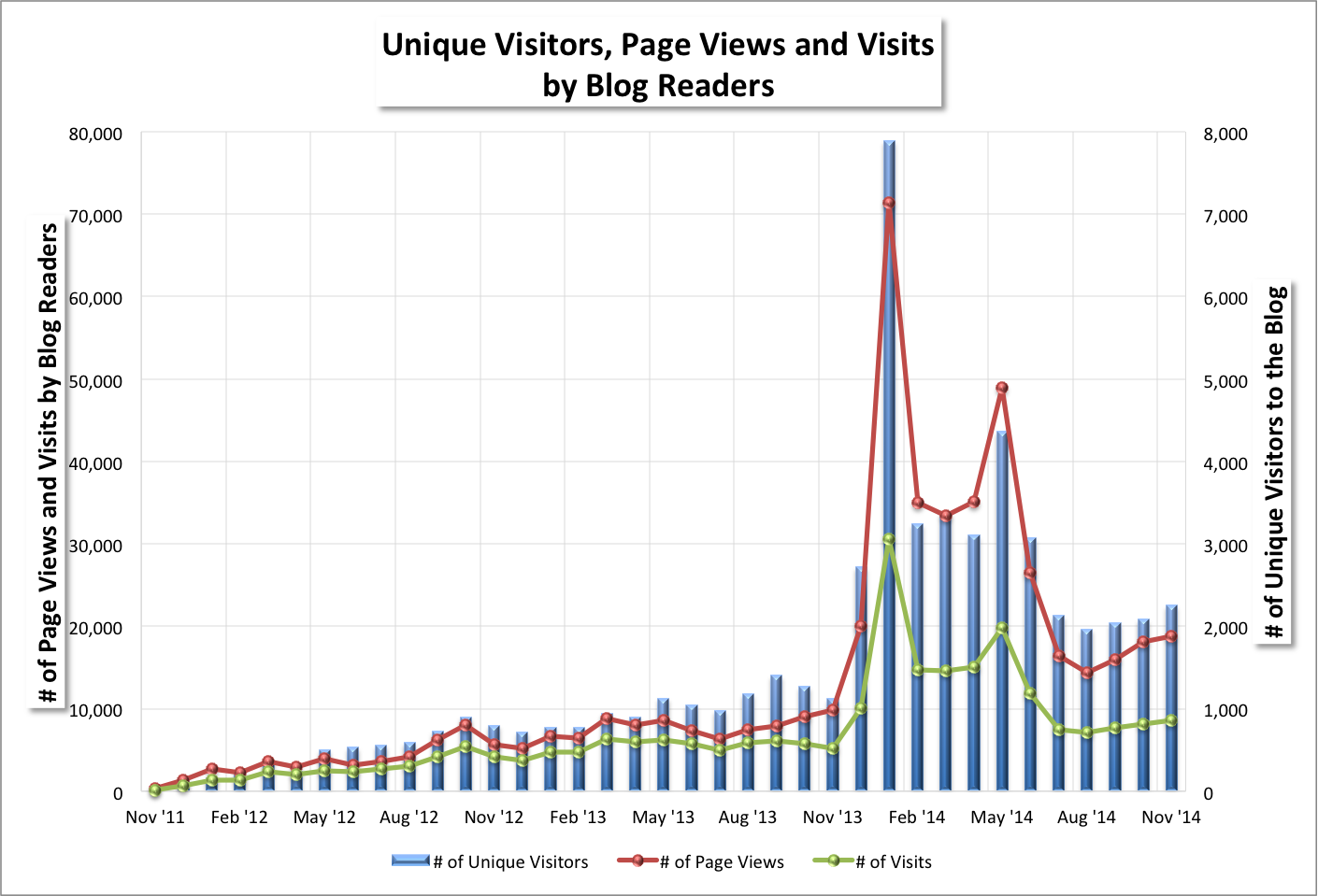
Blog readership mostly rose from October depending on the statistic. I wrote 22 blog posts (7) and news items (15) in November, versus 22 during the previous month (5 and 17, respectively). November month-over-month changes were:
  • +8% for the number of unique visitors (2,255 v. 2,085),
  • +4% for page views (18,851 v. 18,106),
  • +5% for visits (8,591 v. 8,173),
  • -10% for U.S. cities [from where visitors came] (584 v. 649),
  • -16% for world cities (137 v. 163), and
  • No change for countries (51 v. 51).
Click to enlarge.
Click to enlarge.
Click to enlarge.
 Roche's Genentech's Dr. Daniel Chen, M.D., Ph.D., PD-L1 Global Development Leader, noted in May 2014 that:
"One theory about immunotherapies is that they could work for everyone, with any type of cancer. The data to date show that this isn’t the case. Even though everyone has an immune system, not all patients will respond to the same medicine in the same way. 
Our immunotherapy program at Genentech has a large biomarker and diagnostic focus so we can find those who are most likely to experience a meaningful benefit. 
But what about those who do respond, but not well enough? 
Perhaps those people with a small to moderate response should be candidates for combination trials. Some immunotherapies may be more effective if they are combined with different types of medicines, including chemotherapies, personalized medicines and even other immunotherapies. 
In this way, biomarkers for cancer immunotherapy don’t just tell us who will or will not respond. Rather, they could help guide treatment strategies involving one or more medicines."
I recently asked Eric about this. He commented (paraphrasing):
Biomarker (i.e., targeted) therapies have proven quite successful in a number of cases, such as vemurafenib (trade name Zelboraf) and imatinib (trade name Gleevec). But these generally have limited time before escape* occurs since they target one or a few mutations, and cancer cells, which are generally highly adept at mutating, mutate to circumvent the therapy. 
Our understanding of immune targets relevant to cancer is still very primitive along with our ability to devise drugs specific to unique targets. Part of the problem is that "unique" targets are generally conserved**, just as molecular pathways are, in other kinds of cells and thus we get "off-target" effects (e.g., cholitis, secondary tumors, etc). 
Craig would say that PV-10 works by training our very sophisticated immune system to recognize complex patterns of targets that are expressed but sequestered by cancers. This is a bit like grabbing a very carefully selected handful of biomarkers and deploying them simultaneously.
* "Time before escape" is akin to survival time.
** "Conserved" means similar or identical.

 Peter updated Provectus' website to include information about the number and diversity of people and vendors working for the company. See About Us, Management, and scroll to the bottom of the page. It is a competent first step that provides some useful, basic insight into company operations.
Click to enlarge.
Of the 50 FTE figure in the bottom left hand corner, Eric's consultants and contract labor (see "consulting and contract labor" in Provectus' quarterly and annual SEC filings) comprise 36 FTEs (not including himself). The balance of 14 FTEs comprise Provectus' four principals and employees, and 10 FTEs that Peter characterizes as the full-time equivalents of the 134 people servicing and supporting his "corporate infrastructure."

 I recently asked Peter about the possible impact of a potential approval (i.e., a speculative PDUFA date of April 2015) of Amgen's intralesional oncology agent talimogene laherparepvec ("T-Vec") as a monotherapy for metastatic melanoma. He commented (paraphrasing):
People seem to like the idea of intralesional agents becoming appropriate to treat disease, and it is believed both T-Vec and PV-10 are helping to establish the relevancy of and build the intralesional agent category. People like having options as well, so two intralesional agents are better than one, in general. No matter what happens with T-Vec as a monotherapy, it is already believed T-Vec used in combination with ipilimumab is synergistic, and further builds the intralesional agent category.
 According to Neuroscience For Kids, the blood-brain barrier is semi-permeable, allowing some materials to cross, but preventing others from crossing. Further:
"More than 100 years ago it was discovered that if blue dye was injected into the bloodstream of an animal, that tissues of the whole body EXCEPT the brain and spinal cord would turn blue. To explain this, scientists thought that a "Blood-Brain-Barrier" (BBB) which prevents materials from the blood from entering the brain existed."
According to BrainFacts.org:
"The brain is the only organ known to have its own security system, a network of blood vessels that allows the entry of essential nutrients while blocking other substances. Unfortunately, this barrier is so effective at protecting against the passage of foreign substances that it often prevents life-saving drugs from being able to repair the injured or diseased brain."
Very small amounts of rose bengal cross the blood-brain barrier. See, for example, Table 3 of Klaassen's Pharmacokinetics of rose bengal in the rat, rabbit, dog and guinea pig (October 1976).
Click to enlarge.
Some patients in Provectus' melanoma Phase 2 trial had visceral disease, including brain metastases. How many patients with brain mets is unclear. Provectus has publicly discussed one such patient at medical conferences (Subject 0907 with Stage IV M1c disease), noting "“Near complete resolution” of pulmonary nodules observed at Week 12" during an ASCO 2010 clinical development update presentation.

If the brain is on the other side of the blood-brain barrier (and the immune system is on the other, so to speak), and PV-10 is injected into visible lesions on the skin, how were these brain tumors (nodules) positively impacted?

Blood Brain Barrier, Margaret Reece, Ph.D. (November 2013):
"The blood brain barrier is designed to exclude both pathogens and the cells of the immune system. It also excludes large proteins including immune system antibodies. It is only after viruses and bacteria are able to trigger a breakdown of the blood brain barrier that immune system responders gain entrance. And, when it occurs, it seldom turns out well."
The small amounts of rose bengal that may permeate the barrier are very unlikely to be able to reduce or destroy tumors, and the drug was not systemically administered (just injected into the skin at the location of a cutaneous or subcutaneous lesion). As Craig would say, Mother Nature's immune system knows how to get to brain tumors without destroying the normal brain tissue. But how?
"The brain has often been considered an immunologically privileged organ. This was based on early studies that found few antigen-presenting cells in the central nervous system. In addition, there was a perceived lack of a lymphatic system within the brain to carry immunogenic material in the central nervous system to lymph nodes where a humoral immune response could be initiated. And finally, the presence of the blood-brain barrier (BBB) was thought to prevent the entry of immune cells from the peripheral circulation into the brain. However, there is increasing evidence to suggest that the brain is under immunological surveillance." (Miller, Immunobiology of the blood-brain barrier, December 1999)