Showing posts with label Keytruda. Show all posts

October 19, 2016

Turning [more anti-PD-1] non-responders into responders

Image source
Updated below: 10/19/16.

What is PV-10's clinical value proposition to Merck & Co. (pembrolizumab, Keytruda®) and Bristol-Myers (nivolumab, Opdivo®), among other Big Pharma in the oncology space? In no particular order, is it, among other things:
  • As a primer, front-end, turner-on-of-the-engine, stepper-on-the-gas pedal, [insert your favorite over-, weakly- or wrongly-used analogy or metaphor],
  • Synergism, where from an efficacy perspective 1 + 1 >> 2,
  • Agnosticism to tumor type/cancer indication,
  • Safety profile, and/or
  • Turning cold tumors hot, and hot tumors hotter?
Industry discussion appears to recognize immune checkpoint inhibitors work — when/where they do work — in a portion of cancer patients. Is the summary clinical value proposition of PV-10 in combination with Keytruda/Opdivo to make the latter (i.e., these anti-PD-1 drugs) work better when and where they work? Or is PV-10's proposition, the more powerful one, to show it can make Keytruda/Opdivo work better where they do not work?

PV-10's clinical value proposition to Merck & Co. (pembrolizumab, Keytruda®) and Bristol-Myers (nivolumab, Opdivo®) is that it (PV-10) can turn more anti-PD-1 non-responders into responders than any other partner drug or investigational compound.

For this blog post, consider, among other things, two combinations with pembrolizumab (for advanced melanoma):
  • Intralesional* agent electroporation with plasmid interleukin-12 (epIL-12) (ImmunoPulse, OncoSec), the combination of a medical device and an investigational agent, and
  • Intratumoral* agent toll-like receptor 9 (TLR9) agonist SD-101 (Dynavax), an investigational agent too.
* Intralesional = intratumoral

OncoSec. OncoSec announced in November 2014 it would combine ImmunoPulse and pembrolizumab, UC San Francisco and OncoSec Medical Collaborate to Evaluate Investigational Combination of ImmunoPulse and Anti-PD-1 Treatment. Data from this investigator-initiated study were presented at AACR 2016 (April), "Positive Melanoma Clinical Data at American Association for Cancer Research (AACR) Annual Meeting 2016," where patients initially were treated with ImmunoPulse and, then, some went to receive systemic anti-PD-1/PD-L1 therapy. Notably, however, OncoSec announced this month data from the same study would be presented at SITC 2016 (November), "Acceptance of Late Breaking Abstract at Upcoming Society for Immunotherapy of Cancer (SITC) Annual Meeting 2016," where the focus would be on [clinical data from] patients with a low likelihood of response to an anti-PD-1 alone (i.e., anti-PD-1 failures).

Dynavax. Dynavax and Merck & Co. announced a collaboration in June 2015, Investigating the Combination of Immuno-Oncology Therapies. Initial clinical data of the combination of SD-101 and pembrolizumab in patients with metastatic melanoma was presented at ESMO 2016, "Phase 1b/2, Open-Label, Multicenter, Dose-Escalation and Expansion Trial of Intratumoral SD-101 in Combination With Pembrolizumab in Patients with Metastatic Melanoma." Preclinical work on SD-101 was presented at AACR 2016 by Dynavax observed, "These data provide a strong rationale for the clinical assessment of SD-101 in combination with agents blocking the PD-1/PD-L1 pathway in patients unresponsive to PD-1 blockade alone." Dynavax and Merck jointly observed on their ESMO 2016 poster, "Preclinical studies suggest that the immunostimulatory effects of SD-101 might also boost the activity of PD-1 checkpoint inhibitor therapy. In mouse models, SD-101 converted anti-PD-1 non-responders into responders by increasing the quantity and quality of tumor-specific T cells." {my underlined emphasis}

In order for Provectus CTO Dr. Eric Wachter, PhD to put Provectus in a position to garner a collaboration with a Big Pharma and its immune checkpoint inhibitor, he has to provide a compelling demonstration of the features of PV-10 in combination with an anti-PD-1 drug like pembrolizumab (e.g., clinical trial PV-10 in Combination With Pembrolizumab for Treatment of Metastatic Melanoma). The features of this demonstration would include (a) preliminary safety and efficacy results, (b) immune biomarkers to facilitate appropriate patient selection if and when the combination is approved, and, presumably, (c) the ability of PV-10 to better turn anti-PD-1 non-responders into responders.

Contesting anti-PD-1 non-responders into responders should be a big deal for Merck and Bristol-Myers because such contestation is all about eating more of the rest of the pie, much more so than fighting over the same sliver of it.

Updated (10/19/16): OncoSec. ref. "OncoSec (ONCS) Q4 2016 Earnings Call Transcript," Seeking Alpha

I referenced epIL-12 (and OncoSec) above because of the useful information regarding anti-PD-1 failures or non-responders. The oncology playing field continues to evolve, and combination therapy approaches clearly are evolving as well across multiple dimensions, like (i) determining which patients when and how [immune biomarkers], and (ii) expanding the addressable market from responders to non-responders.

Among other aspects of an analysis of epIL-12 (and OncoSec), which historically has been mentioned together with Amgen's T-Vec and Provectus' PV-10, like at ASCO 2014 (see "Expert Point of View: Axel Hauschild, MD," The ASCO Post, Caroline Helwick, July 25, 2014), (a) there does not appear to be an initial pathway to approval yet (if at all) for epIL-12 as a monotherapy and (b) the investigator-initiated study was neither designed nor powered to transition to a pivotal trial as a combination therapy. OncoSec hopes to secure agreement with (acquiescence by) the FDA on a pivotal/registration trial design by the end of the year. Initial pathways to approval, like what Provectus has with PV-10 as a monotherapy for locally advanced cutaneous melanoma, as with valuable beachfront property, is valuable drug treatment "real estate." Nevertheless, it is a good strategy for OncoSec to focus on PD-1 failures; using emerging biomarker data to select "likely" PD-1 failures, however, is likely to prove somewhat more challenging. It will be interesting to see how this plays out.

Dynavax. This is a true treatment combination and company collaboration (compared to the OncoSec treatment combination, for which the clinical trial protocol is here). The results are interesting, if not very preliminary (e.g., efficacy from 5 patients, measurement [for purposes of the ESMO 2016 abstract] was made after only 12 weeks). One would have hoped they could have provided a few more details (e.g, the number of injections of SD-101 [presumably 11 in total], more details on patient stage [particularly Stage IV, like M1a, M1b and/or M1c], what the grade 4 SAE was, etc.).

A 25% serious adverse event (SAE) rate seems a bit high, and this is kind of an odd way to report safety data; usually this is reported as CTCAE Grade 3 or higher events since this includes both severe AEs and the subset of those that qualify as SAEs. Robert et al. reported 10.1-13.3% rate of Grade 3 or higher AEs for pembrolizumab alone (NEJM 2015;372:26).

Notably, investigators/clinical sites on the poster included Agarwala/St. Luke's. The trial itself also is recruiting at Huntsman Cancer Institute (Andtbacka).

Since this is a collaboration with Merck, it would appear the Big Pharma is not requiring rigorous safety testing before the project moves to Phase 2 (a Merck staffer is a co-author on the ESMO 2016 poster). The poster's Methods section notes the trial is a dose-escalation and dose expansion study. It shows data from dose-escalation (i.e., 2 mg, 4 mg, 8 mg), but does appear to refer to the dose expansion portion, which normally would be additional patients at the highest tolerated dose. The N = 6 at 8 mg is dose expansion but, again, if Merck wants to green light this work to a Phase 2 trial, [as a Big Pharma] they probably are not going to get significant push-back from the FDA or institutional review boards (IRBs). If a small biotechnology company has a major player backing it, it is possible to do things that are not plausible for outsiders (i.e., the golden rule). Finally, this study might give Amgen pause, since SD-101 appears to function similarly to T-Vec, may produce a more robust effect than T-Vec and, most importantly, is not a live virus.

September 2, 2016

There's additivity, synergy, and then there's PV-10 (1 + 1 = 3)

PART A

I previously wrote about the concepts of additivity and synergy when adding two agents together (a "combination") or three or more together (a "cocktail"). See The bar (June 24, 2016) and Additive: 1 + 1 < 2. Synergistic: 1 + 1 > 2 (best case, >> 2) (June 25, 2016) on the blog's Current News page.

Additive in the context of immuno-oncology combinations and cocktails represents one plus one is less than or equal to two (or, in the case of three agents, one plus one plus one is less than or equal to three). Efficacy (e.g., response rate, and perhaps other survival and survival surrogate endpoints) of the combination is better than the individual efficacies of the pair's components. That is, the sum of the parts is greater than the whole.
  • 1 + 1 < 2, 1 + 1 + 1 < 3
A synergistic combination, however, should generate efficacy greater than the sum of the individual efficacies, and, in a best case, much greater than the sum, That is, the whole is greater than the sum of the parts
  • 1 + 1 > 2, and in the best case 1 + 1 >> 2
I updated MD Anderson's Dr. Merrick Ross, MD's slide no. 160 of ASCO 2016 Melanoma Symposium's "The Role of Immunotherapy in the Medical Management of Melanoma: An Overview for the Oncologist" for preliminary combination data of oncolytic virus CVA 21 (Coxsackievirus A21) and ipilimumab/Yervoy in Stage III and IV melanoma patients. The upshot for this latest addition, which Dr. Ross probably didn't include because the data is partial (some of the patients treated, but not all) and preliminary, is that CVA 21 and ipilimumab are synergistic, as are oncolytic virus T-Vec and ipi; however, T-Vec and pembro are potentially additive but not synergistic.
Click to enlarge
PART B

As I noted under Is Pfizer paying more [IP] attention to Provectus? (September 2, 2016) on the blog's Current News page, Provectus recently advanced daughter combination therapy patent application '318 (co-assigned with Pfizer) after an initial non-final rejection decision by the U.S. Patent and Trademark Office. Provectus' CTO Dr. Eric Wachter, PhD had a document, as part of this advancement, filed on August 31st. See the several pages below, with my orange emphasis.
Click to enlarge
Click to enlarge
Click to enlarge
Click to enlarge
Click to enlarge
Click to enlarge
Click to enlarge
PART C

H/t InvestorVillage poster STARLIGHT66 for a Barron's August 31st article entitled "Merck: Lung Cancer Lead Depends On “How Smart It Plays Its Hand,”" notably the quote by Bernstein analyst Tim Anderson:
"One of the frequent criticisms with MRK’s I/O program has been that, relative to competitors like BMY/AZN and Roche, its “combination” strategy is less clear, with many believing MRK could be left in the cold over the long run because of this. This is too simplistic of a view, in our opinion. 
MRK has already placed its bets on “chemo combo” through the earlier initiation of trials like Keynote-189 and Keynote-407. In the area of CTLA4 combinations, we believe the chances are high that MRK will soon initiate a phase 3 development program (exact scope unclear) if only to hedge its bets in the event that trials like Checkmate-227 and MYSTIC/NEPTUNE are positive. 
While the onus is on BMY and AZN to fully validate CTLA4 combinations, all MRK has to do is imitate given its sudden lead in the monotherapy 1L lung cancer market that came about through the very different fates of Keynote-024 and Checkmate-026. 
In other potential combination areas with anti-PDx therapies and “3rd generation” agents (e.g. OX40, GITR, IDO, and more) the playing field is more level across the different drug companies. Like its competitors, MRK already has various assets in development – either owned in entirety or accessed through partnership. Progress with almost all of these later generation drugs, across all companies, has seemed to be on the slower side; activity in a single-agent setting, for example, has often seemed underwhelming, in contrast to the single agent activity seen with the anti-PDx’s and anti-CTLa4′s. 
Lastly, even if “combination therapy” comes to fruition and the data is compelling (whatever the regimen), there will likely be the attendant trade-offs of incremental toxicity and higher cost. Therefore, it seems likely that some segment of the 1L lung cancer market will continue to exist for anti-PDx monotherapy, where MRK has a first-mover advantage. 
On balance, we continue to think investors under-appreciate the potential durability (and value) of MRK’s coming lead in 1L lung cancer. Part of this depends on how smart MRK plays its hand from here."
I think it's pretty clear Eric is signalling or outright saying the combination of Provectus' intralesional agent PV-10 (Rose Bengal) and Merck & Co.'s anti-PD-1 drug pembrolizumab for patients with advanced melanoma is synergistic. Is he foretelling the results are stellar? Could efficacy exceed, at a minimum, the response rate of Bristol-Myers' combination of anti-CTLA-4 drug ipilimumab and anti-PD-1 drug nivolumab?

The Barron's article suggests Merck is searching for the ideal front-end (perfect primer) to marry to/combine with pembrolizumab. How will the Big Pharma "play its hand?"

May 5, 2016

Advancing from “occasional cures” to “routine cures”

On the blog's Current News today I compared an article in The Australian from last month, April 2016, "Melanoma drug Keytruda denied full listing on PBS," to one in The ABC from June 2015, about a year later, "'Revolutionary' melanoma drug worth $150,000 a year listed on PBS, saving Australian patients thousands."

Last year, Australian patients with advanced melanoma gained access to Merck & Co.'s anti-PD-1 or immune checkpoint inhibitor drug pembrolizumab (Keytruda) following its initial, "partial" listing on the country's Pharmaceutical Benefits Scheme (PBS). This year Keytruda was denied full listing on the PBS because there was insufficient evidence of clinical benefit to justify its cost — with The Australian calling Keytruda "a much-hyped melanoma drug."

The above dialog from Australia is one part of an ongoing, maturing, global discussion with respect to this topic: whether current “revolutionary” drugs are truly revolutionary, and ultimately worth the requested price. A paragraph from The Australian's article goes to the very heart of this topic:
"The knock-back comes less than a year after the PBAC flagged concerns about a “substantial mismatch” between the public’s expectations for the so-called “breakthrough drug” and the supporting scientific data." [PBAC is Australia's Pharmaceutical Benefits Advisory Committee]
Keytruda (aka lambrolizumab) received the FDA's breakthrough therapy designation (BTD) for advanced melanoma in 2013.

Since the beginning of 2016 there has been an increasing realization that declaring “mission accomplished” in the fight against cancer might be premature. At the Vatican's recent 2016 healthcare conference, Cellular Horizons: How Science, Technology, Information and Communication will Impact Society, it was noted that the current immuno-oncology (I-O) drugs lead to “occasional cures,” but that this outcome is not good enough. Part-and-parcel with this view is the realization that combinations — combinations of different cancer treatments, whether therapies or therapeutics — likely will be paramount to advancing from occasional cures to routine cures.

The global oncology community is actually now talking about cures, realizes the immune system is crucial for this (as was first noted by the Society for Immunotherapy of Cancer in 2013), and is looking at cancer with a markedly increased sophistication in the search for necessary treatment algorithms for various tumors and tumor subtypes.

As with the rest of the oncology community, Provectus has challenges ahead, but PV-10 appears to be congruent with the mainstream more and more daily.
Click to enlarge. Image source

March 19, 2016

It's 2016: Intralesional therapy [for oncology] is "here to stay"

(H/t a regular hatter for the article heads-up and link)

Melanoma, intralesional (IL) agent for oncology, and PV-10 key opinion leader Dr. Sanjiv Agarwala, MD of St. Luke’s Cancer Center (and a HemOnc Today editorial board member) made his presentation Current Trials with Oncolytic Agents at the HemOnc Today Melanoma and Cutaneous Malignancies conference on Friday in New York.

In a March 19th article by Alexandra Todak entitled Intralesional therapy ‘here to stay’ for melanoma, Agarwala said the following.

About Provectus' pivotal Phase 3 trial entitled PV-10 vs Chemotherapy or Oncolytic Viral Therapy for Treatment of Locally Advanced Cutaneous Melanoma:
“If we’re going to show monotherapy with PV-10 works, you have to design a randomized trial. It is not easy to design a randomized trial for a monotherapy intralesional agent, when you have all of these drugs available. This trial is designed in a very specific way, and it will be very interesting to see the results of this trial compared to the talimogene laherparepvec [Imlygic, Amgen] trial, because that trial was designed in a different era.”
About the role of IL agents in a physician's toolkit:
“There is no getting away from the fact that even monotherapy with intralesional agents for the right patient population produces good clinical results. The question is, in what setting are you going to use it? For us, in the medical oncology world, whether we will pick this first or not is a bit of a question.”
About the utility of IL agents for later-stage (i.e., advanced or metastatic) melanoma patients:
“We’ve been able to now make an intralesional therapy applicable to not only patients with M1a disease, but also to patients with M1b and M1c disease. So, patients with multiple metastatic sites might be able to benefit.”
About the combination of IL agents with other cancer therapeutics and therapies like immune checkpoint inhibitors; Provectus' Phase 1b/2 program in this regard is entitled PV-10 in Combination With Pembrolizumab for Treatment of Metastatic Melanoma:
“Combinations will be the future. Why not find a way to combine modalities that have different mechanisms of action and have, very importantly, nonoverlapping toxicities?” 
And:
“We have to realize intralesional therapy is not going anywhere, it is here to stay. It is a new paradigm for potential combinations, and perhaps in the future the ultimate melanoma regimen is going to be with an intralesional therapy with a systemic, checkpoint inhibitor. Monotherapy also is applicable to specific patients.”

January 22, 2016

Combining PV-10 with a Checkpoint Inhibitor Enhances the Systematic Immune Response of PV-10

{Bolded and underlined emphasis below is mine}

2013: In Chen and Mellman's Oncology Meets Immunology: The Cancer-Immunity Cycle [1], cell death is Step #1 (Release of cancer cell antigens [cancer cell death]) below.
Click to enlarge.
Figure 1, The Cancer-Immunity Cycle
Therapies and therapeutics that cause cell death are highlighted in Chen & Mellman's Figure 2 below, again Step #1:
Click to enlarge.
Figure 2, Therapies that Might Affect the Cancer-Immunity Cycle
I think it is well documented in biomedical literature that treatments like chemotherapy, radiation therapy (or radiotherapy), and targeted therapy drugs lead to immunogenic cell death ("ICD").

June 2014: At ASCO, then Senior Member of the H. Lee Moffitt Cancer Center and Director of its Donald A. Adam Comprehensive Melanoma Research Center, and now senior faculty of NYU Langone Medical Center and its Laura and Isaac Perlmutter Cancer Center, Deputy Director of the Perlmutter Cancer Center and Co-director of its Melanoma Program, Dr. Jeffrey Weber, MD, PhD said of clinical PV-10 work undertaken by Moffitt, where patients had metastatic disease refractory to previous ipilimumab, anti PD-1 and/or vemurabenib therapy:
"This data provides more and more evidence that you are altering both local and systemic immunity in a positive way. It also provides a rationale for combination trials of PV-10 with check point protein inhibitors, such as ipilimumab, pembrolizumab and nivolumab. PV-10 might offer the perfect way to prime the immune system." [2]
November 2014: At SITC Moffitt presented their melanoma combination poster entitled Efficacy of Intralesional Injection with PV-10 in Combination with Co-Inhibitory Blockade in a Murine Model of Melanoma; i.e., PV-10 + one of {anti-CTLA4, anti-PD1, anti-PDL1}. I wrote about this in November 18, 2014's blog post Provectus notebook, where the preclinical Moffitt study comprised a single injection of PV-10. Of course, contrast that study approach, which had focused goals, with Provectus' Phase 1b/2 combination therapy clinical development program that sees Stage IV melanoma patients receive injections of PV-10 into all accessible disease (I believe) every 3 weeks for the duration of the study, together with immune checkpoint inhibitor pembrolizumab.

At the time frequent medical writer of PV-10 Janet Fricker wrote article in Medical News Today about Moffitt's SITC 2014 poster presentation entitled Melanoma shows improved regression with combination of PV-10 and checkpoint inhibitor. The article has an interesting quote from the cancer center's Dr. Shari Pilon-Thomas, Ph.D. about their work:
"The spirit of our study was to determine whether combining PV-10 with a checkpoint inhibitor would enhance the systematic immune responses of the initial injection of PV-10."
Phrased via slightly different editing: The spirit of the study was to determine whether combining ABC (PV-10) with XYZ ver 2.0 (e.g., pembro) would enhance the systematic immune responses of ABC (PV-10). Not, whether combining XYZ (pembro) with ABC (PV-10) would help XYZ ver 2.0 (pembro).

January 2016: At the 2016 Genitourinary Cancers Symposium Galsky et al. surmised in Phase II trial of gemcitabine + cisplatin + ipilimumab in patients with metastatic urothelial cancer:
"We hypothesized that chemotherapy may lead to immunogenic cell death, and other immunomodulatory effects, which could subsequently be exploited with the addition of ipilimumab."
Phrased via slightly different editing: Combining DEF (chemotherapy) with XYZ ver 1.0 (e.g., ipi) might enhance/exploit the immune response of DEF.

January/February 2016: At the 2016 Academic Surgical Congress the University of Illinois at Chicago ("UIC") will note:
"Therefore, based on these results, further evaluation of PV-10 as a potential agent to stimulate immunologic cell death in solid tumors is warranted."
Takeaways:
  • Immunogenic cell death is critical to the commencement of the cancer immunity cycle.
  • The potency of the initial generation of ICD likely dictates the prolonged or sustained potency of the subsequent cycle steps or cascade.
  • Adding a key combination partner to the mix likely augments the potency and sustainability of the immunity cycle.
  • The greater the synergy between the components of the combination -- the two elements of the pairing -- the greater the potency and sustainability, or durability.
  • Oncolytic viruses, like Amgen's talimogene laherparepvec (Imylgic), also can cause ICD. See, for example, "Oncolytic Virotherapy and Immunogenic Cancer Cell Death: Sharpening the Sword for Improved Cancer Treatment Strategies," Workenhe et al., Molecular Therapy (2014); 22 2, 251–256.
  • Moffitt and UIC, independent of each other, now have shown PV-10 causes potent ICD.
  • Provectus' clinical data from its A Phase 1b/2 Study of PV-10 Intralesional Injection in Combination With Systemic Immune Checkpoint Inhibition for Treatment of Metastatic Melanoma has to be good enough to rise notably above the noise of the many combination therapies trials already being run.

[1] Oncology Meets Immunology: The Cancer-Immunity Cycle, Chen et al., Immunity, Volume 39, Issue 1, 1-10
[2] Provectus outlines path forward for PV-10, Janet Fricker, ecancernews, June 10, 2014

July 16, 2015

Assessing Provectus' Pivotal Melanoma Phase 3 Trial, Part II

The second in a series of blog posts and news items assessing the company's pivotal Phase 3 trial for unresectable locally advanced cutaneous melanoma (Stage III patients, and not metastatic [Stage IV] melanoma).
  1. Win or lose: Will the trial succeed in meeting or fail to meet its primary and/or secondary endpoints?
  2. Time-to-success or -failure: How long might it take for the trial to succeed or fail?
  3. Good or bad process: Are there process steps and aspects thereof that may provide hints of potential future trial success or failure.
Entry 1: 3. Good or bad process:" Patient enrollment. See Assessing Provectus' Pivotal Melanoma Phase 3 Trial, Part I (July 13, 2015) on the blog's Current News page.

This blog post, "3. Good or bad process:" Designing an interim analysis for efficacy into Provectus' pivotal melanoma Phase 3 trial

Blog post takeaways:
  • Provectus' Phase 3 trial has two "looks" designed into it: first, an interim analysis, and second, the final analysis or data readout.
  • The interim analysis will be for both safety and efficacy (after 50% of the required events of disease progression have occurred). If the treatment arm of PV-10 can show it is overwhelmingly better than the control arm of systemic chemotherapy (dacarbazine or temozolomide), then the trial could be stopped for efficacy.
  • As a result of designing a single efficacy look (that also includes a safety look) into the trial Provectus, management appears to be signalling they intend to apply for accelerated approval, assuming the trial meets at the very minimum its primary endpoint of progression-free survival ("PFS").
  • Pivotal clinical trials of smallish to small biotechnology companies (i.e., market capitalizations in the hundreds of millions of dollars, or a little more or a little less) that do not have interim analyses for efficacy designed into them should indicate these companies' drugs are marginal (i.e., have small effect sizes). Said analyses were not designed in by their management teams because their drugs cannot afford the statistical hit of more than one look. Each efficacy look into a blinded trial's dataset incurs a statistics penalty when one calculates the statistical significance of the difference in performance of the treatment arm over the control arm (if any). Safety looks do not incur penalties.
[*] A clinical trial's Data Monitoring Committee ("DMC") or Data and Safety Monitoring Board ("DSMB") may:
  • Perform one or more pre-planned interim analyses for several different types of reasons, and/or 
  • Terminate the trial with or without pre-specified stopping rules that may be associated with the interim analysis(es).
Reasons for pre-planned interim analyses include:
  1. Safety: To see if the treatment drug is safe,
  2. Efficacy: To see if the treatment drug is overwhelmingly better than the control drug, and
  3. Futility: To see if the treatment drug is unlikely to beat the control drug.
Pre-specified stopping rules based on the above types of/reasons for interim analysis(es) include:
  1. Safety: Stop the trial is there are x number of serious adverse events in the treatment arm (an unspecified safety stopping rule would require either a DMC or DSMB to review a trial's overall safety to make a decision to stop, if any or at all),
  2. Efficacy: Stop the trial for efficacy, and
  3. Futility: Stop the trial for futility.
* [The above, which I edited for the purposes of this blog post, essentially is copied from the March 2012 post Futility Analysis in Clinical Trials - Stop the trial for futility of the blog On Biostatistics and Clinical Trials]

Provectus' poster at ASCO 2015 (June) indicated the company's pivotal Phase 3 trial will have a single interim analysis for both safety and efficacy undertaken by a DMC, in addition to the trial's final data readout. Thus, the trial will be a multi-look one. Fuzzy purple emphasis below is mine.
Click to enlarge. Image source.
The company also notes its interim analysis for efficacy (as well as safety) on the trial's ClinicalTrials.gov webpage. See below; fuzzy purple emphasis is mine.
Click to enlarge. Image source.
PV-10 is a drug with a [very] large effect size; that is, it works very well and is far from incremental or marginal. Provectus' ESMOR 2015 poster (September) displayed two reminders of how effective the drug is when Stage III melanoma patients have all of their disease (all their lesions) treated (i.e., injected with PV-10). At the per patient level; fuzzy purple emphasis below is mine:
Click to enlarge. Image source.
At the per lesion level; fuzzy purple emphasis below is mine:
Click to enlarge. Image source is the same as immediately above
Because of this very large effect size the pivotal trial of PV-10 for locally advanced cutaneous melanoma can withstand more than one efficacy look; that is, the additional look of an interim analysis for efficacy. Provectus, however, has not publicly discussed whether the pre-planned interim efficacy look includes a pre-specified stopping rule for efficacy. The FDA has provided guidance regarding interim analyses for efficacy and trial stoppage that might be warranted as a result.

In order for Provectus' to seek accelerated approval on the basis of the pivotal trial's interim analysis, the beat by the PV-10 treatment arm of the chemotherapy control arm will have to be significant. In my June 2014 blog post Trial Math: Meeting the Primary Endpoint, Pt. 1 I endeavored to calculate that hurdle rate (i.e., the size of the beat) using what information about the trial might be available. At the time and through today the company's CTO Dr. Eric Wachter, PhD has not provided the trial's hazard ratio. As a result I used a historical one Provectus' COO/CFO Peter Culpepper had publicly communicated, which facilitated the calculation of the size of the beat as 87% — PV-10's median PFS had to chemo's median PFS by 1.3 months. In the example below I used a median chemo PFS of 1.5 months, and 87% comes from the math of {(2.8 months - 1.5 months) / 1.5 months}.
Click to enlarge.
I recently redid my clinical trial math using what appears to be a more proper and precise equation. See Suresh et al.'s (2012) Sample size estimation and power analysis for clinical research studies, where their equation is below.
Using current parameters (such as the trial's N of 225), Eric's design yields a 90% power to detect a 70% improvement in median progression-free survival — from 1.5 months [if you use chemo's median PFS from above] to 2.55 months for PV-10. This approach also facilitates calculation, I think, of the trial's hazard ratio, which could be 0.588: {(2.55 months - 1.5 months) / 1.5 months}. By raising the hazard ratio, or lowering the size of the beat from 1.3 months {2.8 - 1.5} to ~1 month {2.55 - 1.5}, Eric may have made it easier for PV-10 to hurdle systemic chemotherapy in the trial (or made the eventual beat more impressive).

BioVex/Amgen's pivotal melanoma Phase 3 trial of OncoVEX/T-Vec for patients with advanced melanoma included a planned interim analysis for efficacy in the form of overall survival ("OS"), which was presented at ASCO 2013. The trial's primary endpoint was durable response rate, while OS was a secondary one that T-Vec barely missed with a p-value of 0.051.

On the other hand Vical's Allovectin-7's pivotal Phase 3 trial had no interim analysis for efficacy designed into it. See that company's CEO statement in a comment I made on a Seeking Alpha article about Vical in 2012. Fuzzy purple emphasis below is mine.
Click to enlarge. Image source.
Big Pharma beats multi-efficacy look pivotal clinical trials of somewhat better drugs  (i.e., having smaller effect sizes) by using large numbers of patients. The immune checkpoint inhibitors represent notable relative improvement over prior patient options; however, patient trial numbers were not insubstantial.

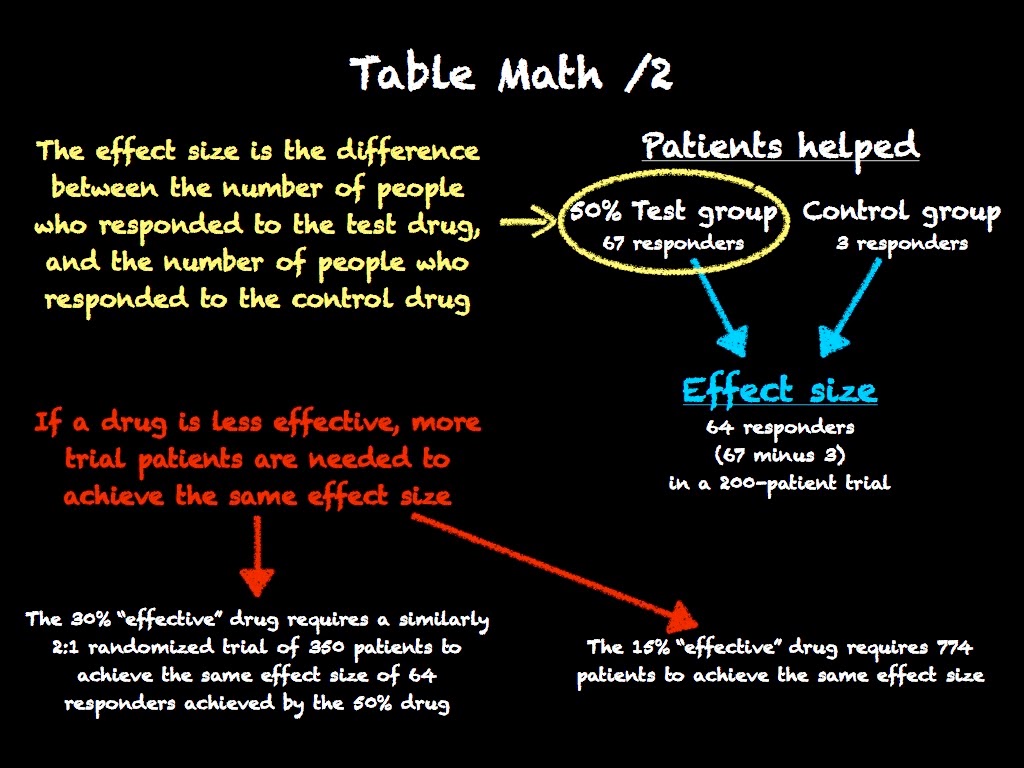
Effect size is a measure of strength (of something over something else). In the context of a clinical trial where the responses of two groups (a control group and a test drug one) are being compared, the difference in response between that of the control group and that of the test drug group is known as the effect size.

Should the control and test (treatment) groups be close in response, and thus the test drug has a small effect (i.e., it is a less efficacious agent), a large or larger number of patients are needed in order for the test drug to distinguish itself; that is, for the confidence interval (say 90% or 95% interval) of the test drug to not overlap or run into the confidence interval of the control. Conversely, if the test drug is very effective, a large effect size may anticipated, and thus a relatively small number of trial patients are needed; that is, the confidence interval of the test arm, in this case, may be large without overlapping the confidence interval of the control arm. The fact Provectus only is utilizing 225 patients in its pivotal Phase 3 trial signals this study assumes a relatively large effect size for PV-10 (i.e., PV-10 is very efficacious). Generally speaking, the more effective a drug is the less patients would be needed (without taking into account other factors that might influence clinical trial design) in a trial.

More effective, less patients needed. Less effective, more patients needed.

Consider the spreadsheet table below, which quantifies the above discussion. In order to generate the same difference of patients helped (64 is between 62-67), the 15% "effective" drug requires a trial of 750-800 patients (774 to be precise) . The 30% "effective" drug, which is better than the 15% drug, needs 350 patients to achieve the same difference of 64 patients. The 50% "effective drug, which is better still, needs an even smaller number of patients in its trial (200).
Click to enlarge.
The math of the above table is below.
Click to enlarge.
Click to enlarge.
Now see a table below I originally posted on the blog in June 2014 (note Provectus' pivotal Phase 3 trial N at the time was 210, which was later increased to 225).
Click to enlarge.
Updating this table to include the approvals in 2014 of immune checkpoint inhibitors Keytruda and Opdivo for advanced melanoma:
  • Keytruda’s efficacy was established in 173 clinical trial participants while its safety was established in 411 (source), and
  • Opdivo's efficacy was demonstrated in 120 patients while its safety was evaluated in 370 (source).

September 9, 2014

Bristol-Myers vs. The Field (ex-Provectus)

Last week Bristol-Myers filed a lawsuit against Merck over [anti-]PD-1 agent pembrolizumab (trade name Keytruda), which was approved last week by the FDA for late-stage or metastatic melanoma.
Specifically, Bristol-Myers claims that Merck is violating the patent on its Opdivo mediation for tackling melanoma, which was recently approved in Japan and became the first so-called PD-1 inhibitor to win regulatory backing anywhere. A PD-1 inhibitor blocks a protein that acts as a brake on certain immune system cells and prevents them from attacking healthy tissue. (Bristol-Myers Sues Merck Over a Patent on its new Cancer Drug, The Wall Street Journal, September 8, 2014)
Merck disclosed PD-1 antibody patent oppositions and litigation, at the time in Europe, in its 10-Q filing for the period ending June 30, 2014 (see page 22):
As previously disclosed, Ono Pharmaceutical Co. (“Ono”) has a European patent (EP 1 537 878) (“’878”) that broadly claims the use of an anti-PD-1 antibody, such as the Company’s immunotherapy, pembrolizumab (MK-3475), for the treatment of cancer. Ono has previously licensed its commercial rights to an anti-PD-1 antibody to Bristol-Myers Squibb (“BMS”) in certain markets. The Company believes that the ‘878 patent is invalid and filed an opposition in the European Patent Office (the “EPO”) seeking its revocation. In June 2014, the Opposition Division of the EPO found the claims in the ‘878 patent are valid. The Company expects to receive the Opposition Division’s written opinion in the third quarter of 2014, after which it will begin the appeal process. {Underlined emphasis is mine}
As FiercePharma's Tracy Staton writes: "The lawsuit asks for damages, but more importantly, asks the court to declare that Merck infringes that PD-1 patent. Such a decision would bolster Bristol-Myers and Ono's argument that they are owed royalties on sales of rival PD-1 drugs."

As I wrote in my Why Keytruda's approval is a good thing for PV-10 (September 8, 2014) news item under the blog's News tab:
KOLs see PD-1s as treating the bulk of late stage cancer. Key opinion leaders ("KOLs") see PD-1s, which fall under the category of checkpoint protein inhibitors that also include CTLA-4 and PD-L-1 agents, as an improvement over CTLA-4 agents like approved ipilimumab (trade name Yervoy) and tremelimumab. KOLs will use PD-1s to treat as many indications as they can scientifically support. Abstracts of Merck oncology-sponsored pembrolizumab studies being presented at ESMO 2014 in late-September, for example, include bladder and gastric cancer, advanced melanoma, non-small cell lung cancer ("NSCLC"), and head and neck cancer.
Bristol-Myers and Merck's PD-1s are projected to play key roles in the supposed several tens of billions of dollars equity research analysts estimate will be derived from the immuno-oncology addressable market.

But KOLs believe the more dominant use of PD-1s will come from combining them with other drugs to treat late-stage cancer, rather than strictly using them as monotherapies. I summarized 14 previously announced and/or conducted combination studies below, and first in my Combinations (July 24, 2014) news items under the blog's News tab.
Click to enlarge.
Click to enlarge.
Bristol-Myers, however, has its bases covered with a combination therapy patent that covers PD-1s and other therapeutic compounds and compound categories. Again, Merck challenged it, noting such in the above mentioned quarterly filing:
On April 30, 2014, the Company, and three other companies, opposed another European patent (EP 2 161 336) (“’336”) owned by BMS and Ono that it believes is invalid. The ‘336 patent, if valid, broadly claims anti-PD-1 antibodies that could include pembrolizumab. {Underlined emphasis is mine.}
Bristol-Myers and Ono Pharmaceutical's '878 patent covers PD-1s as monotherapies.

Bristol-Myers and Ono's '336 patent covers PD-1s in combination with other agents, and appears to include a number of companies' products including Amgen's oncolytic virus and intralesional agent talimogene laherparepvec ("T-Vec"). T-Vec had been combined with Bristol-Myer's approved [anti-]CTLA-4 agent ipilimumab (trade name Yervoy), the results of which were presented at ASCO 2014. Amgen and Merck plan to combine T-Vec with Keytruda in a trial slated to start later this year.

A Big Pharma (BMS) with a market capitalization of about $85 billion (per Yahoo! Finance as of yesterday's close) battling one (MRK) with a market cap of about $176 billion. Afterall, in 2013, Citi analyst Andrew Baum estimated potential annual immuno-oncology-related sales to be $35 billion by 2023 (cough). Titans battling...

It does not appear PV-10 is covered by Bristol-Myers and Ono Pharmaceutical's '336 combination therapy patent. PD-1s in combination with PV-10 apparently are, however, covered by Provectus' combination therapy patent application (20120263677 ["'677"]) that it jointly filed with Pfizer (through an expansion, or continuation in part, of Claim #1) in 2012. Pfizer and Provectus would share CTLA-4-related combination therapy sales revenue via the '667 patent application if/when issued, but the former has no claim in the patent app on economics derived from PD-1-related combination therapy sales.

Whether the '878 monotherapy patent ultimately prevails -- that is, whether Merck is violating the patent for tackling cancer (see paragraph 047) -- is Merck's problem, and the Big Pharma eventually may elect to direct royalties Bristol-Myers and Ono's way(s).

Merck could, however, circumvent paying the other parties by meaningfully combining pembrolizumab/Keytruda with PV-10. Directionally speaking, immuno oncology is trending towards combination therapies for late-stage cancer treatment. Strategically, PV-10 should permit Merck's PD-1 to achieve greater tumor destruction and immunological signaling, and be the perfect front end for an immunologic back-end like Keytruda for the ultimate and better benefit of patients than what the PD-1 alone could achieve as a monotherapy. This combination proposition of course would require a sound scientific and medical data-based foundation, which one hopes Moffitt Cancer Center will present and convey at the Society for the Immunotherapy of Cancer's annual meeting in early-November. Tactically, an effective Keytruda/PV-10 combination with a compelling clinical value proposition should obviate the need for royalty payments to Bristol-Myers/Ono because the '336 combination patent would not be infringed. Increasing anti-PD-1 antibody patent opposition and litigation could tip Merck's decision-making scales in favor of embarking on a near-term combination study of Keytruda and PV-10, with perhaps an eye to a longer-term combination.