Showing posts with label Dr. Craig Eagle. Show all posts

January 14, 2016

"Going to be a leading player in 2nd wave of combos."

Blog post title attribution: From a tweet by @lisamjarvis below:
Click to enlarge. Image source
Provectus issued a press release yesterday, Confirms First Patients Dosed in Trials of PV-10 for Melanoma, which also included the sub-headline "Phase 1b/2 Trial of PV-10 In Combination with Keytruda® for Stage IV Metastatic Melanoma." See my initial comments under "FPFV" (January 12, 2016) on the blog's Current News page.

As I noted in January 10th's blog post Generating Clinical Data, I believe the ideology behind Provectus' pivotal melanoma Phase 3 trial (that is, management's consequential ideas and ideals) is a clear and present focus on the earlier treatment of cancer patients — in the pivotal study's case, the treatment of patients with locally advanced cutaneous melanoma, otherwise mostly known as Stage III (specifically, Stage IIIB-C recurrent, satellite or in-transit cutaneous or subcutaneous melanoma). The ideology is evidenced if and only if/when and only when the trial's hypotheses are proven: (i) complete response of injected tumors is tantamount to elimination of disease symptoms, and (ii) PV-10 can forestall or prevent the spread of the disease from Stage III to Stage IV if all of it is treated.

Provectus management, however, acknowledges that while the greater unmet need in melanoma is the silent masses of earlier stage patients with no real good treatment options, therapy or therapeutic, a potentially much greater driver of value for this indication for a company like Provectus (and thus valuation or market capitalization) lies in combining PV-10 with an immune checkpoint inhibitor like pembrolizumab (Keytruda) in patients with advanced melanoma (Stage IV disease), which comprises a fraction of the total population of people afflicted with this cancer.

The company's CTO Dr. Eric Wachter, PhD's first quote in the PR is interesting:
"With patients starting treatment in both of these studies, the clock is ticking to interim results and ultimately the completion of these studies. Our recruitment activities are moving ahead and we are hopeful that these studies will play critical roles in demonstrating effectiveness and safety of PV-10 in melanoma." {Underlined emphasis is mine}
Eric has the tendency to be [very] precise, on occasion, I believe, at the detriment of accuracy, in context. Nevertheless, "the clock is ticking," at least for me, is sort of odd in its usage in that sentence. Or is it? "clock is ticking, the:" The time (for something to be done) is passing quickly.

Later, in the PR, in regards to the Phase 1b/2 combination study, the release (Eric) notes:
"Up to 24 subjects will be enrolled in the Phase 1b portion of the study. Each subject in this cohort will receive the combination of IL PV-10 and pembrolizumab. The expected completion date is in 2016 for the Phase 1b portion of the study." {Underlined emphasis is mine}
When would be an interim data readout be undertaken; sometime in 2016 (if the completion date is planned for this year as well), but when exactly?

Eric's second quote in the PR says:
"Current research suggests that using anti-cancer drugs in combination can have additive or synergistic effects that can improve the outcomes patients experience. KEYTRUDA® and PV-10 together may prove more effective than either agent alone in treating certain cases of melanoma. We believe that our current Phase 3 study that tests PV-10 on its own for Stage III patients is designed to prove its effectiveness, but we also believe that we should examine combination therapies to maximize potential benefit to patients, especially those with advanced disease." {Bolded and underlined emphasis is mine}
As I also noted in Generating Clinical Data, the crux of the Phase 1b/2 study is showing PV-10 can work in combination with another drug or drug compound, proving orthogonality from both safety and efficacy perspectives. This study's hypothesis in my view is PV-10, together with a checkpoint inhibitor, can benefit patients (Stage IV melanoma) with disease inaccessible to PV-10 injection, with a management ideology of demonstrating a PV-10 solution for late-stage patients with heavy tumor burdens and visceral disease.

An interim data readout of the Phase 1b study might be based on about half of the target number of patients (it might not be, but my baseline guess is half), or about 12 (i.e., half of "up to 24 subjects"). In 4Q15 I heard speculation 5 to 6 patients had been treated (by that time). If PV-10 plus Keytruda makes for a potent combination, how many cycles would a patient require to show meaningful response [rates] and progression-free survival? Provectus' completed Phase 2 Study of Intralesional PV-10 for Metastatic Melanoma saw complete responses mostly require 1-2 injections of Rose Bengal, but in some cases up to 4 treatments. Patients in the Phase 1b study will have up to 5 treatments of both therapies.

Could the trial have recruited enough patients for an interim data readout, and could those patients have received 1-2 cycles of PV-10 and Keytruda?
Click to enlarge.
Takeaway: In saying the clock is ticking to interim results, is Eric actually saying the Phase 1b study in particular is nearly there?

As for the title of this blog post, Pfizer is a part-owner of Provectus' intellectual property regarding combination therapy: Combination of local and systemic immunomodulative therapies for enhanced treatment of cancer (including continuation #1, continuation #2).

December 21, 2014

Let Me Tell You A Story About Pfizer

Provectus issued a press release and filed an associated 8-K this past week regarding the addition of a third Pfizer executive to its strategic advisory board ("SAB"), Deanna Angello, Director, Commercial Strategy and New Business Planning of Pfizer's Global Established Pharma business. As an aside, there are two other businesses in the reorganized company: Global Innovative Pharma and Global Vaccines, Oncology and Consumer Healthcare.

It would seem reasonable to say there Pfizer's interest in Provectus has existed since at least 2011 (and likely before, probably starting in 2010) and continues to exist, led by Pfizer's Dr. Craig Eagle, M.D. Eagle's last reported position at the firm was Vice President of Strategic Alliances and Partnerships for the Oncology unit. His professional background includes patient care (he was a hematologist-oncologist), and both managerial and participatory experiences in pharmaceutical research, drug development, regulatory affairs, pricing, reimbursement, and post-merger integration. Until I believe relatively recently, it hasn't included profit/loss ("P&L") experience.

Dr. Eagle also appears to be a forward-thinker about oncology, and the role and opportunity of the immune system to restrain, if not defeat, cancer. Consider, for example, a snippet of an Oncology Business Dynamics interview of Eagle following ASCO 2007:
"Oncology Business Dynamics: And the other investigational agent we seemed to hear a lot about was CP675,206. What’s new with this one? 
Craig Eagle: This is a very interesting compound which essentially releases the brakes on the immune system. CTLA-4 is a molecule which normally puts the brakes on the immune system and stops it from attacking tumors. CP-675,206 is an antibody which works on CTLA-4 and renders it inactive so that the immune system can attack the tumor. We presented results from a phase 2 study with 89 patients in which we saw survival times 10.3 to 11 months, which is longer than historical data. While this is preliminary data it was also encouraging enough that we are going to further our investment in the development of The CP-675,206 Phase 3 study in metastatic melanoma has completed enrollment and we are awaiting the data In this study CP-675,206 was used as a single agent administered once every three weeks." {Underlined emphasis is mine.}
CP-675,206 was Pfizer's initial label for its monoclonal antibody and immunotherapy tremelimumab, which is related to Bristol-Myers' approved immunotherapy ipilimumab (trade name Yervoy). Pfizer out-licensed tremelimumab to AstranZeneca's MedImmune in 2011.

Eagle's longstanding interest in PV-10 is a second example; a local drug that is very safe and kills cancer locally, and has demonstrated the ability to systemically kill cancer. A third example would be his contribution to and involvement in Provectus' patent application Combination of Local and Systemic Immunomodulative Therapies for Enhanced Treatment of Cancer, which covers and protects the combination of PV-10 and other therapeutic agents, particularly all checkpoint blockade categories (i.e., anti-CTLA-4, anti-PD-1 and anti-PD-L1), and of which he is a co-author (Pfizer is a co-assignee). He probably saw much earlier than most the eventual trend of the FDA and pharmaceutical industry towards the use of combinations of drugs to treat late-stage cancer.

His interest and, by extension, Pfizer's, however, has not translated into an increase in Provectus' share price. The stock price on the date of the first public Pfizer touchpoint, Eagle's addition as the first Pfizer executive on the SAB on August 30, 2011, was $0.92. The price on the date of the fourth public touchpoint, Angello's addition on December 17, 2014, was $0.88. The stock market has placed no premium on a Pfizer-Provectus relationship or association.

The historical touch points between Pfizer and Provectus, starting in 2011 -- three Pfizer executives on Provectus' SAB, and the companies as co-assignees of a combination therapy patent application that includes the pairing of PV-10 and different categories of checkpoint inhibitors -- might encourage one to ask: "Given Pfizer's interest in Provectus, why hasn't it invested in and/or acquired the company yet?"

One answer, it would seem, is not for lack of "trying." I believe Pfizer (Eagle) has tried three times. For two of those times, Provectus management would not have found the valuation proposition sufficiently compelling and thus worthwhile to pursue. In the third instance, Craig et al. likely concurred with valuation but fell short in their efforts to reciprocate Pfizer's interest to formalize the relationship/association.

Transactions, whether venture capital, private equity or portfolio management, typically stem from an underlying value proposition and, more often than not, require a catalyst. PV-10's clinical value proposition, together with the drug's ease of administration and low cost to manufacture, ship and store, is both very clear and attractive. See, for example, my blog post PV-10 (Rose Bengal) Clinical Value Proposition. The historical record of fact and "fiction" paints a picture of potential catalysts that may have provided context for either an acquisition of Provectus or an equity investment in the company by Pfizer. The facts are the addition of three Pfizer executives to Provectus' SAB, and the joint oncology combination therapy patent application the two companies made. The "fiction" includes:
  • A rumored 2011 bid for the company for the same $1 billion valuation as and around the same time when Amgen acquired Boston (Woburn), Massachusetts-based, privately held, intralesional oncology company Biovex,
  • A rumored equity investment that may have led or co-led Provectus' preferred stock "IPO (using the NASDAQ ticker symbol PVCTP) in 2012, which was to have been predicated on or catalyzed by a special protocol assessment ("SPA") for a melanoma Phase 3 trial. The "IPO" might have been contemplated at a $1 billion pre-money valuation that, while yielding a minority ownership in Provectus for Pfizer, could have provide the impetus and opportunity for Provectus to grow its market capitalization much higher, and
  • The rumored 2014 bid for the company for a valuation of more than $2 billion prior to the company's submission of its breakthrough therapy application ("BTD").
2010-2011

Provectus presented preliminary, full, melanoma Phase 2 results at the Society for Melanoma Research's Melanoma 2010 Congress (see Provectus' press release Provectus Reports Full Phase 2 Study Data on PV-10 for Metastatic Melanoma). Prior to that, competing intralesional oncology therapy company Biovex, venture-backed and Boston-based, began enrolling patients in its pivotal melanoma Phase 3 trial for OncoVEX GM-CSF in 2009 (the press release is here, and clinical trial information is here). In 2011 Amgen acquired BioVex for a top-line amount of $1 billion, and renamed the drug talimogene laherparepvec ("T-Vec").

Without reference to a specific timeframe but sometime in 2011 it is possible Dr. Eagle had a casual conversation with Provectus about their interest to be acquired. He may have understood PV-10's value proposition, and Amgen's acquisition of BioVex could have been a direct or indirect catalyst. In M&A parlance the acquisition would have been a precedent transaction used to provide a datapoint establishing price. Provectus management, believing they knew what PV-10 and thus the company were worth, then may have rebuffed Eagle's informal overture.

Given his work with tremelimumab, his interest in PV-10 and its potential in combination with other drugs, and/or possibly a positive opinion of Provectus' early-stage trial effectiveness and capital efficiency, all underscoring a desire to continue working with the company if he could not acquire them, it is possible Eagle tried to out-license Pfizer's anti-CTLA-4 agent to Provectus.

Eagle joined the SAB in August 2011. Pfizer out-licensed tremelimumab to MedImmune (AstraZeneca) in October.
Figure 1. Click to enlarge.
2011-2012

It has been said biotechnology companies typically are acquired when they are in Phase 3 trials. BioVex was acquired by Amgen after beginning its pivotal melanoma Phase 3 trial for intralesional oncology agent T-Vec (formerly OncoVEX) but before an interim analysis was read out.

In 2011 Provectus seemed like it would commence a pivotal melanoma Phase 3 trial. The company had held a meeting with the FDA in October 2011. In January 2012 management issued press release Provectus Receives Guidance From FDA On Pathway to Approval for Phase 3 Trial of PV-10 For Metastatic Melanoma noting they would seek an SPA for the trial. In July Peter filed a $100 million mixed securities shelf of both common and preferred stock; he filed the prospectus for the "IPO," an offering of preferred shares with warrants, in September (the related SEC filings are here and here, respectively). The fundraising round was to have totaled $30 million, if I recall properly, with a "fictional" pre-money valuation of somewhere around or between $800 million and $1 billion.

The situation made sense. While Provectus management may not have been willing to sell the company (i.e., give up all ownership) for a BioVex-like amount of a $1 billion, they might have been prepared to give up a percentage to Pfizer and the round's other investors to cement a relationship with the Big Pharma company. In return, however, Pfizer likely would have required Provectus to be on a firm pathway towards the commencement of a Phase 3 trial. Unfortunately, as we finally learned on the company's May 23rd conference call in the wake of the FDA's denial of Provectus' BTD application, Eric had been unable to agree upon a trial design (endpoints and patient population) with the Agency. There ended up being no investment by Pfizer because there ended up being no catalyst (i.e., no Phase 3 trial design, no Phase 3 trial).

The "IPO" was cancelled in October 2012 amid monstrous volatility in the share price.
Figure 2. Click to enlarge.
2013-2014

Finally, during Provectus' December 16, 2013 Type C meeting with the FDA, Provectus appeared to establish its initial pathway to the licensure of PV-10 with the Agency. See, for example, January 2014 press release Provectus's PV-10 Path to Initial Approval in U.S. Now Clear Per FDA Meeting Minutes, which was locally advanced cutaneous melanoma. The day after the meeting the company issued press release Provectus Announces Name Change to Provectus Biopharmaceuticals, Inc. and Reincorporates in Delaware in which they seemingly buried the addition of the second Pfizer executive to Provectus' SAB, Bob Miglani. Miglani appeared to have substantive international pharmaceutical business experience, and a corporate functional role (as opposed to Dr. Eagle's operational and oncology-focused role). In the same January press release above management noted they also would apply for BTD.

Sometime before Provectus submitted its BTD application it is possible Dr. Eagle had a casual conversation with Provectus about their interest to be acquired this time for $2 billion or thereabouts. He may have been more comfortable with PV-10's regulatory pathway -- albeit not completely certain about it -- and the company's BTD application could have been a direct catalyst (a successful application would have made Provectus much more expensive to buy in his mind). Provectus management, believing PV-10 and the company were worth more, would have rebuffed Eagle's second presumably informal overture.

Provectus' BTD application was denied in May 2014.
Figure 3. Click to enlarge.
2014 And Beyond

In early-November 2014 Moffitt Cancer Center presented preclinical combination therapy work at SITC 2014. Around mid-November Pfizer seemingly jumped into the middle of the immuno-oncology pool with their own anti-PD-1 agent in one hand and Merck KGaA's anti-PD-L1 agent in the other. According to the immediately linked Pfizer press release, Albert Bourla, Group President of Pfizer's [Global] Vaccines, Oncology and Consumer Healthcare business said "Immuno-oncology is a top priority for Pfizer."

Last week, on December 17, Provectus issued press release Provectus Biopharmaceuticals To Sponsor American Association of Physicians of Indian Origin in which they seemingly buried, yet again, the addition of a third Pfizer executive to Provectus' SAB, Deanna Angello. Angello appears to have substantive commercial strategy experience, which notably includes "...formulating robust business cases, and performing due diligence to thoroughly assess the commercial value and fit of in-licensing and acquisition opportunities," and an operational role in Pfizer's Global Established Pharma business, which presumably is not where the bulk of the Big Pharma company's oncology assets lie. Wouldn't they reside in Global Vaccines, Oncology and Consumer Healthcare?

Returning to the concept that many biotechnology companies or assets are acquired or licensed during their respective Phase 3 trials, Provectus soon should announce the company will begin enrolling patients in its own pivotal melanoma Phase 3 trial. Interestingly, Pfizer, but more likely Dr. Eagle, has added a colleague with experience constructing and making the business case to license a therapeutic or buy the company that owns it. It would appear, however, Angello is in a different Pfizer business than Eagle. Wouldn't his visible title put him in Global Vaccines, Oncology and Consumer Healthcare?

I speculate Eagle currently is tied (or has moved) to Pfizer Injectables, which is part of the Global Established Pharma, because he probably needs to add P&L responsibility to his resume to further his career prospects at Pfizer. The division's portfolio of products includes oncologics (PV-10 is an injectable compound of course). Additionally, if someone is going to be tapped to assess the commercial value of the drug, why would he or she come from an ostensibly different Pfizer business. Eagle may be augmenting his professional background while at the same time maintaining his running start on trying to acquire Provectus for Pfizer.
Figure 4. Click to enlarge.
The answer to the question "Given Pfizer's interest in Provectus, why hasn't it invested in and/or acquired the company yet?," if you believe my "fiction," might be that the stars -- valuation and catalyst -- have not yet aligned for both Pfizer and Provectus. It would seem to me Eagle has a reasonably long-standing belief in how to more effectively treat cancer, and a long-standing interest and belief in Provectus and their treatment approach. Craig et al. are and have been focused on protecting the economics of their fully owned cancer asset, and have not been nor currently appear inclined to give the company away. It would also appear Pfizer (Eagle) has been prepared in the past to offer a very healthy premium to the then market capitalization of the company.

While it is not a foregone conclusion Pfizer will acquire Provectus, it would appear the Big Pharma company may be in the pole position (also see my July 2012 Pole Position post). The better question to ask Provectus management, and a key question existing and prospective investors in the company should pose to themselves, might be "Can Provectus get its price?"

January 28, 2014

PV-10's Pharmaceutical Alpha

In investment management, there are several measures of risk-return (aka risk-reward), including alpha, beta and Sharpe Ratio (see, for example, Forbes' Measuring Risk With Alpha, Beta and Sharpe Ratio by Richard Loth). Most investment professionals and retail investors do not outperform the market. Most investment funds, mutual, hedge or otherwise, after fees and expenses (and, more often than not, before too) do not generate alpha.

Alpha measures the value an investment manager adds to his or her fund portfolio. Warren Buffett, Jim Simmons, Ray Dalio, etc. established their reputations by generating lots of alpha for notable periods of times. Beta measure volatility. A beta greater than 1 means a portfolio (or security) will be more volatile than the market (less than 1 means less volatile, and equal to 1 means the same volatility). Many hedge funds generate high beta; that is, when the market goes up they go up higher, and when the market goes down they go down more. Some funds are low beta ones; they go up less when the market goes up and go down less when the market goes down. "Investors would most likely prefer a high alpha and a low beta." Sharpe Ratio measures risk-adjusted performance, and "...tells investors whether an investment's returns are due to smart investment decisions or are the result of excess risk."

While far from a perfect analogy, many or most of the pharmaceutical industry's oncology drugs generate beta. Few, if any, generate real alpha. Most have forgettable Sharpes. Layer on the cost of treatment (i.e., mutual fund costs or hedge fund fees and expenses), only the most effective drugs (i.e., the very best investment managers) deliver a compelling patient (i.e., investor) value proposition.

As I have written before on the blog before, and continue with the above analogy:
  • Pharmaceutical Risk = Safety,
  • Pharmaceutical Return = Efficacy, and
  • Pharmaceutical Fees & Expenses = Treatment Cost.
PV-10 for melanoma (or any of the solid tumor cancers for which it likely should have great potential) is like a very high alpha, very low beta, very inexpensive-to-own fund.

Safe. Efficacious. Broad spectrum of use. Low cost.

✩     ✭     ✩     ✭     ✩

January 28th press release: Provectus Announces PV-10's Assessment for Drug-Drug Interaction Potential is Subject of Article Published by Xenobiotica

Byline: Demonstrates Risk of Clinically Relevant Drug-Drug Interactions with Rose Bengal is Low

Key Statement:
  • "The published research indicated that the risk of PV-10 causing clinically relevant drug-drug interactions is likely minimal."
  • "Sorafenib is a competitive inhibitor of cytochrome P450 (CYP) drug metabolism enzymes and is reliant on the UDP-glucuronosyltransferase (UGT) pathway for efficient clearance. CYP and UGT enzymes help to biotransform small lipophilic drugs like sorafenib into water-soluble excretable metabolites."
  • "As we discuss our clinical results with regulatory authorities, we continue to be intensely committed to building all sections of the prescribing information for a future package insert for PV-10."
The paper's Discussion section helps to place the conclusion of low risk of clinically relevant or significant drug-drug interaction in context, and discusses what is known, what can by hypothesized, what is not known, and what requires or deserves more work. The paper and the PR begin to reveal more of PV-10's orthogonality (drug-drug interaction) potential. My posts on orthogonality are here, here, here and here.

Orthogonal, as you know, refers to the the idea of perpendicular, non-overlapping, independently varying or uncorrelated items. Two lines at right angles to each other are perpendicular, or orthogonal. X, Y and Z axes conventions reflect axes perpendicular (or orthogonal) to each other.

I think there are at least two key takeaways from this work and PR. First, clinical trial outcome. Sorafenib, co-developed and co-marketed as Nexavar by Bayer and Onyx Pharmaceuticals (acquired by Amgen in August 2013) is the standard of care for the treatment of advanced hepatocellular carcinoma. The company currently is running an expanded liver cancer Phase 1 trial comparing sorafenib (cohort 1) to PV-10 plus sorafenib (cohort 2). Sorafenib/Nexavar is not a very good drug, but it remains the go-to-solution for physicians for this disease.

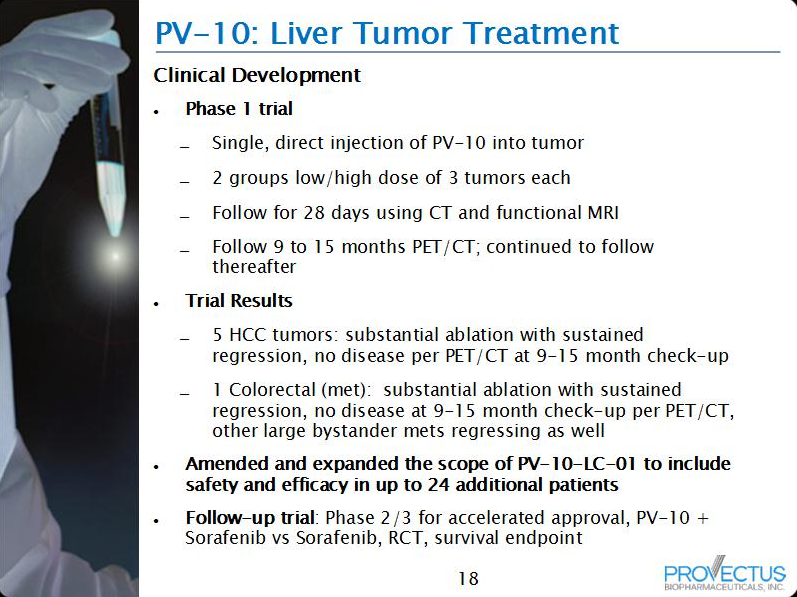
By demonstrating low clinically relevant drug-drug interaction, all or most of the difference in efficacy between cohort 1 and 2 should be attributed, positively (more efficacy in 2 than 1) or negatively (less efficacy in 2 than 1), to PV-10. The trial is permitting a single intralesional injection of PV-10 in patients with either recurrent hepatocellular carcinoma (HCC) or cancer metastatic to the liver. Success data (higher efficacy in cohort 2 v. cohort 1), likely measurements should include overall response (complete, partial, stable) of injected tumors, would inform the FDA and impress Big Pharma, particularly if they are even remotely close to what was demonstrated for locally advanced cutaneous melanoma. Provectus has not updated the market on its liver cancer Phase 1 trial save this old information from its current website presentation.
Click the figure to enlarge it.
This biochemistry work published today is very useful for when the company shows its expanded liver trial efficacy results and analysis to the FDA and Pfizer, er, Big Pharma.

Second, market opportunity. "Three fourths of worldwide liver cancer cases in males and two thirds in females occur in the fifteen Asian countries." Sorafenib is not well liked in Asia for its utility (more so than in the U.S.). Sorafenib/Nexavar's price certainly is not liked there either. Nevertheless, the drug is the standard of care, until it is not.

"The drug, which is particularly effective on late-stage kidney and liver cancer, costs approximately $69,000 per year in India, so in March 2012 an Indian court granted a license to an Indian company to produce to the drug at a 97 percent discount" (quote source, and for the two quotes below, is here) "Nexavar costs approximately $96,000 per year in the United States, but Bayer assures “western patients” that they can have access to the drug for a $100 copay." [Bold and underlined emphasis is mine.] "In an interview with Bloomberg Businessweek, Bayer CEO Marijn Dekkers said that his company’s new cancer drug, Nexavar, isn’t “for Indians,” but “for western patients who can afford it.”"

A generic version of Nexavar may hurt Bayer/Amgen. PV-10 reducing Nexavar to near obsolescence certainly won't kill Bayer/Amgen, but the companies certainly will miss the sales (and that will impact earnings to an extent balance sheet financial engineering cannot fix). For example, in the U.S., $96,000 per year for Sorafenib/Nexavar, or a $20,000-30,000 "one shot, one kill," single use (multiple injections, if necessary) 100 mL vial of PV-10. The issue of treatment cost, in the U.S. and around the world, is far from resolved. The market opportunity for liver cancer for PV-10 still remains a very, very large addressable market times PV-10's likely very large market share times some price per treatment.

The lack of drug-drug interaction makes possible the combination of PV-10 and other drug therapies (chemotherapy, immunotherapies). That's, um, Pfizer and Provectus' joint patent application (Combination of Local and Systemic Immunomodulative Therapies for Enhanced Treatment of Cancer), which should be fully approved later this year.

This biochemistry work published today, assuming expanded liver cancer Phase 1 study data is consistent with other PV-10 liver and other cancer indication tumor results and more work conducted on combination therapies including PV-10 is successful, should open very significant market opportunities for Provectus and PV-10

December 26, 2013

Why Pfizer Will Try to Acquire Provectus in 2014…

…And ultimately may not succeed.
Having, among other things, engaged in share buy backs (four in the past two plus years), sold off dietary supplement capsule business Capsugel in August 2011, sold off its nutrition business in November 2012, and spun off global animal health business Zoetis in June 2013, Pfizer announced in July it would reorganize. All of this would appear to be consistent with CEO Ian Read’s strategy of restructuring and reforming the business. The share price responded favorably since 2011, nearly doubling the advance of the broader market S&P 500 index.
Click to enlarge the figure.
Presumably, Pfizer’s long-term growth strategy (because squeezing more out of less and buybacks don’t necessarily contribute to long-term, sustainable, price-to-earnings (“PE”) multiple expansion) is to effect a break-up of the company along the lines of the previously announced reorganization, where one share of Pfizer held by an investor today might be three different shares “tomorrow” (i.e., by or before 2017) after each of the respective businesses floats on its own (or cash if one or more of the three is acquired).

The three businesses, for the moment called “groups,” would be (sourced from FiercePharma):
  • A variety of therapeutic areas including immunology and metabolic diseases, with products that won't go off patent until after 2015,
  • Vaccines, cancer and consumer healthcare, again with products that boast at least a few more years of patent life, and
  • Products that have already have gone generic, as well as branded drugs set to go off patent through 2015.
Different P-E ratios would apply to each group. Very roughly speaking, Pfizer today trades at a P-E ratio in the 20s. A ratio around there, give or take, likely would be applied to the first and third groups above, while the hope is a higher, Celegene-esque ratio (e.g., 30s, 40s, etc.) would be applied to the second.

Pfizer would begin reporting financial results and statements for each business/group starting in 2014. Such standalone reporting is a staple for evaluating businesses, and determining and projecting their valuations.

There’s a lot written, opined and prognosticated about Pfizer’s reorganization, strategy behind it, likely success, etc.

This blog, however, is about Provectus. The seller (Provectus management, company shareholders), at some in order to achieve full monetization, needs a buyer (Pfizer or another Big Pharma company). More importantly the buyer needs to really need Provectus so as to generate a transaction whose valuation is commensurate with PV-10's (and PH-10’s) innovation.

Pfizer overt history with Provectus includes:
  • Dr. Craig Eagle, a Pfizer executive, joining the company’s corporate advisory board (“CAB”) in August 2011,
  • In March 2012 (but really starting some time in 2011), the filing of a combination patent (however, it would have taken time to write it and have it go through Pfizer's legal department), and
  • Robert (“Bob”) Miglani, another Pfizer executive, joining the CAB in December 2013.
Management thinks Eagle has been a very helpful, insightful, supportive adviser. It’s always a good (great) thing when an advisory board member adds value. Casual shareholders and observers will not appreciate the dynamic that exists. Shareholders paying attention to this “relationship,” however, do understand the nature of the dynamic.

PV-10’s value proposition, and thus its potential to create immense value for its eventual acquirer/owner, is remarkably simple and comprehensive: safety, efficacy, multi-indication viability, use, cost, and pricing.

The drug is:
  • Very safe,
  • Very effective, both loco-regionally (local-regionally) and systemically,
  • Highly applicable to solid tumor cancers (and, with time to more fully demonstrate, very likely applicable to soft tissue and blood cancers too),
  • Beyond safety and efficacy, highly useful as a cancer treatment because of its tissue sparing benefit (with time to more fully demonstrate, use before, instead of, and after surgery, as well as in combination with other therapies to further enhance effectiveness),
  • Very inexpensive to manufacture, store and ship,
  • Highly flexible in its pricing because of its low development cost, and
  • Well protected from an intellectual property (“IP”) perspective.
For any acquirer, PV-10 presents a self-contained, ready-made, good-to-go, sustainable, competitive advantage, business strategy and revenue model for decades to come.

Interestingly, while PV-10’s compelling value proposition and vast potential for value creation very lucratively would accrue to its acquirer, its potency bodes darkly for those companies who lose out on an auction process for Provectus. Unlike anti-CTLA-4, -PD-1, -PDL-1, -etc. agents where relatives reside with different Big Pharma companies, PV-10 is sufficiently unique so as not to have molecularly similar peers.

As a result, only one Big Pharma will possess it and, by virtue of strong IP kung fu, its relatives. As PV-10 use proliferates, and begins its march towards pervasive use, think of the resultant pharmaceutical industry fracturing as a very profitable hedge fund pair trade: Long acquirer, short pick-your-non-acquirer.

As an investor I wrote in my September 2013 investment letter“PV-10, a novel oncology compound being developed by Knoxville, Tennessee-based Provectus Pharmaceuticals, Inc. (“Provectus” or the “Company”) (OTCMKTS: PVCT), exemplifies innovation over incrementalism, meaningful over marginal, productized technology over hypothetical, and changing the world over accepting the status quo, with not an insignificant amount of serendipity over contrivance. In sum, these form the quintessential essence of a paradigm shift in the treatment of cancer.

This is where my investment thesis begins and ends: a novel drug compound with a pristine safety profile, a treatment well tolerated by and easily administered to patients, a ready made product inexpensively produced at scale, and a vast addressable market of unmet need that should be fully and very profitably met over time.

My thesis comprises compelling clinical, regulatory, business and stock value propositions in a pharmaceutical industry ravenous for safe and effective oncology solutions, with the prospect of annual market growth rates exceeding other therapeutic areas, that following approval(s) should deliver a lucrative monetization for shareholders.”

I have very high expectations for the company’s monetization. While a portion of this monetization should come from higher share prices, the vast majority should arrive when Big Pharma acquires the company.

How does one value a paradigm shift? A start might be Trust Intelligence’s Alan Ross’ Provectus Pharmaceuticals: Small Cap, Huge Upside where (based on certain assumptions he makes) he values Provectus at $100 per share or thereabouts.

For me, valuation is a combination of fundamental analysis and “what the market gives you.” In the case of the latter, “the market” is the stock market and Provectus’ eventual acquirer. There’s much to be written on the topic of valuation.

When I think about potential themes for Provectus in 2014, Pfizer undoubtedly is near or at the top of the list, which also includes the FDA, liver, China, India, etc. I really haven’t answered the “question” posed by the attention grabbing title, and the byline, of this post. I’d like to see how January plays out before delving into this topic in much more detail.

December 17, 2013

Pfizer adds a 2nd executive to Provectus' advisory board


Pfizer added a second executive to Provectus' corporate advisory board ("CAB"), Bob Miglani, Senior Director, External Medical Affairs (PR here).

In August 2011 Pfizer oncology executive Dr. Craig Eagle joined the CAB. At the time Eagle was Vice President of Strategic Alliances and Partnerships for Pfizer's Oncology Business Unit.

Provectus also announced it had received sufficient shareholder support to reincorporate in Delaware (from its original incorporation in Nevada) and change its name to Provectus Biopharmaceuticals, Inc. (from Provectus Pharmaceuticals, Inc.).

Updated [12/17/13]: With Miglani's CAB announcement placed at the end of today's PR and having no separate PR, I have to wonder whether the Pfizer mothership and/or its corporate legal department, possibly concerned about appearing to endorse the company (and/or, perhaps, not wanting to reveal interest in Provectus (rom a worldwide license and/or M&A perspectives), prevented Craig et al. from issuing a separate PR on the matter.

After all, Eagle's addition to the CAB 28 months ago came with its own PR and appropriate title: "Dr. Craig Eagle of Pfizer Joins Provectus Pharmaceuticals's Corporate Advisory Board." Underline emphasis is mine. For Miglani, today's PR's byline merely said: "Bob Miglani Joins Corporate Advisory Board."

In September 2012 Provectus issued a PR regarding its patent application for combining local and systemic therapies 15 months ago, co-authored with Eagle and assigned jointly to the company and Pfizer (and which looks for all intents and purposes to be approved). The PR made no mention of Pfizer. Here again, I think Pfizer did not allow Provectus to include its name in the PR.

I suppose allowing two executives of varying corporate influence to join a tiny biotechnology company's corporate advisory board and agreeing to jointly submit a combination therapy patent could be construed as not-an-endorsement-of-said-biotech. To me, it (and other dots) more than suggest interest to acquire the biotech.

September 14, 2013

Upping the Volume

Click to enlarge figure.
5- and 10-day average volume of Provectus share crested early this week, after digesting a 1.36MM share day on August 28th, the day after Agora Financial sent out a newsletter alert related to the company. Through the end of the week, trading volume (5- and 10-day averages, again) remained 3-5 times that of May through mid-August.

I highlight 4 "events" (as green dots) on the figure to the right: daily trading volumes for Moffitt's August 22nd PR, Agora Financial's August 27th newsletter alert, Peter's arrival in China on September 3rd (he actually arrived earlier, but the 3rd was the first trading day of his trip) and Peter's return to the office on September 9th. A teaser for Peter's interview with The Wall Street Transcript was made available on the 13th.

Click to enlarge figure.
A graph of cumulative trading volume (left axis, and blue, red, green and purple markers to the left) points to a change in behavior since the Agora Financial alert. You could observe, I suppose rather obviously, that someone(s) is(are) buying in anticipation of something(s). Unfortunately, there has been ample supply of stock for sale, which has kept a reasonable lid on share price (right axis, and blue line to the left).

The crux of the situation for the Provectus management team, and thus the stock, is to demonstrate their ability to manage the regulatory approval process to fruition, without which or until such time there is no credibility of company managers in the eyes of serious life science investors.

There is no doubt is has taken a long time for the company, specifically Eric, to complete the final clinical study report, which has taken the following notable steps over 6 years:
The metastatic melanoma ("MM") Phase 2 final clinical study report has been submitted to the FDA in its entirety.

One could rationalize the pros and cons of the time taken to complete the data analysis process. Here's where my inexperience with, or lack of knowledge of, the clinical trial process (and thus I suppose biotech investing) reveals itself.

Provectus' MM Phase 2 trial process break downs into:
  • Patient accrual and treatment: 2 years,
  • Through data gathering, initial reads and preliminary analysis: 3+ years,
  • Through final analysis: 5 years, and
  • Through final clinical study completion: 6 years.
Without a final clinical study report, it appears there is no process step bridging data set compilation and finalization and regulatory decision-making. In plain English, no final study report, no SPA (con). At least for me, this begs the question of whether Eric was surprised in or before October 2012 that the Company would not receive the SPA (ultimately, regulatory clarity) until the final clinical study report was completed.

No study report facilitates or results in or simply is low profile, which either is intentional or unintentional, particularly when data only is released at medical conferences, and provides an extremely valuable opportunity to scoop other companies and their therapeutic agents with Provectus and Pfizer's September 2012 joint combination therapy patent application: Provectus Pharmaceuticals' Patent Application Published for Combining Local and Systemic Therapies for Enhanced Treatment of Cancer.

Time taken also allowed for two key discoveries, one much more unexpected than the other. First, the orthogonality of PV-10, which Peter describes in last week's The Wall Street Transcript ("TWIST"): "Fortunately, and importantly, our drug PV-10 does not have any negative interactions with literally all the drugs we’ve combined it with to date. It truly works in a synergistic manner, by boosting the patient’s immune system response."

This orthogonality, while key to the pharmaceutical industry, as Peter also comments on in the TWIST interview -- "Pfizer recognizes, as the industry does, that our drug may be valuable when used in combination with other agents." --  also may play a key role in the outcome of regulatory clarity with the FDA, such as breakthrough therapy designation ("BTD") in combination with, say, ipilimumab marketed as Yervoy and/or vemurafenib marketed as Zelboraf for stage IV M1a, b and c MM patients, rather than "just" BTD for loco-regional control of Stage IIIb and IIIc patients.

Second, the very unexpected discovery and proof of a local immune-mediated response, which is the core of Provectus' abstract at ECCO 2013 -- "The new data analysis described in Abstract No. 3,755 further examines these response rates relative to a specific reaction, locoregional blistering...This phenomenon, which generally occurred within seven days of PV-10 injection but with no clear pattern of incidence, typically resolved within four weeks. Appearance of this potentially immune-mediated effect was strongly predictive of outcome." -- may play a key role in potentially a parallel regulatory clarity outcome with the Agency, such as accelerated approval ("AA") or outright approval for stage IIIb and c MM patients with refractory, locally advanced disease.

I think there has been an interesting development with the FDA more broadly, which may greatly benefit Provectus. Last week, "[a] federal advisory committee cleared the way on Thursday for the first approval of a cancer drug that would be used to treat patients before surgery to remove their tumors[:]" Genentech's Perjeta as a preoperative treatment or neoadjuvant therapy.

From the same New York Times article by Andrew Pollack: "About 39.3 percent of patients who received Perjeta plus Herceptin and taxotere had what was called a complete pathologic response, meaning no invasive cancer was detected in their breast tissue or in any removed lymph nodes. For patients who received only Herceptin and taxotere, only 21.5 percent had a complete pathologic response."

Combined with results from Moffitt Cancer Center's ("Moffitt's") Detection of Immune Cell Infiltration Into Melanomas Treated by PV-10, a Feasibility Study, management believes they now have demonstrated to the FDA that "[i]n this patient population refractive to other local treatments such as surgery and radiation, intralesional PV-10 provided a viable strategy to maintain, with minimal intervention, locoregional control of the disease with the potential to delay, reverse or prevent progression to life-threatening visceral disease." This is the last sentence of the company's ECCO 2013 abstract.

Pollack wrote about Perjeta: "It is not clear whether a drug that increases the rate of pathologic complete responses will actually prolong lives or reduce recurrences. For that reason, the F.D.A. would give so-called accelerated approval to Perjeta, subject to confirmation with more data later." Bold is my emphasis.

PV-10's ability to forestall the onset of metastatic disease for melanoma -- that is, to make clear loco-regional control -- may imply patients live longer or not suffer recurrences. If Provectus and Moffitt's cumulative data convinces the Agency, outright approval may be the regulatory outcome. If more confirmation is necessary, AA and a so-called post-marketing study may be the outcome.

You'll recall I previously wrote about good, better, best in regards to regulatory outcome in my post entitled With the FDA, It's Good, Better, Best for PV-10 and $PVCT. There:
  • Good was a special protocol assessment ("SPA"),
  • Better was BTD, and
  • Best was AA.
After gaining more knowledge of and better insight into the situation, it would seem appropriate to revise my own assessment of good, better, best as:
  • Good still equals SPA,
  • Better still equals BTD, but with a much better and swifter conversation with the FDA about what comes with BTD (more specifically, how quickly, specifically and broadly to bring PV-10 to market for metastatic melanoma, like a 50-person trial with certain specifications that would more definitively translate into the most appropriate label for the drug), and
  • Best equals (a) AA for certain Stage III patients and (b) BTD for Stage IV patients with the remaining process to approval and certain defined likely a little later.
Regulatory clarity of pretty much any sort should trigger worldwide license discussions. Best clearly should trigger the acquisition of Provectus.

Management continues to believe clarity will be achieved in 2013. Currently, they profess to not know with what the FDA will come down as it relates to good, better, best (which are my descriptors).

Peter is in New York next week to continue regional license transaction discussions/process with the Chinese (and perhaps the Indians, who are said to be quite close behind in terms of eventually consummating a deal).

There is a rumor circulating that an addition will be made to the company's corporate advisory board, an author, speaker and Fortune 50 company executive.

Peter's TWIST interview was wide-ranging, and I have a number of thoughts on it.

I have more to say about time taken, discoveries, process, Eric, hindsight, foresight, what matters in football (winning, not stats), Craig, accumulated deficit, my support of management, and the like.

For now, from various touch points, it very much feels like the home stretch of one race or process, with the beginning of the next very much in sight.

June 19, 2013

$PVCT & $PFE's Hisun-Pfizer Pharmaceuticals Co., Ltd.

In my blog post "I think the situation with $PFE and $PVCT has escalated," I wrote the injection of PV-10 and its subsequent chemoablative action creates lots of antigens. The creation of lots of antigens is the key to the successful, sustainable treatment of cancer and, thus, its cure. Antigen presentation is a process in the body's immune system by which macrophages, dendritic cells and other cell types capture antigens and then enable their recognition by T-cells. PV-10 creates an "antigen storm," the creation of many antigens, much more than than any other antigen-creating material currently available. One would think Dr. Eagle is well are of this.

In the context of Provectus' white paper describing PV-10's systemic immuno-stimulatory effects, it is interesting to read Dr. Eagle's comments about stimulating the immune system and doing so to in a specific way. What follows is a transcript of a Generex conference call from October 2010, where Dr. Eagle had sat on this company's scientific advisory board ("SAB"). Interestingly, in November 2010, Dr. Eagle visited with and viewed Provectus's presentation of its preliminary MM Phase 2 results at an Australian conference.

Bold emphasis below is mine. The "Eric" below refers to/is Dr. Eric Von Hofe, President of Antigen Express, Generex's wholly owned subsidiary (and not Provectus' Dr. Eric Wachter).
Thanks Eric. For the people on the phone, my name is Craig Eagle, and I’m an MD by training in Australia, and I’ve been working with Generex for the last six to nine months as part of its Scientific Advisory Board, and really what I want to do and discuss today was two very high-level concepts particularly around Antigen Express and the immune portfolio.  And the first is around the science. We all every day depend upon the immune system to protect us from diseases whether it be cancer or infections. And we know, and certainly many companies in the field of cancer technology are looking at ways to augment the immune system to attack cancer. One of the things that Antigen Express is working on is looking at it from two angles. One is to stimulate the immune system in itself, that’s (two key) protein, and the other is to (inaudible) direct and stimulate the immune system to a specific target. Now the beauty of this approach and the reason that I think there’s a lot of potential research required here to prove whether these compounds achieve treatment in cancer centers around the fact that, as Eric mentioned, the platform. 
In particular the platform of stimulating the immune system and directing it is a platform that has been recommended in the scientific world of (immuno-) oncology, and at the moment, the forerunner is looking at HERC2 breast cancer. Now the beauty of looking at HERC2 breast cancer as the forerunner is that Antigen Express, I believe, has designed the right experiments to test whether the vaccine works, but also HERC2 expression breast cancer is an area that has already shown and been well defined to have benefit from treatment, in particular, people may be familiar with a product called Herceptin, and Herceptin was a breakthrough for treating patients with that particular cancer.
And so the vaccine will then add and be able to augment potentially the immune system in a (robified) cancer population that still needs further treatment.  Also, what makes it exciting from the Antigen Express point of view, in my view, is related to the fact that they can build on that cancer immunology to then branch out to other cancers where there could be positive results.  In particular, the signs would suggest that the HERC2 expression, just like Herceptin, has been used in other cancers, could be explored with further research on its benefit there.

Finally I just want to move along to other areas, and Eric mentioned those, and that is the immune system could be used in (antigen effectives (ph) or as an immune modulator for areas like diabetes.  So now when you look across multiple and different biotech companies, and certainly from a research point of view, there are probably three criteria that are key to remember. The first is that, as Eric mentioned, in the Antigen Express space there’s a platform. A platform to stimulate the immune system to achieve what it needs to achieve to control cancer, infections and other diseases, and it’s just a case of producing, testing and doing the right research to develop those products forward.  The second area, then, is to do the right experiments and the right testing, and Eric and the team at Antigen Express have been working very hard to make sure that the trials that they are doing are trials that we (to the) right questions from a scientific point of view.

So the quality of the trials has to be paramount and above all very important to show whether the (products) worth or not.  And finally the third area is actually an overall direction for the potential treatment of patients in a (robified) population.  So I’ve already mentioned that HERC2 breast cancer is well defined and there is a very significant unmet medical need with women with cancer of the breast who get their cancer progressing despite the best standard of care, and so there’s certainly potential here to actually save lives and help women with breast cancer.  So all in all I think that Antigen Express creates a great, stable platform to actually explore and research these compounds moving forward.  I’ll hand over now to Gerry Bernstein who can then further discuss the metabolic aspects of Generex. Gerry?
Dr. Eagle's interest in or perspective of stimulating the immune system with great specificity seems very consistent with Provectus' path to immuno-oncology.

As an aside, in checking Generex's SAB website page and the SAB website page of it's subsidiary Antigen Express for links to use in this post, it would appear Dr. Eagle is not mentioned on either site's SAB pages anymore. I believe he still is a director on the boards of Regenicin and Assured Pharmacy.

Pfizer announced the signing of a memorandum of understanding ("MOU") with Hisun Pharmaceuticals in June 2011 to establish their joint venture ("JV"), Hisun-Pfizer Pharmaceuticals, which no doubt took many months to construct before signing. The JV was contributed to/funded in September 2012, nearly 15 months later.

Recent articles about Hisun-Pfizer suggest a very independent company from Pfizer. The economics of the JV are notable for Pfizer, which owns 49% of it versus Hisun's 51% controlling stake. Kevin Xiao is CEO of Hisun-Pfizer, with whom Peter interacted this week.

Whether a deal gets done with Hisun-Pfizer for China more than likely is up to the Chinese, and not exclusively Pfizer, who I think are encouraging a transaction for this geography between the JV and Provectus parties. I think that because I think, after Peter and Eric's recent trip to New York and various meetings with Pfizer there, Dr. Eagle has more recently taken a more active role in his interactions with Provectus (although I'm sure he's been a contributing SAB member since he joined).

June 7, 2013

$PVCT's Empire State of Mind

New York
Concrete jungle where dreams are made, oh
There's nothing you can’t do
Now you’re in New York
These streets will make you feel brand new
Big lights will inspire you
Let's hear it for New York
(Empire State of Mind by Jay-Z, featuring Alicia Keys)

First, now, I want to blog about Peter's week in New York (with a particular focus on Pfizer), which ends today (although I don't know if he'll return to Knoxville tonight or tomorrow morning). There are some items that should be discussed. Others require further explanation.

Second, on Saturday, perhaps, I'll blog about Craig's presentation here in town Wednesday night. I learned several interesting things.

Third, on Sunday, I'll blog about the FDA's pending regulatory decision about the SPA, accelerated approval, and breakthrough therapy designation that translates into either accelerated approval or a truncated Phase 3 trial. In my mind, it's good, better, best. The FDA's validation, at this point, is more important than the validation of a regional or worldwide deal, transforming (or nearly so, depending on the outcome) disbeliefs overnight.

There lies, or will lie, a common thread in these blogs, and the thread is "disbelief."

Since April 2010, when Provectus held an end-of-Phase 2 meeting with the FDA regarding PV-10's regulatory pathway for metastatic melanoma, the share price has lost nearly 60% of its value.


Dilution, on a fully diluted basis (i.e., preferred stock, common stock, stock options, warrants), from December 31, 2009 to December 31, 2012 [to make the math easier], totals nearly 70% (although warrant net exercises might, in due course, reduce comparable dilution to 60%).

Yet, in the intervening period, from April 2010 to June 2013, PV-10's efficacy has increased, the drug still maintains a pristine safety and adverse event profile, PV-10's mechanism of action is understood, and there now is proof of the drug's systemic properties and benefits.

I posit, that despite the above mentioned dilution, shareholders are better off in 2013 than 2010. Depending on the assumptions one uses for intrinsic value then and now, you should come up with a reasonable, objective increase in value or valuation (5-15x).

Again, to make the math easier, I used 2012 and 2009 year-end numbers from Provectus' 10-K. A $2.5B intrinsic value is, in reality, emblematic of a post-AACR PV-10.


But, for most shareholders, what matters only is the change in their share price (or market capitalization), and that's been downward, a lot (-60%).

The stock market, some/many in the Wall Street community, some/many potential investors and some/many existing shareholders do not believe in nor trust management, and thus do not believe in the data. If they did, they would buy or buy more shares. These disbeliefs, the first more problematic and resulting in the second, have led to the obscuring of value that clearly exists in Provectus and that Big Pharma very much sees and desires.

Although disbelief in or lack of trust in management mostly results from self-inflicted wounds, these wounds are far from fatal, and there should be no doubt about the immense value management has created in its innovation of PV-10.

Simple, angelic or divine regulatory clarity will transform disbelief in both management and PV-10 overnight.

Peter is in New York this week working with various parties regarding regional license transactions in India, China and Japan, as well as having follow-up meetings with shareholders, analysts and Big Pharma.

Peter has had and will have meetings with Pfizer and Pfizer-related people. Eric is NYC on Friday to join Peter in Pfizer-related, and perhaps Pfizer, meetings. It is unintelligent to think Pfizer is not interested in PV-10 and Provectus. I think more pertinent questions are when, under what circumstances and for how much Pfizer will buy, rather than why or for what reason.

Pfizer's M&A strategy [subscription to The WSJ is required to access the preceding link] is more likely to comprise "biotech bolt-ons and small tie-ups" (like acquiring Provectus) rather than "megamergers" or the ilk (like acquiring Celgene).

Pfizer's threshold for these smaller purchases is $4B. That is, it won't pay more than $4B in an upfront payment for a biotech bolt-on or small biotechnology company like Provectus.

Healthcare investment bankers suggest the acquisition premium paid for public companies in the space range mostly from 30-50%, but can be as high as 100%. "Premium" means the per share price paid for a company in excess of its then current, pre-acquisition announcement, share price.

Pfizer is not unwilling to pay a 100% premium. For example, if Company XYZ's current share price is $4, Pfizer may be willing to pay $8 per share.

Celegene bought Abraxis BioScience for a $2.9B upfront payment (net of Abraxis' cash on hand). Provectus management has the expectation of at least a Celegene-Abraxis value for its acquisition by, say, Pfizer. Should Pfizer be willing to pay a 100% premium for Pfizer, Provectus' market capitalization must reach at least $1.45B, through regulatory clarity (the greater the better) and, more than likely, regional license deals, before Pfizer might consider bidding $2.9B for the company (using the Celgene-Abraxis example).

If Provectus seeks a $4B payment from Pfizer, the market cap must reach $2B.

Peter utilizes Pfizer, when he discusses this Big Pharma, as a proxy for significantly increased Big Pharma interest in Provectus post-AACR. He also brings up Pfizer because of the recent focus on immunomodulatory agents and the company's joint patent application with Pfizer for these agents in combination with PV-10.

Pfizer is captivated by PV-10. Among a variety of other touch points and situations, Craig Eagle first engaged Provectus when he traveled to Australia for Dr. Agarwala's presentation preliminary MM Phase 2 trial data in November 2010. Pfizer and Dr. Eagle proffered a unique deal to Provectus that ultimately did not materialize. Craig joined the company's corporate advisory board in August 2011. The joint patent application worked its way through Pfizer in 2012 before being filed in October of that same year. Eric and Peter spent time with Dr. Eagle at ASCO 2013. Which brings us to this week, where topics of discussion and meetings include China.

There should be no doubt about Pfizer's interest in Provectus. Of course, there is no certainty that Pfizer will buy Provectus, or buy it at a Celgene-Abraxis-like valuation.

There also should be no doubt about other Big Pharma and Big Biotech's interest in the company as well. Of course, there is no certainty that any of these companies will buy Provectus, or buy it at a Celgene-Abraxis-like valuation.

Regulatory clarity awaits. Disbelief must be transformed.

There is, however, without a doubt, in front of your eyes, significant Big Pharma interest in Provectus.