Provectus also announced it had received sufficient shareholder support to reincorporate in Delaware (from its original incorporation in Nevada) and change its name to Provectus Biopharmaceuticals, Inc. (from Provectus Pharmaceuticals, Inc.).
Updated [12/17/13]: With Miglani's CAB announcement placed at the end of today's PR and having no separate PR, I have to wonder whether the Pfizer mothership and/or its corporate legal department, possibly concerned about appearing to endorse the company (and/or, perhaps, not wanting to reveal interest in Provectus (rom a worldwide license and/or M&A perspectives), prevented Craig et al. from issuing a separate PR on the matter.
After all, Eagle's addition to the CAB 28 months ago came with its own PR and appropriate title: "Dr. Craig Eagle of Pfizer Joins Provectus Pharmaceuticals's Corporate Advisory Board." Underline emphasis is mine. For Miglani, today's PR's byline merely said: "Bob Miglani Joins Corporate Advisory Board."
I suppose allowing two executives of varying corporate influence to join a tiny biotechnology company's corporate advisory board and agreeing to jointly submit a combination therapy patent could be construed as not-an-endorsement-of-said-biotech. To me, it (and other dots) more than suggest interest to acquire the biotech.
Provectus' share price opened at $0.64 on August 22nd, a price it had closed at on August 21st and 20th, and August 1st and July 30th, and July 12th, and July 3rd, 2nd and 1st, and... Following Moffitt Cancer Center's August 22nd release of its rather startlingly titled press release Single Injection May Revolutionize Melanoma Treatment, Moffitt Study Shows, the share price closed at $0.63, down a cent from its open that day. The following day the share price closed at, you guessed it, $0.64. Average daily trading volume for the week numbered just north of 96,000 shares.
This week closed with a share price of $1.04 and an average daily trading volume (for the week) of a little more than 848,000, nearly 9 times that of the week Moffitt's PR came out.
In between:
Agora Financial came out with a newsletter alert about the company on August 27th,
Peter traveled to China a third time the week of September 2nd,
Peter said very bold and interesting things in the TWST interview, which the company later revised (the original version was circulated via Provectus News, while the revised version is available on Provectus' website via the link above). He followed this up with equally bold language in the TLSR interview, which effectively was another press release (having been paid for by the company), albeit an informative one.
But, I don't think the stock jumped 40% in two weeks because Peter was bold (the share price moved dramatically in the last couple of days, as high as $1.14, a figure not seen since May 2011).
I think the market sniffed something(s) out: A China deal. Peter was in New York ostensibly, it would seem, to try to close a regional license transaction. Did he? Regulatory clarity. We've been waiting for what seems like forever for the moving playing field of oncology to stop moving. Did it? Time will tell if the market was correct.
To add to the anticipation of next week and the week after: First, Moffitt will hold a symposium on September 28th, Update for Clinicians on Diagnosis and Treatment of Melanoma and Other Cutaneous Malignancies, where one hopes PV-10 is mentioned. Second, Provectus' ECCO 2013 poster presentation will be made September 30th, when one hopes a PR or two are issued by the company to provide much more data from the MM Phase 2 final clinical study report.
Peter's TWST transcript revision is interesting. It was changed from "So our goals are to be in a Phase III trial in melanoma or submitting for FDA approval, and to be in Phase II in liver cancer, potentially with breakthrough therapy designation, because we have also filed the application for breakthrough therapy designation in both the melanoma and liver indications" to "So our goals are to be in a Phase III trial in melanoma or submitting for FDA approval, and to be in Phase II in liver cancer, potentially with breakthrough therapy designation, which means an application for breakthrough therapy designation in both the melanoma and liver indications."
Transcription error? I doubt it. Slip of the tongue, or pen? Maybe, on two counts. First, I think next week should commence the earliest we might hear about regulatory clarity (as I previously wrote, and framed in the first of two blog polls). Second, with the incredible success of the 6-patient HCC Phase 1 trial, and patients already treated in the expanded Phase 1 trial, achieving breakthrough therapy designation for this indication would seem highly probable (I think the company will have much more to say about this indication, and there interaction with the FDA about it).
We are, however, approaching the end of the quarter, around when, whether before or after, the company undertakes a BDO-induced fund raising to maintain the accounting firm's going concern opinion of Provectus. Balancing this need to raise capital, or perhaps satiating it in full and then some, is the potential exercise of warrants priced at $1.00. As at December 31, 2012, there were approximately 14 million of these warrants outstanding and exercisable (out of about 30 million warrants with a weighted average exercise price of $1.05).
Issued 1.9 million warrants to consultants in exchange for services during the three months ended March 31, while about 900K were forfeited,
Issued 2.6 million warrants to consultants in exchange for services during the three months ended June 30, while about 1.1 million were forfeited,
During the three months ended March 31, issued 7.8 million $1.00 warrants, which includes fee-based warrants to Network 1 Financial,
During the three months ended June 30, issued 5.6 million $1.00 warrants (including those to N1), and
Issued 4.3 million $1.00 warrants related to February's Series A 8% Convertible Preferred Stock issuance.
The above reconciles with the 50.3 millions warrants outstanding and exercisable as at June 30, 2013 on page 9 of the most recent 10-Q. Assuming the consultant warrants have an exercise price of $1.00 (both issued and forfeited), there are nearly 35 million $1.00 warrants as at June 30. Speaking to the company and several capital markets folks on this issue, the prevailing view is that a share price in the $1.25-1.50 range will cause a substantial portion of these warrants to be exercised and provide the company with a large amount of cash. Some of the resultant common stock may be subsequently sold at those or slightly higher share prices, while others may be held longer or much longer.
The next couple of weeks should provide several opportunities for news flow (e.g., a China deal, regulatory clarity, Moffitt, ECCO, CAB, etc.), and a completely different situation for the share price.
The company noted, through Provectus News, that it had aired a public service announcement (of a sort) during "Melanoma Month" (May), which also included comments from corporate advisory board member and LiveSTRONG Foundation CEO Doug Ulman.
An increase in awareness of Provectus and PV-10 was reflected by a greater percentage of new visitors to the blog toward the end of the month when the announcement was first aired. % New Visits and Unique Visitors were sizably up in May.
Click to enlarge.
May produced another record high for blog visitors.
Southwest Airlines Flight 3600, on which Doug Ulman was when he tweeted the above, is an Austin (AUS) to Reagan National (DCA) flight. There's a good chance he is, among other potential commitments, with Peter and engaged in patient advocacy efforts at the conference and elsewhere in Washington.
The only emotion I wish to convey is gratitude. Thank you, Ministers, for your consideration. [In a tone reserved for telling someone to 'Go to Hell'] Live long and prosper.
Pfizer's presence in China is notable. See below:
Click figure to enlarge it. Source: China's Pharmaceutical Industry - Poised For The Giant Leap. KPMG, 2011.
If Provectus is pursuing a geographical license of PV-10 in China, it seems logical to me (given Dr. Eagle's role and responsibilities at Pfizer and his presence on Provectus' corporate advisory board) that management would have discussed the situation with Dr. Eagle to make informed decisions (e.g., partnership selection, R&D needs, sales & marketing approaches, pricing thoughts, manufacturing options, distribution resources, etc.).
At the time I had and, until recently, still wondered what would happen to the LIVESTRONG Foundation and brand were Lance Armstrong to fall. What happens to iconic brands when something happens to the icon: e.g., LIVESTRONG and Lance Armstrong, Apple and Steve Jobs, Berkshire Hathaway and Warren Buffett, Microsoft and Bill Gates, etc.?
The Foundation has been quick to change some name-related things.
Click on the figure to enlarge it.
Other things may take more time.
Click on the figure to enlarge it.
With Lance Armstrong stepping off the Foundation's board of directors, the brand likely will evolve as an entity unto itself, with Mr. Ulman increasing his leadership role, own brand and brand association.
Click on the figure to enlarge it.
He certainly appears to be paying attention to Provectus. As an aside, for now, social media, in time, should be key to spreading of awareness of PV-10 within the community of cancer patients, survivors and their family members, and far beyond.
Someone who already is recognized nationally and globally (growing) as a cancer advocate, and
Chief executive of a global organization and brand.
I had thought management would have already utilized him in events and/or PR-related or oriented activities to increase PV-10's (and, thus, the company's) visibility and awareness.
I am told activity in this regard is inbound. I, like you, will keep an eye out for all things Provectus-and-Ulman.
Yesterday, a joint patent application between Provectus and Pfizer became public. The application was a broad combination therapy patent pharmaceutical and biotechnology companies typically file to cover actual and potentially effective therapy combinations. You may recall I blogged on this topic in January.
The application is strategically important because Bristol Myers already has a broad combination therapy patent for its CTLA4 inhibitor ipilimumab, which competes with tremelimumab, the Pfizer drug of the same mechanism of action.
In October 2011 AstraZeneca subsidiary MedImmune in-licensed treme from Pfizer. MedImmune assumed global development rights, while Pfizer retained rights for certain combination therapies. To put the backdrop of this in-license deal and the growing Provectus-Pfizer relationship in context, there are several events to consider chronologically:
The Australia melanoma conference occurred in November 2010,
Pfizer sought partners for treme in 2010 and 2011,
Dr. Eagle joined Provectus' corporate advisory board in August 2011, and
While the Provectus-Pfizer patent was filed in March 2012, its priority data date was October 3, 2011 (the same date, coincidentally, as the MedImmune PR).
PV-10 was the only combination therapy of import Bristol Myers did not patent as a combination because, at the time of Bristol Myers patent filing, PV-10 was not on its and others radar screens. The Big Pharma company locked up all productive combinations as far as it was concerned.
Provectus management -- knowing PV-10 and treme's respective mechanisms of action (as well as ipi's) -- saw the opportunity to link PV-10 to the Pfizer drug. As a result, Provectus locked up Pfizer should it decide to launch a treme combination therapy.
There also has been much discussion about combining PV-10 and ipilimumab. We could learn more about this combination when Moffitt releases more data and results, which is inbound and, perhaps, imminent, and Craig speaks at the Society for Immunotherapy of Cancer Annual Meeting in late-October.
Amgen's T-vec or OncoVex and Vical's Allovectin were among those caught in Provectus' combination therapy net. Imagine being scooped by "4 guys from Knoxville." Significant kudos are due Jaimie Singer on this and the synthesis patent applications, among other things she contributes to Provectus.
So, as far as the relationship ("corporate legal," the name business unit line folks may give to the men and women at a corporation's HQ's legal department, hates the word "partnership") goes, we have:
A patent application filed in March 2012 and made public in September 2012, but likely worked on as late as Spring or Summer 2011, and possibly earlier (i.e., 1H11)
An industry-wide respected senior oncology executive (respected for both his technical and commercial acumen) in Pfizer's Dr. Eagle added to Provectus' corporate advisory board in August 2011 (i.e., 3Q11), and
A rumored $7 per share all cash bid for the company by Pfizer in Fall 2011 (i.e., 2H11).
Anything else? Hmmm...
A quick reminder for folks who might be confused, since all these drugs sound the same: Onyx Pharmaceuticals and Bayer's sorafenib (Nexavar) will be combined with PV-10 for the contemplated HCC Phase 2/3 trial and compared with sorafenib alone. Pfizer's sunitinib (Sutent) failed a late stage liver cancer trial when compared to Nexavar.
None of us can predict or foresee who will acquire Provectus (or, for that matter, who will do a mini-oncology or dermatology deal with the company). Well, maybe Eddie Morra knows. We can try to predict or we can think we're making educated guesses, but it's mostly speculation for now. Management's thoughts on this topic are key.
Craig Eagle's presence on Provectus' corporate advisory board (CAB) is an important data point. Executives within Big Pharma have different degrees of flexibility in their respective business mission, role and responsibilities. How many oncology-focused biotechnology companies have executives from Pfizer's Oncology Business Unit (OBU) associated with them in a formal or informal fashion? How many executives within OBU are associated with oncology-focused companies? For that matter, how about other Big Pharma?
In a world where there are few drug in development that work and fewer still that work well, Big Pharma teams tasked with refilling drug pipelines (outside of internal R&D) keep their eyes on a short list of candidates. No one wants to be uninformed or late to the game when it comes to understanding who has a drug that works and works well. No one wants to be too far down in line when it comes times to act.
Craig Eagle's extensive and germane experience clearly is a very big plus for Provectus to access and from which to benefit. It does strike me, however, that he occupies the pole position on behalf of Pfizer for when it comes time to act.
This ad was first shown during the televised 2012 Superbowl. I'm going to borrow from it gratuitously for this post.
It's halftime at Provectus. The company's second half is about to begin. All that matters now is looking ahead and finding a way forward. Management is in their locker room discussing what they can do to win this game in the second half. Shareholders are hurting. And they're all wondering what management is going to do to make a comeback. They're all scared, because this isn't a game.
Monthly volume grinds lower and lower.
Quarterly volume paints an even more pathetic picture.
To add insult to injury, short interest, a mostly useless statistic at this point, creeps higher.
And the stock price has been cut in half over five years.
Despite a bleak stock picture, there became something very real, very palpable, about Rose Bengal, PV-10 and Provectus in 2012's first half:
On January 18, the FDA indicated an additional end-of-Phase 2 meeting with Provectus was not required, allowing the company to submit a design for a Special Protocol Assessment.
On March 19, Provectus released top line Phase 2 data for PH-10's first randomized controlled psoriasis study, corroborating the drug's effectiveness in mild-to-moderate plaque psoriasis.
On March 26, H. Lee Moffitt Cancer Center & Research Institute confirmed PV-10 chemoablation of melanoma lesions leads to a systemic response and the induction of systemic anti-tumor immunity, finding higher levels of interferon-γ, which is thought to be the quintessential cytokine mediating an immune response to melanoma.
On April 13, MD Anderson Cancer Center's Dr. Merrick Ross updates HemOnc Today Conference attendees about intralesional ablative therapies and PV-10. What has been said in private for months and months now is said more and more in public: PV-10 should be approved as a first-line therapy now.
On May 14, Provectus forms an independent board of directors with the addition of Jan Koe and the stepping down of the company's Dr. Eric Wachter. Earlier, in April, the NASDAQ formally lowers the requirements for stocks like PVCT to list on its exchange. In Provectus' case, a greater-than-$2-bid for 5 consecutive days only is needed.
On May 30, the company adds Doug Ulman, national cancer survivorship advocate and president and CEO of LIVESTRONG, to its corporate advisory board.
On June 22, Provectus releases top-line final data from its phase 2 clinical trial of PV-10 for metastatic melanoma. Dr. Agarwala's presentation also reveals overall disease burden is reduced, PV-10's response is durable, and the FDA is helping to get the drug approved with an easily beatable hurdle for PV-10 in the Phase 3 trial.
On June 26, an article in Cancer Watch highlighted Moffitt Cancer Center's studies confirming the direct effects of PV-10 chemoablation as well as its systemic response, and including powerful statements from key opinion leaders: PV-10 generates the quintessential immune response for melanoma, PV-10's induced antigen response is a surgical strike, there is no question there is a clinical need for PV-10, and the father of intralesional therapy acknowledging PV-10's promise.
On June 29, Provectus files a mixed securities shelf of both common and preferred stock, potentially setting the stage for a strategic minority investment by a bug pharmaceutical company.
All that matters now is what's ahead. How does management come from behind? How do shareholders win?
The SPA
A geographic-specific, indication-specific deal (or two)
A strategic minority investment, or perhaps a larger deal of some sort including the sale of Provectus shares to a corporate
A dermatology deal
More Moffitt murine study results
Moffitt human study results
Commencement of the MM Phase 3 trial
Progress towards accelerated approval
More intellectual property
A NASDAQ listing
Yeah, it's halftime shareholders. And, Provectus' second half is about to begin.
Doug Ulman is a great add for several reasons. I think is quite a coup for management. Come to think of it, "quite" is an understatement.
Mr. Ulman fills or provides the role of patient advocate on the advisory board as (i) a three-time cancer survivor, (ii) someone who already is recognized nationally as a cancer advocate, and (iii) chief executive of the global LIVESTRONG organization and brand.
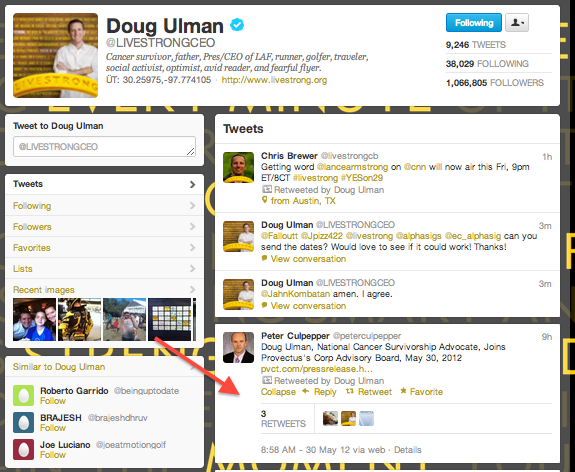
You can follow Doug's tweets here. As you can see from the screenshot below, he has more than a million followers on Twitter.
His addition dramatically raises Provectus' awareness among several groups of people, including (i) cancer patients and survivors, and their families, (ii) the cancer research community (Doug served a four-year term as the Chairman of the National Cancer Institute Director's Consumer Liaison Group), (iii) the national media, and (iv) charitable and philanthropic organizations.
LIVESTRONG and Doug's use of social media and other Internet-based tools to foster communities of cancer sufferers and their families and serve as a model for other non-profit organizations is well known. See here.
Speaking of brand, Provectus now is associated with Lance Armstrong's global brand, and vice versa.
While its $50.4 million in annual revenue is less than what the 97-year-old American Cancer Society raises in a month, Livestrong has been a catalyst for better cancer care and education across the globe. "It's a force to be reckoned with," says Leslie Lenkowsky, a professor at Indiana University's Center on Philanthropy. Livestrong's help line, guidebooks, and website helped more than 400,000 people last year. Its social-media efforts reach about 3 million supporters. It has pioneered programs here and abroad for survivors; worked to unify the fractured cancer community; and instigated a worldwide crusade, which includes the United Nations and the Clinton Global Initiative, to make the world's No. 1 killer a health-care priority. "I can't think of an organization with the breadth of activity that the foundation has," says Dr. Larry Shulman, chief medical officer at the renowned Dana-Farber Cancer Institute in Boston, "and that includes the American Cancer Society." (source of October 2010 quote here).
LIVESTRONG's board members appear to be as or more prominent, influential and connected as well.
I had the good fortune many years ago to hear a keynote speech by Hamilton Jordan. It takes reminding, by oneself and others around you: There is no such thing as a bad day.
Management has been working on gaining this key opinion leader relationship for more than a year. Note Doug's tweet last April:
Let's put ourselves in Doug's shoes for a moment as he diligenced the company in order to determine whether he would or should accept Provectus' invitation to join the corporate advisory board. If you were him, what questions might you pose to management and its references? Perhaps these:
How well does PV-10 work? How safe is it?
What do physicians and the medical community think about PV-10?
What does the FDA think about PV-10?
Where is the drug in the regulatory approval process?
How soon could PV-10 be available to patients?
How did PV-10 come about? Is it unique? If so, why?
How does PV-10 compare to other kinds and types of treatment?
Who are the founders and management team? What is their background, history, and success and failures?
Who are the members of the board of directors and advisory board?
I have no doubt he conducted a tremendous amount of due diligence. I have to believe Doug needed to be completely convinced his association with Provectus, and by default his associating LIVESTRONG's brand and reputation with the company, was in the best interests of LIVESTRONG and himself.
Doug Ulman joining Provectus' advisory board speaks (shouts) volumes about PV-10, the company and management. I think it speaks to the veracity of management as well.
You may recall I constructed and posted a similar illustration to the one below in order to elucidate the potential and possible triggers or catalysts for the company (and its share price) along the way to the end-game. I added a few more triggers/catalysts to the original illustration/post.
Click on the picture to enlarge it on your screen.
In the U.S., it is Memorial Day weekend, where citizens remember the men and women who died while serving in the United States Armed Forces. With no trading on U.S. stock exchanges Monday, this week there remain 3 trading days in May before the first trading day of the last month of the second calendar quarter.
My expectations for the remainder of the second quarter? I'm keeping an eye out for:
The SPA for the pivotal MM Phase 3 trial;
More Moffitt immunology-related work results;
Final MM Phase 2 trial results; and
Addition(s) to the corporate advisory board.
While I don't rule out a dermatology deal, or the process of arriving at such, being announced, I think more time might be required for this item to play itself out.
Should the SPA or two or more of the other items arrive in June, it is possible the share price may hurdle the threshold for a NASDAQ listing.
I've received several e-mails and blog comments regarding the announcement yesterday of Jan Koe's addition to Provectus' board of directors.
"Mr. Koe, age 61, has a 30-year track record of success in consulting, asset management, real estate and public company governance, and has represented major insurance firms, national retailers and Fortune 500 companies. He is President of GoStar, which is the manager of Real Solutions Opportunity Fund 2005-I and Real Solutions Fund Management LLC and Real Solutions Investment LLC. He is also Principal of Method K Partners, Inc., a commercial real estate firm, which he founded in 1988. He has served on the Board of Directors of ONE Bio, Corp. where he was Chair of the Compensation Committee and a member of the Financial Audit Committee. He holds a degree in Business Administration and Psychology from Luther College."
Mr. Koe's professional history (based on a more comprehensive search of the Web) paints the picture of an entrepreneurial individual who has a good amount of experience and enjoyed success as a principal of and investor in a number of businesses spanning several industry sectors. I think his corporate governance experience is a strength.
The key takeaway is that Koe's addition, which enabled the formation an independent board, is a strategically-motivated tactical move. Simply put, it facilitates the listing of the stock on the NASDAQ in advance of a potential myriad of expected regulatory, business and clinical news that will have greater impact on the share price if the stock is listed on a major exchange rather than over-the-counter.
At a closing price today of $0.865, the stock is well below the $2 per share threshold. One key piece of news (e.g., the SPA, a dermatology term sheet, etc.) should do the trick, thrusting the share price across this threshold.
Just some speculation on my part...
Board member Dr. Kelly McMasters has much more medical and clinical trial experience. Board member Al Smith IV has much more name recognition. The company could have added a much higher profile name than Jan Koe (and, for that matter, Al Smith) in due course. These are not rash actions, but deliberate and deliberated decisions.
Why form an independent board, now?
As I wrote a few days ago, the pipeline of catalysts is backing up, and the clock is ticking on when these catalysts will catalyze the share price: the MM Phase 3 SPA, a dermatology term sheet, more Moffitt immunology data, the Munich MM Phase 2 data, accelerated approval for MM, an addition to the corporate advisory board, and an HCC Phase 2/3 trial suitable for an SPA.
Maybe something or some things (i.e., catalysts) are inbound.