Showing posts with label Pancreas. Show all posts

June 7, 2013

$PVCT: Craig Redux

Craig presented in town to about 40 biotech and life sciences industry folks, together with a handful of investment management people, this week. I learned several interesting things, such as...

Craig's murine work on bladder cancer appears to have successfully demonstrated what he had intended with treated and untreated lesions.

He also indicated success with the bystander for pancreatic cancer in, I presume, murine models.

The number of Big Pharma in due diligence with Provectus has increased to at least 4 companies.

May 17, 2013

$PVCT CEO Letter: PV-10 may cure multiple cancer indications


One of the letter's most key sentences is found in the opening paragraph: "The progress we have made on all fronts confirms our underlying belief in the value of our products and their potential to create a new paradigm for cancer treatment as well as value for our shareholders." Of this sentence, the key phrase is: "a new paradigm for cancer treatment." Craig has innovated a very unique small molecule oncology compound that appears very capable of successfully treating many different cancers. Third party Moffitt has covered multiple indications (e.g., melanoma, breast, lung).

May 14, 2013

$PVCT CEO Letter: Final MM P2 PV-10 data presented, Systemic immune response shown in multiple cancers


The takeaways appear to be:
  • Final MM Phase 2 data finally was reported in 2012,
  • Murine study data, via Moffitt, showed PV-10's systemic, anti-tumor immune response,
  • This systemic immune response was shown in multiple cancers (i.e., melanoma, lung, breast),
  • Combination therapy complementariness of PV-10 and "ipi," and
  • Potentially year-end completion for the expanded HCC Phase 1 trial.
A question: Will Dr. Rosemurgy be the PI for a pancreas P1 trial?

November 17, 2012

$PVCT.OB: PV-10 -- A Vaccine, or Vaccine-like

Click on the figure to enlarge it.
The abstract and poster from Craig et al.'s participation at the Society for Immunotherapy of Cancer (SITC) 27th Annual Meeting has begun the elaboration of the anti-tumor immune response to PV-10 immuno-chemoablation. This publicly builds upon Moffitt's description of PV-10's immunologic mechanism of action, presented at the 2012 Society of Surgical Oncology Annual Meeting, that confirmed PV-10 chemoablation of melanoma lesions leads to a systemic response and the induction of systemic anti-tumor immunity.

In the SITC abstract (above) Craig et al. hypothesized production of a vaccine- like immune response using a small molecule drug was possible and required:
  • An intralesional route of injection that generates rapid, durable tumor destruction via autolysis;
  • Rapid clearance of drug from normal tissue; and
  • Anti-tumor effects targeted only to tumor tissue.
According to Provectus, PV-10 appeared to meet each of these requirements.

"Treating cancer has historically relied on a trifecta of treatments—surgery, chemotherapy, and radiation—known colloquially as “slash, poison, and burn.” Vaccines have a potential advantage over these three options in that the body’s response is longer lasting (on a scale of years as opposed to weeks or months), which could possibly eradicate the micro-metastases that often linger after standard treatments end. Moreover, cancer vaccines have similar minor side effects to traditional vaccines: inflammation at the injection site and flu-like symptoms." Read more here.

"Cancer vaccines are designed to boost the body’s natural ability to protect itself, through the immune system, from dangers posed by damaged or abnormal cells such as cancer cells. The FDA has approved two types of vaccines to prevent cancer (Gardasil® and Cervarix®): vaccines against the hepatitis B virus, which can cause liver cancer, and vaccines against human papillomavirus types 16 and 18, which are responsible for about 70 percent of cervical cancer cases. The FDA has approved one cancer treatment vaccine for certain men with metastatic prostate cancer (Provenge®)." Read more here.
Click on the figure to enlarge it.
The great anticipation of Moffitt's next presentation(s), purportedly at the AACR Annual Meeting 2013 that will be held April 6-10 in Washington, DC (according to sources external to Provectus), derives from the release of more results and conclusory statements regarding the production of a vaccine-like immune response from PV-10 immuno-chemoablation, and both the preventative and therapeutic vaccine or vaccine-like benefit of the drug.


November 1, 2012

$PVCT.OB: Blog Reader Questions

Would a repeat of the study with HCC and melanoma cell lines make sense using pancreatic and breast cancer cell lines? If so, would that be significant to Big Pharma when these 4 studies are viewed collectively?
I think there are some technical challenges, especially with breast cancer. Cancers have to be Major Histocompatibility Complex-matched to the host. Cancer, including mouse cancer, should immediately be killed by the immune system. That is why organ transplants have to be matched as closely as possible. Anti-tumor immunity does not reason. It kills what is not identical to the host.

I do not know of mouse breast cancers lines that would match an immuno-competent host. I think Provectus already has successfully treated naturally occurring breast cancers in mice, and killed human breast cancers produced in mice deficient of anti-tumor immunity (nude mice). I recall Craig showing these pictures in past presentations. I think naturally occurring breast cancer has been treated in dogs. Breast and prostate cancer markets are very hard to penetrate except in very late stage disease, which makes success expensive for Provectus to pursue and achieve in small markets at this tine. Target markets like liver cancer are more accessible.

I think management some pancreatic cancer data in mouse models, ablating pancreatic cancer tumors and again observing the bystander effect. Running more mechanism variants in animal models probably would not add value. One real problem with pancreatic cancer is diagnostic, as it often is very widespread when detected. The immune system can be overwhelmed. For now, it is an open question, and one only answered by trials, as to the value for the company for this disease. A combinational therapy approach probably would have the highest chance of success.

As I previously wrote, I think other types of cancer tumors also have been studied by Moffitt. Mechanism of action is not required for FDA licensure, only safety and efficacy. To secure permission to run trials in humans, Provectus has to demonstrate to regulatory authorities that PV-10 appears safe and has potential benefit, not how it works. The company has run most of its studies with that goal in mind. Other goals have included hoping to improve efficacy or expanding into new indication markets.

As for adding value to Big Pharma, the greatest additional value would be demonstrating safety and efficacy in humans. The vast majority of the melanoma market is not very late stage disease. In the melanoma studies, the majority of the market is lies between early stage 4 and earlier, which is where the MM Phase 3 trial was designed to target. A small percentage of the market is very late stage disease.

Part of Provectus' recent presentation at the SITC 27th Annual Meeting clearly was directed at expanding into the very late stage disease market area by using a combined therapy treatment protocol. I think management believes it is the right thing to do for ethical reasons even though it could gain little in market size.

Work with models should be expanded to and published data should be available for other chemo- and immunotherapy agents (e.g., anti-CTLA 4). The goal would be to demonstrate safety and efficacy in these models with the subsequent goal of asking regulatory authorities for permission to test the combined protocols in humans.

A similar path has been followed in expanding the liver studies in people for late stage disease or disease with heavy tumor burden that might be overwhelming the human immune system. Provectus should have data on the combined therapy (PV-10 + sorafenib) in mice and permission to test the combined therapy in humans, which I think would start as soon as the trial site is able to begin the study.

September 29, 2012

$PVCT.OB: Didn't See That Coming

I have been blogging a lot this month. There has been a lot about which to write. Month-over-month blog readership is up 30-60% across all major metrics (e.g., visits +46%, unique visitors +31%, pageviews +57%, average visit duration +41%, etc.). There will be as much or more to write about next month.

I think this there is an outcome much of the market currently does not see coming. I wrote yesterday about the market confusion regarding the PVCTP "IPO" and the current depression of the share price. At this point in time the market is about expectations. And those expectations, unfortunately, are not high going into ESMO 2012 and October.

We await regulatory clarity of the path to approval of PV-10 for metastatic melanoma (i.e., the SPA PR). We know the company requires money to conduct pivotal, key and other trial work (e.g., MM Phase 3, expanded liver Phase 1, liver Phase 2/3, pancreas Phase 1, psoriasis Phase 3, etc.). $15-30MM certainly substantially or fully covers this work. The market is unsure of the timing of the SPA PR. It also thinks the company will incur substantial dilution to achieve this fund raising.

What happens to market expectations of the company and common stock share price if the SPA PR is followed by a license deal announcement, whether dermatology or geographic-specific oncology, that provides most or all of the money above? This outcome causes a complete and utter upside surprise to the market, given what it thinks right now. The share price should blow upward because Provectus not only would have exceeded expectations but destroyed them through a non-dilutive "financing" event.

Below is my current take of the horse race of financing and "financing" options to secure monies for more trial work. I hope to update this more frequently as facts change and events transpire.


September 23, 2012

$PVCT Preferred Stock Offering ($PVCTP): An "IPO" In The Making?

Several thoughts about the PVCTP preferred stock offering vehicle have been bouncing around inside my head since it was first revealed through an SEC filing on September 4th. What was management's strategy for its utilization? Initial reactions by many were less than positive: fund raising, now?, more dilution?, how?, why?, when?, etc.

Provectus had established structural access to capital via the Lincoln Park equity line of credit and mixed securities shelf filing. Interest to invest by institutional and fund investors remained very strong. Fund raising at September prices would be painful of course, but there was no immediate need for capital.

Furthermore, management first spoke of a strategic investment strategy in its early-August 10Q filing, where strategic referred to Big Pharma companies.

The common stock could be used to facilitate a minority investment by Pfizer or J&J or another Big Pharma company, but the premium afforded PVCT.OB most likely would be limited on an absolute basis. Acquisitions tend to be viewed differently than investments by corporations. A 30%, 40% or 50% premium could work (typical of recent investment deals, suggesting a deal price of $0.90 to in excess of a $1.00 per share), but could a 1,000% premium be achieved (i.e., a $7 or thereabouts share price)? With time and news, the common stock could climb to the minimum $2 share price over 5 consecutive days and list on the NASDAQ as PVCT. But at current price levels, any fund raising would be more superficial than substantive (i.e., a "token" investment of several millions of dollars) rather than a signaling investment of of $20MM to do the pivotal MM Phase 3 trial. How long would the company have to wait for the common stock share price to rise to do a subsequent fund raising (assuming the initial one was a "superficial" one with Big Pharma) to sufficiently capitalize the trial?

I suppose a non-listed convertible preferred stock could be created out of the mixed security shelf specifically for a Big Pharma company. The preferred stock might garner a higher or much higher as converted common stock premium. The common stock might respond well as a result, with a Big Pharma company like Pfizer entering the capitalization table. But would that be enough to jolt Provectus' valuation?  With time and news, the common stock could climb to the minimum $2 share price over 5 consecutive days and list on the NASDAQ as PVCT. Similar follow-up comments apply here, too.

If the company was not going to dilute its capitalization unnecessarily, how was PVCTP going to work and why?

Provectus never enjoyed a true or real IPO. In order to carry-out post-September 11th fund raising, the formerly privately held company did a reverse merger into a public shell. As a result, one of the biggest hurdles Provectus historically has faced and continues to face is being an over-the-counter stock.

So what does PVCTP really achieve? A lot, I think, and at different levels, too, from:
  • The more awareness and credibility that comes from a NASDAQ listing (relative to an over-the-counter listing), to
  • The monies to signal the intention to move forward with the pivotal MM Phase 3 and other key and pivotal trials (e.g., HCC expanded Phase 1, HCC Phase 2/3, pivotal psoriasis Phase 3), to
  • The significance of a lead corporate investor, who clearly could be an acquirer of Provectus, to
  • The addition of life sciences and other name investors as shareholders, to
  • A robust valuation [for PVCTP] out-of-the-gate, to
  • Reasonable but nowhere excessive PVCTP deal parameters (e.g., per share price, conversion ratio or price, warrant coverage), to
  • Facilitating greater mainstream media coverage by virtue of a NASDAQ-listed security together with a Phase 3 trial commenced, to
  • Eventually pulling PVCT.OB onto the NASDAQ and turbo-charging its trajectory thereafter.
Whew! That is a mouthful! In many ways, PVCTP, should the company utilize the preferred stock offering vehicle, is an IPO (forgiving the usage of the phrase given that PVCT.OB already publicly trades).

How does this happen? Here are my thoughts:
  • Lead investor: Pfizer, at a minimim.
    • There could be a co-lead.
    • For the round to be successful (to management and existing shareholders) a strategic investor like Pfizer, J&J or another Big Pharma company, who are much less sensitive to valuation and deal parameters (that also impact valuation) than financial investors, is required.
  • Other investors: 299 or more other lot holders
    • 300 lot holders are required for PVCTP to list on the NASDAQ. That number very likely will include new life sciences, name and other investors as well as existing shareholders.
  • Offering amount (of PVCTP): ~$30MM
    • $15MM is the minimum amount to list on the NASDAQ.
    • An amount closer to $20MM at a minimum fully funds the pivotal MM Phase 3 trial. A higher number like $30MM provides more flexibility to fund other trials, like the HCC expanded Phase 1, the HCC Phase 2/3 trial, the Phase 1 pancreatic cancer trial and the pivotal psoriasis Phase 3 trial, and other pre-clinical and clinical work, etc.
    • I doubt the figures rises much beyond $30MM.
    • Demand for the offering also will play a role in the amount. If the offering is robustly oversubscribed, management may agree to a higher amount; however, oversubscription also plays a role in the determination of the valuation/per share price, conversion ratio and warrant coverage.
  • Valuation: $1B pre-money
    • A WAG, using actual and rumored historical datapoints. Maybe higher, or maybe lower.
  • Per share price (PVCTP): $1B pre-money
    • I think at least $5-6. $4 is the minimum price to list on the NASDAQ. Price obviously is influenced by supply (the amount of money management wants to raise for both operations, cosmetic and valuation reasons) and demand (over or undersubscription).
  • Conversion ratio: ?
    • I do not have a good handle on this yet, and therefore cannot really speculate.
    • 1-to-1 would be nice; that is, each share of preferred stock would convert into one share or common stock. Maybe higher (i.e., each preferred share converts into more than one common share, which is less favorable to existing shareholders), but unlikely to be lower (i.e., more favorable to existing shareholders).
  • Warrant coverage: ?
    • 40-50% is a datapoint I have been told. That is not bad, but the final figure may be higher (less favorable) or lower (more favorable).
  • Rights & Provisions: Customary
    • Per the offering prospectus supplement. There may be certain revisions or refinements if the vehicle is used.
Potential dilution: ~6%. Ultimately a single digit figure, so the final figure maybe higher or lower than the above number. Dilution would be based on or influenced by (i) the fully diluted number of existing shares, options and warrants (assumed for purposes of potential dilution calculation as 150MM), (ii) the number of shares (6MM) in the PVCTP offering, as well as warrant coverage (50%), (iii) the price ($5) and size ($30MM) of the offering, (iv) the offering's conversion ratio (1-to-1), and (v) whether the valuation is pre- ($1B pre-) or post-money (at this valuation level and given the offering amount, there is not much difference). Changes to my placeholder assumptions changes dilution. Much more information about the offering is likely going to be available mid-week.

An "IPO" is made more effective (better terms for the company, better on-the-day and post-"IPO" share appreciation and buying) the more demand there is for PVCTP. Demand comes from pre- and post-"IPO," PVCTP share price-moving news. If the vehicle is used, the "IPO" could occur during or around the week of October 8th (U.S. equity markets are not closed on Columbus Day), perhaps earlier like the end of the week of October 1st or later like the week of October 15th. Early- to mid-October makes sense because of the news going into and throughout the fourth and last quarter of this calendar year:
  • We await the SPA PR in Q3,
  • ESMO occurs as September becomes October, and PRs should reflect what is revealed by the company at this conference,
  • Craig speaks in early- and late-October about immunology and MOA,
  • More Moffitt data will be revealed and released,
  • Potentials in dermatology and/or mini-oncology should be consummated in Q4,
  • High profile peer review publications are expected, and
  • High profile mainstream media coverage is expected.
Management still may not utilize the PVCTP preferred stock offering vehicle. If they do use it, I think it will be in the manner I described above (or a derivation thereof) and will look forward to watching all of them ring the NASDAQ bell.

August 29, 2012

Blog Reader Question

Could we have both a SPA and AA? AA for US market and some kind of SPA to get approval in Europe, Australia and ROW? What do think the markets reaction would be with an AA in September?
I think an investor or shareholder's near-term focus should be on the SPA for metastatic melanoma. I do not believe AA is likely in the near-term (i.e., in September). I think Big Pharma thinks AA is a possible [but not probable] outcome and very worthy of an attempt to obtain it.

There is a lot on which to focus in the months of September and October in hopes of hearing or reading about material updates and progress, including (in no particular order):
  • The non-core spin-offs,
  • A dermatology deal and/or publication,
  • The melanoma regulatory path, license deal and/or publications,
  • Moffitt immunology results of additional mouse and initial human studies,
  • The liver/HCC regulatory path, license deal and/or publication, and
  • The pancreas regulatory path.
For now, we wait...

May 28, 2012

April 26, 2012

CEO Letter Thoughts

PV-10
Metastatic Melanoma


During 2011 we held our second and third meetings with the FDA to discuss the design of a pivotal Phase 3 randomized controlled trial ("RCT") suitable for Special Protocol Assessment ("SPA"). In December the FDA provided us further guidance regarding the submission of our Phase 3 protocol for review, notifying us that they did not require an additional end-of-Phase 2 meeting. Using the recommendations that we received from senior FDA officials regarding patient population and primary endpoint, we are requesting SPA review of our protocol. While the review process could occur in as little as 45 days from the date of submission, we expect it will be an iterative process, and thus, more time may be required to work with the FDA on a study design agreement. This, we believe, represents a major step for our company, probably the most significant achievement yet, in our pathway to approval for PV-10.


⬆ I will address this in a separate post.


As you may recall, too, the Australian Therapeutic Goods Administration ("TGA") has agreed in November 2010 to the same primary endpoint of progression free survival that has been proposed to the FDA. In our meetings with TGA we discussed the use of interim data from the first half of Phase 3 study subjects, in conjunction with safety data collected in earlier studies of PV-10 for melanoma, to allow early evaluation for marketing approval in Australia for metastatic melanoma. TGA agreed that these data should be sufficient for this review if the analysis confirmed efficacy.

⬆ This appears to be just a recap.


In addition, nonclinical studies, designed to characterize the immunologic response to PV-10 chemoablation, have been conducted by researchers at the Moffitt Cancer Center in Tampa, Florida, with initial results reported in March 2012 at the Society of Surgical Oncology Annual Meeting. Paul Toomey, M.D., presented his work and that of his colleagues, confirming that PV-10 chemoablation of melanoma lesions leads to induction of systemic, tumor-specific anti-tumor immunity. Additional nonclinical studies are underway with confirmatory clinical studies planned. This work is fundamental for full characterization of PV-10's systemic benefit and may provide pivotal support for accelerated approval in the U.S.

⬆ I previously posted that the full scope of Moffitt's work -- completed, in-process and in the near future -- makes accelerated approval a real possibility.


Liver Metastasis


In April 2011 we received orphan drug designation from the FDA for Rose Bengal, the active ingredient in PV-10, for the treatment of hepatocellular carcinoma ("HCC"), the most common form of primary liver cancer. This designation entitles Provectus to exclusive marketing rights for PV-10 for HCC in the U.S. for up to seven years if we are the first company to receive marketing approval for this therapeutic drug product. We are also eligible to apply for a waiver from the FDA of certain user fees required by the Prescription Drug User Fee Act ("PDUFA"). In other words, once regulatory approval is received, orphan drug designation provides assurance for the value of our company's proprietary property, grants us market exclusivity, thereby affording us both financial and regulatory benefits. This orphan drug designation for HCC is in addition to that received for metastatic melanoma in December 2006.

⬆ This appears to simply highlight what management has been doing to move PV-10 for HCC along.


We are conducting nonclinical drug-drug interaction studies to verify safety of combining PV-10 with sorafenib, the standard of care for nonresectable locally advanced primary liver cancer. This supports advanced development of PV-10 for HCC in clinical studies comparing PV-10 with the standard of care versus the standard of care alone, to demonstrate an overall survival benefit of treating HCC with PV-10. We expect to provide further guidance on this important indication when we are closer to commencing a Phase 2 or Phase 2/3 clinical study.

⬆ I find it interesting to read that non-clinical drug-drug interaction studies to verify safety of combining PV-10 with sorafenib are ongoing (i.e., confirming the orthogonality of PV-10 and sorafenib). I do not have an expectation of the potential timing of a Phase 2 or Phase 2/3 trial yet.


Breast Cancer and Other Oncology Indications


One of our many objectives during 2011 was to demonstrate that PV-10 has multi-indication potential, and we intend to continue that quest in 2012. We are now in a position for a Phase 2 study in recurrent breast carcinoma, following the completion of our Phase 1 study several years ago. We look forward to being able to report further progress on this indication as well. Furthermore, we have shown success with PV-10 in treating pancreatic cancer in nonclinical studies and are considering a proof of concept clinical study in this equally important indication.

⬆ I take two things away from this. First, the company can start a Phase 2 trial, and second, they appear to me to be assessing whether to start such a trial. I also find it interesting to read about the success in treating pancreatic cancer in non-clinical studies. If you recall, Craig mentioned this in talks late last year.

Compassionate Use Program


I am also pleased to report that our Compassionate Use Program for PV-10 for patients with non-visceral cancers continues, with over 70 patients enrolled in six centers across the U.S. and Australia. The protocol for this program enables subjects to undergo more frequent and extensive treatments with PV-10 over a longer period of time than was allowed under the protocols used for the Phase 1 and 2 trials. We believe this dose regimen serves as a blueprint for our planned Phase 3 clinical trial for metastatic melanoma.

⬆ I previously posted that 
the utility of Provectus' compassionate use program, outside of the great benefit it has had and continues to have for patients accepted into it, is not fully appreciated.

PH-10
Psoriasis


Our largest clinical trial to date was completed in 2011. The data from this Phase 2C RCT, which enrolled ninety-nine subjects with mild-to-moderate plaque psoriasis, corroborated the potential effectiveness of PH-10 observed in these patients in our earlier clinical study.

⬆ 
This appears to be just a recap.


Reaching this milestone has also triggered increased efforts for our company to seek a licensure of PH-10 for the treatment of serious dermatological diseases, which would include psoriasis and atopic dermatitis, another indication for which PH-10 has completed Phase 2 clinical trials. We remain on track to secure a term sheet from a potential partner that would lead to a proposed licensing agreement and the engagement of a financial advisor to effect this transaction.

⬆ This also appears to be just a recap.


We have also successfully completed various dermatological toxicity studies which are appropriate at this stage of development of PH-10. We will work with the FDA to design the remaining toxicity studies necessary to support a New Drug Approval (NDA) filing. Because of the well-tolerated safety profile of Rose Bengal, we are enthusiastic about the potential for widespread acceptance of PH-10 upon eventual expected approval.

⬆ Again, another recap. I think management also is sharing their perspective about the licensing process and prospective partner feedback on PH-10.


PRESENTATIONS AT SCIENTIFIC CONFERENCES


PV-10 was the subject of several scientific presentations this year. Of particular note, Dr. Sanjiv Agarwala, Principal Investigator for the Phase 2 melanoma study, presented data at the European Association of Dermato-Oncology ("EADO") Conference in Nantes, France, in June 2011. This audience of prospective European investigators who specialize in dermato-oncology had a special interest in injectable therapies, and we were encouraged by the level of interest this group had in PV-10, particularly as we prepare for a global Phase 3 trial.

⬆ This appears to be just a recap.


In November 2011, Professor Merrick Ross, M.D., a Principal Investigator for our Phase 2 Melanoma trial, delivered a presentation at the 2011 International Melanoma Congress during the 5th Meeting of Interdisciplinary Melanoma/Skin Cancer Centres meeting in Tampa, Florida. His presentation included a discussion on the role of intralesional therapies for controlling both local disease and their possible effect on systemic disease, such as that which has been shown in Phase 2 testing of PV-10.

⬆ At the HemOnc Today conference in NYC earlier this month, Dr. Ross publicly said PV-10 should be approved. I have much more blog post material on PV-10 and the HemOnc Today conference.


We expect additional presentations at scientific conferences this year that will be announced when appropriate, as well as various peer-reviewed publications either this year or next.

⬆ Management is trying to push for the publication of the MM Phase 2 and/or HCC Phase 1 trial results in globally recognized peer-reviewed periodicals in 2012. Only time will tell if they are successful.

CORPORATE DEVELOPMENTS


Prominent leaders joined our Board of Directors and Corporate Advisory Board this year. Alfred E. Smith IV, Senior Advisor for the Marwood Group, joined our Board of Directors. Mr. Smith has extensive financial and healthcare experience. His knowledge of business and medicine has already helped provide our company with guidance on several drug development and corporate strategies.

⬆ This appears to be just a recap.

Dr. Craig Eagle, MD, Vice President of Strategic Alliances and Partnerships for the Oncology unit at Pfizer, and Stuart Fuchs, Chairman and CEO of CognoSPECTi, joined our Corporate Advisory Board. Dr. Eagle's experience in drug development, and Mr. Fuchs's venture capital and investment banking experience in the biotech industry, are great assets to our company as we further our path towards commercialization. Mr. Fuchs joined the Corporate Advisory Board after having served eight years on our Board of Directors. We expect to appoint others to our respective Boards this year and next.

⬆ Comments related to Eagle and Fuchs also appear to be just a recap. I think the comment related to the potential future appointments to the Corporate Advisory Board and the Board of Directors is very interesting to read.

Our balance sheet remains strong, with $7.7 million in cash and cash equivalents, providing us ample cash to fund our operations through 2013. Since we seek to spin-off our non-core subsidiaries, and concentrate our efforts on our drug development activities, in December 2011 we completed an unregistered offering of Units. Each Unit, which included shares of common stock in Pure-ific and a warrant to purchase ¾ share of the Company's common stock, were sold to accredited investors. The net proceeds of this transaction are expected to be used to spin-off Pure-ific as a new publicly traded company. We plan to fund and spin-off the remaining four non-core subsidiaries as well.

⬆ This also appears to be just a recap.

Also, we are in the process of implementing a new executive bonus plan that is expected to be based upon certain additional performance-based criteria, such as stock price and the signing of partnership agreements. This plan will replace the prior one which had been based on the attainment of certain scientific, medical and clinical milestones. We will disclose the details of the new plan once it is finalized.

⬆ I think the comments related to a new bonus compensation plan are interesting to read. I plan to follow-up with more due diligence, analysis and commentary on this topic.

April 3, 2012

Reproducibility

I think of reproducibility as Moffitt Cancer Center & Research Institute attempting to reproduce the features underlying the clinical value proposition of the principal investigators attempting to reproduce the features underlying the clinical value proposition Craig et al. produced.


Did Moffitt reproduce "much better efficacy" in demonstrating the bystander effect that the principal investigators reproduced in human trials that Craig et al. produced in murine trials and animal tumors?


Did Moffitt reproduce "much higher degree of tumor reduction" in demonstrating the bystander effect that the principal investigators reproduced in human trials that Craig et al. produced in murine trials and animal tumors?

Did Moffitt reproduce "both local and systemic effects on diseased tissue" in demonstrating the bystander effect that the principal investigators produced in human trials that Craig et al. produced in murine trials and animal tumors?

Yes, they did.


Were the above -- "much better efficacy," "much higher degree of tumor reduction" and "both local and systemic effects on diseased tissue" -- reproduced across different kinds of indications by Moffitt in demonstrating the bystander effect that different principal investigators reproduced in human trials that Craig et al. produced in murine trials and animal tumors?


We'll have to wait and see...

Repeatability

I want to approach repeatability and reproducibility in a simple, but not simplified, manner.

Let's revisit PV-10's clinical value proposition:


I think of repeatability as Craig et al., the principal investigators and Moffitt Cancer Center & Research Institute attempting to repeat the features underlying the clinical value proposition.


Do we see a repetition of "much better efficacy" in murine trials? In animal tumors? In human trials? In demonstrating the bystander effect? For example, have you examined the comparable disease stage patients from the Phase 1 and 2 metastatic melanoma trials? In particular, the trial population contemplated for the pivotal MM Phase 3 trial? What does efficacy look like?

Do we see a repetition of "much higher degree of tumor reduction" in murine trials? In animal tumors? In human trials? In demonstrating the bystander effect? What if you were to graph the degree of tumor reduction, would the plot look completely and randomly scattered, or would there be a concentration (a pattern, if you will)? How would that pattern look in murine trials? In animal tumors?

Do we see a repetition of "both local and systemic effects on diseased tissue"in murine trials? In animal tumors? In human trials? In demonstrating the bystander effect?

Do the above -- "much better efficacy," "much higher degree of tumor reduction" and "both local and systemic effects on diseased tissue" -- repeat across different kinds of indications? Do we see the same thing? Do we see "much better efficacy," "much higher degree of tumor reduction" and "both local and systemic effects on diseased tissue" in patients sickened by metastatic melanoma? By hepatocellular carcinoma?

Yes, we do.

March 30, 2012

Very Quick Hits for March 30

ex·cit·ed. Coming out of SSO, there is a palpable sense of excitement in management.

clar·i·ty. Following a call with management earlier today, I think I have never been more clear in my projection for or estimation of the company's trajectory.

CEO letter. I think the letter will come out next week.

Much more later (shortly).

March 14, 2012

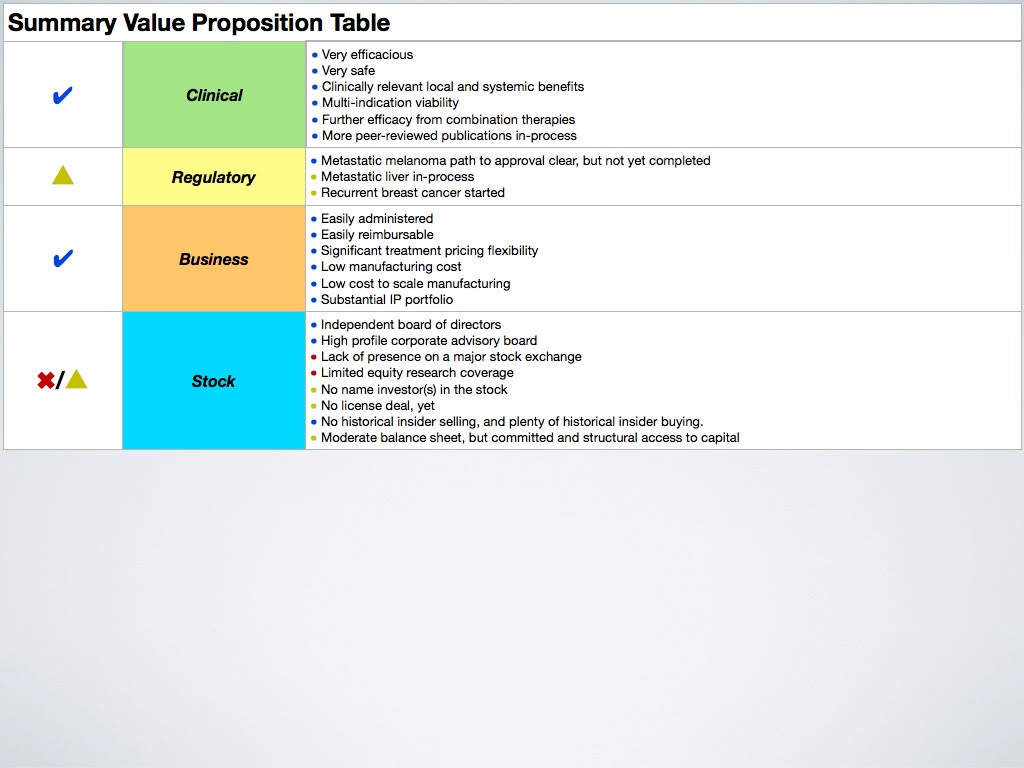
Summary Value Proposition

As you will have seen from the various value propositions I posted, PH-10 and dermatology are not addressed. With the annual meeting of the American Academy of Dermatology starting Friday in San Diego, and with the likely release of the top-line psoriasis Phase 2c trial results this week or next, the dermatology side of the business is quite relevant and germane. There are considerable clinical, regulatory and business commonalities between the dermatology and oncology applications of Rose Bengal. To focus my thinking, I only used oncology; however, dermatology certainly is an important and valuable value driver and contributor to my investment thesis.

Click on the table below to see a much larger version on your screen. Updated February 2013.


March 12, 2012

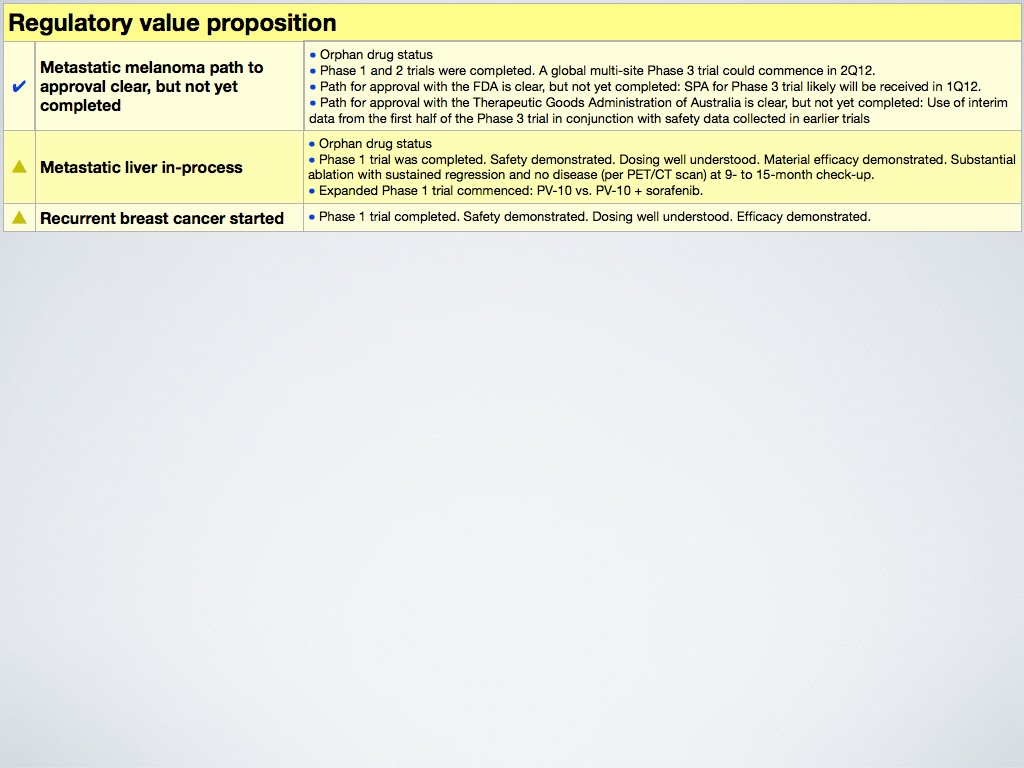
Regulatory Value Proposition

Click on the table below to see a much larger version on your screen. Updated February 2013.


March 4, 2012

Time line? (update)

I previously blogged clinical- and regulatory-oriented time lines. At the request of a reader, I also included conference and transaction-oriented items to this time line table.


March should be a busy month for PRs/news and information. I think the timing of a potential pancreas Phase 1 trial would be pushed out (I don't know how much so), as management completes preparation (e.g., undertake several studies to rule out PV-10 interactions with the sorafenib/Nexavar comparator) for a HCC (liver) Phase2/Phase 3 trial.


Click on the table below to see a much larger version on your screen.


Pushing out the pancreas trial is the only change to this version of the time line. I added (a) a "germination period" in Q2 for a potential derm transaction (i.e., the sale/license of the dermatology side of the business) and (b) the CEO letter, which could come out in late-March, after the 10-K is filed around mid-March.

February 17, 2012

Time line? (update)

I previously blogged clinical- and regulatory-oriented time lines. I have revised my expectation regarding the release of the top-line psoriasis Phase 2c trial data. Click on the table below to see a much larger version on your screen.


February 6, 2012

OneMedRadio Interview

OneMedPlace's OneMedRadio's Dr. Malini Chatterjee recently interviewed Craig Dees. You can hear the interview here. It's nearly 40 minutes, and certainly is worth a listen. Management said they did not pay OMP for this research coverage.

Here's what struck me about the interview:
  • I chuckled when I heard the interviewer's comments on the previous guidance from the company on the SPA process. I think the company unofficially secured the SPA (my post on this topic is here). I must not be the only one. The interviewer's phrases were telling, paraphrasing: "Provectus received the blessing of the FDA for the final design" and "the FDA came to a consensus with Provectus on the design."
  • The interviewer spoke several times on Rose Bengal's prior approval by and large safety dossier already on file with the FDA. Caig said management specifically chose Rose Bengal because of this long and well documented safety history, but that it was not the only halogenated xanthene in their portfolio.
  • Craig's comments about their prior knowledge of the cold-loading dose, which enabled Provectus to be more effective in their approach to PV-10 dosing.
  • He said he hoped the [monitoring] committee would stop the Phase 3 trial early on the basis of statistically superior numbers of the PV-10 arm compared to the comparator arm (of either DTIC or TMZ) and Rose Bengal's large safety dossier. -- [It make sense that management will very likely include an interim data read-out as part of the final protocol. Interim data generated from such a read-out presumably would be the basis for seeking early approval in Australia and terminating the Phase 3 trial in the U.S. for purposes of an early NDA filing.]
  • The interviewer commented on the likelihood that the Phase 3 trial would be an open label one. Craig noted that PV-10's distinct color and intra-tumoral injection makes it very difficult to blind the study to either the treating physician or the patient. He also drove home the point that it is difficult to compare PV-10 either with historical standard of care drugs (like DTIC and TMZ) or recent approvals (like Yervoy and Zelboraf) on the basis of safety, efficacy, method of delivery, patient population, cost, among other things. -- [The former are provided intravenously or ingested and measure benefit in a very small number of months, while the latter are for very late stage patients (and is very expensive) or a genetic subset of the population (and patients relapse with the disease coming back with greater ferocity).]
Some other comments of Craig:
  • A reminder Provectus is designing a Phase 1 pancreatic trial. --[Look for another creative and intelligent trial design by management. Typically Phase 1 trials test if a new treatment is safe (safety toxicity) and look for the best way to give the treatment (dosing). Management's version of a Phase 1 trial yield efficacy results (revealed for HCC, currently unrevealed for breast). A potential primary endpoint might be pain relief.]
  • The European market for MM is increasing.
  • While Craig did not want to provide specific comments about size of the accessible MM population for PV-10, he was very clear the eventual accessible patient population PV-10 was going to be much bigger than that of the label indication. In previous posts, I have noted management's strategy is to get approved quickly for a very focused indication. Of note was his comment that PV-10 could be used first by physicians contemplating surgery for their patients.
  • Price of treatments is becoming more important. Craig mentioned the cost of treatment several times in the interview: the prohibitive or near-prohibitive cost of treatments on the market and the flexibility Provectus has with their pricing. -- [A stumbling block for much higher Yervoy sales is, among other  things, the excessive cost of treatment. Provecust has not yet issued guidance on the price of PV-10. The presumed $20,000 to $30,000 cost is an assumption made by research analysts at Rodman & Renshaw and Maxim Group, and not based on any specific guidance from management.]
  • At about 14:39, Craig provides a nice perspective on the mechanism of action: System wide anti-cancer immunity. Anti-tumor immunity. Self-destruct mechanism.
  • He talked about the consistency, reproducibility and repeatability of results thus far, comparing Phase 1 trial patients with the first cohort of the Phase 2 trial and the suitable stage-based patients in the second cohort. The second cohort included much sicker patients who management felt needed to be in the trial because it was the right thing to do for them.
  • Craig said it was important to watch patient acquisition. -- [The faster patients are enrolled and treated in both arms, the faster we can expect the time for the comparator arm to fail, and thus patients in that arm can be moved over to the PV-10 arm, as a precursor to waiting for the interim results to be made available.]

February 2, 2012

Time line? (update)

I previously blogged clinical, regulatory and publication time lines. In an updated version below, the peer-reviewed paper in a global publication now more likely appears towards the end of Q3 or sometime in Q4. Click on the table below to see a much larger version on your screen.