Showing posts with label Corporate Governance. Show all posts

November 27, 2012

Lawyers (follow-up)

A Provectus shareholder filled out the lawyers' solicitation information to learn of the follow-up. Below is the e-mail the shareholder received, together with an accompanying retainer agreement.
Click on the figure to enlarge it.

July 3, 2012

It's halftime at Provectus. The company's second half is about to begin.


This ad was first shown during the televised 2012 Superbowl. I'm going to borrow from it gratuitously for this post.

It's halftime at Provectus. The company's second half is about to begin. All that matters now is looking ahead and finding a way forward. Management is in their locker room discussing what they can do to win this game in the second half. Shareholders are hurting. And they're all wondering what management is going to do to make a comeback. They're all scared, because this isn't a game.

Monthly volume grinds lower and lower.


Quarterly volume paints an even more pathetic picture.


To add insult to injury, short interest, a mostly useless statistic at this point, creeps higher.


And the stock price has been cut in half over five years.


Despite a bleak stock picture, there became something very real, very palpable, about Rose Bengal, PV-10 and Provectus in 2012's first half:
  • On January 18, the FDA indicated an additional end-of-Phase 2 meeting with Provectus was not required, allowing the company to submit a design for a Special Protocol Assessment.
  • On March 19, Provectus released top line Phase 2 data for PH-10's first randomized controlled psoriasis study, corroborating the drug's effectiveness in mild-to-moderate plaque psoriasis.
  • On March 26, H. Lee Moffitt Cancer Center & Research Institute confirmed PV-10 chemoablation of melanoma lesions leads to a systemic response and the induction of systemic anti-tumor immunity, finding higher levels of interferon-γ, which is thought to be the quintessential cytokine mediating an immune response to melanoma.
  • On April 13, MD Anderson Cancer Center's Dr. Merrick Ross updates HemOnc Today Conference attendees about intralesional ablative therapies and PV-10. What has been said in private for months and months now is said more and more in public: PV-10 should be approved as a first-line therapy now.
  • On May 14, Provectus forms an independent board of directors with the addition of Jan Koe and the stepping down of the company's Dr. Eric Wachter. Earlier, in April, the NASDAQ formally lowers the requirements for stocks like PVCT to list on its exchange. In Provectus' case, a greater-than-$2-bid for 5 consecutive days only is needed.
  • On May 30, the company adds Doug Ulman, national cancer survivorship advocate and president and CEO of LIVESTRONG, to its corporate advisory board.
  • On June 22, Provectus releases top-line final data from its phase 2 clinical trial of PV-10 for metastatic melanoma. Dr. Agarwala's presentation also reveals overall disease burden is reduced, PV-10's response is durable, and the FDA is helping to get the drug approved with an easily beatable hurdle for PV-10 in the Phase 3 trial.
  • On June 26, an article in Cancer Watch highlighted Moffitt Cancer Center's studies confirming the direct effects of PV-10 chemoablation as well as its systemic response, and including powerful statements from key opinion leaders: PV-10 generates the quintessential immune response for melanoma, PV-10's induced antigen response is a surgical strike, there is no question there is a clinical need for PV-10, and the father of intralesional therapy acknowledging PV-10's promise.
  • On June 29, Provectus files a mixed securities shelf of both common and preferred stock, potentially setting the stage for a strategic minority investment by a bug pharmaceutical company.
All that matters now is what's ahead. How does management come from behind? How do shareholders win?
  • The SPA
  • A geographic-specific, indication-specific deal (or two)
  • A strategic minority investment, or perhaps a larger deal of some sort including the sale of Provectus shares to a corporate
  • A dermatology deal
  • More Moffitt murine study results
  • Moffitt human study results
  • Commencement of the MM Phase 3 trial
  • Progress towards accelerated approval
  • More intellectual property
  • A NASDAQ listing
Yeah, it's halftime shareholders. And, Provectus' second half is about to begin.

June 2, 2012

Quick Hits for June 2

Blog reader contribution: You can find out new board member and outsider Jan Koe's beneficial ownership of Provectus stock here. He directly or indirectly owns 636,300 shares and 100,000 warrants ($1.25 exercise price).


ASCO 2012: Management is in Chicago for meetings with key relationships.


Is it possible...that longtime (and historically large shareholder) Donald Adams and/or related parties (Joan Adams) were selling into the buying interest (as he or they have in the past) on the day Doug Ulman was added to the corporate advisory board? While this action does not abrogate management's role and responsibility to generate awareness of the company and buying interest in its stock, it certainly is unfortunate and frustrating.


Blog reader question: So considering all the info/news we have seen in the past couple of months, what can go wrong? It seems they should/will get the SPA. They have enough cash till next year. They have a slight chance of getting the A.A. from the FDA. They have shelf stock as a safety net. They should get a derm deal = more $. They should be able to sell the company / drug. They are ready to jump to the NASDAQ. Its cheap. Its easy to produce. Maybe the phase III results wont be that attractive: I doubt it because with the Compassionate use program their results where better since they where able to use as much of PV-10 as they wanted. And the list goes on... From a pessimistic POV why should i NOT BUY more shares? As an investor i am always looking for the "catch", the downside.
The "catch" -- really, the challenge and opportunity -- is whether Provectus can harness recent and future triggers or catalysts to raise the share price to a height that is near or exceeds what management deems to be fair value for the company. 
An acquirer should (and likely would) pay a premium to the then current share price to buy Provectus. But if the share price is not high enough, even a healthy premium may not get still provide a valuation well below the implied share price management thinks is the right number. Let's say the company offered itself to Pfizer right now. Pfizer would pay about $300MM, or a couple of hundred million dollars as a premium to the current market capitalization of $99MM (as of Friday's close), plus some kind or form of contingent value right. That figure is well below the $3B expectation for an upfront payment (plus a/the CVR).
The fairly obvious point of getting on to the NASDAQ is to harness the catalysts to foster as much irrationale exuberance in the stock to drive the share price up to at least about $1-2B, or about $10-20 per share (rough math), so that when Pfizer (or some other big pharmaceutical company) decides to buy Provectus, they'll pay at least $3B upfront. Funds and institutions that cannot or will not buy the stock on the over-the-counter exchange will initiate positions once it is available on the NASDAQ. Other entities will enter above $5 based on their respective charters or constraints.
The catch, then, is simply whether all of the company's intrinsic value is successfully manifested in a higher share price.


Do (should) I you worry about:
  • The dance cards of prospective acquirers filling up without Provectus (i.e., do I worry about M&A chairs being filled when the music stops? No, because the pipeline needs of Big Pharma are so significant, and the potential of both PV-10 and PH-10 is so vast. Many solid tumor indications still are very much wide open for emerging therapies for blockbuster impact, and there is no topical drug like PH-10 on the market or in development.
  • A loss of Big Pharma interest in PV-10 and Provectus, or about the drug and the company being overtaken by some as yet unnamed or named competitor or drug or therapy flavor of ASCO or the year? No, because Rose Bengal is so unique, and Big Pharma readily acknowledges such uniqueness. Management has created a new class of therapy for both PV-10 and PH-10.
  • Big Pharma playing hardball with the company in the event the cash balance is not has high as management would hope whenever Provectus tells Pfizer and other suitors the company is interested in doing a deal (either license or full-on acquisition? No, given that the company has the Lincoln Park Capital agreement in place, along with two effective S-3s.
  • Big Pharma could (would) call Provectus' bluff about acquisition and say "go develop PV-10 yourself," as a way of driving valuation down for them to buy the company later? No, because as Big Pharma business development folks will tell you, “we’re desperate.”


Recall...that management has turned down several license offers or curtailed license interest because the initial valuation overtures did not meet Provectus' own valuation hurdle figures.


Moffitt data...is a very significant part of the company's future.

May 30, 2012

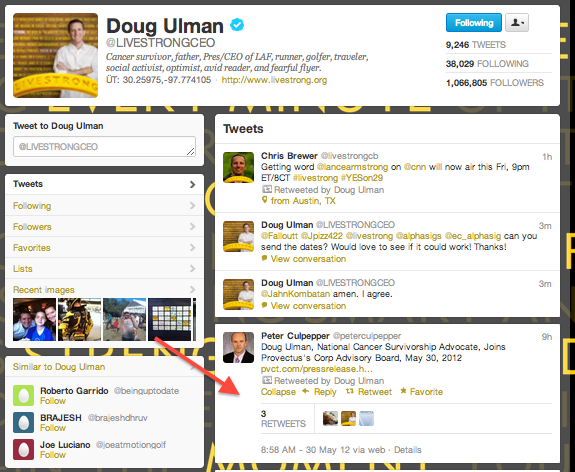
Corporate Advisory Board Member Doug Ulman Tweets

Actually, Doug Ulman retweeted Pete's tweet about adding Doug to Provectus' corporate advisory board.


I retweeted Pete's tweet. You can follow me on Twitter here and @PVCTinvestor.


Doug Ulman, National Cancer Survivorship Advocate, Joins Provectus Pharmaceuticals’ Corporate Advisory Board


Provectus announced today that LIVESTRONG's President and CEO Doug Ulman joined its corporate advisory board. LIVESTRONG is the Lance Armstrong Foundation.

Doug Ulman is a great add for several reasons. I think is quite a coup for management. Come to think of it, "quite" is an understatement.

Mr. Ulman fills or provides the role of patient advocate on the advisory board as (i) a three-time cancer survivor, (ii) someone who already is recognized nationally as a cancer advocate, and (iii) chief executive of the global LIVESTRONG organization and brand.


You can follow Doug's tweets here. As you can see from the screenshot below, he has more than a million followers on Twitter.


His addition dramatically raises Provectus' awareness among several groups of people, including (i) cancer patients and survivors, and their families, (ii) the cancer research community (Doug served a four-year term as the Chairman of the National Cancer Institute Director's Consumer Liaison Group), (iii) the national media, and (iv) charitable and philanthropic organizations.

LIVESTRONG and Doug's use of social media and other Internet-based tools to foster communities of cancer sufferers and their families and serve as a model for other non-profit organizations is well known. See here.


Speaking of brand, Provectus now is associated with Lance Armstrong's global brand, and vice versa.

While its $50.4 million in annual revenue is less than what the 97-year-old American Cancer Society raises in a month, Livestrong has been a catalyst for better cancer care and education across the globe. "It's a force to be reckoned with," says Leslie Lenkowsky, a professor at Indiana University's Center on Philanthropy. Livestrong's help line, guidebooks, and website helped more than 400,000 people last year. Its social-media efforts reach about 3 million supporters. It has pioneered programs here and abroad for survivors; worked to unify the fractured cancer community; and instigated a worldwide crusade, which includes the United Nations and the Clinton Global Initiative, to make the world's No. 1 killer a health-care priority. "I can't think of an organization with the breadth of activity that the foundation has," says Dr. Larry Shulman, chief medical officer at the renowned Dana-Farber Cancer Institute in Boston, "and that includes the American Cancer Society." (source of October 2010 quote here).

LIVESTRONG's board members appear to be as or more prominent, influential and connected as well.


I had the good fortune many years ago to hear a keynote speech by Hamilton Jordan. It takes reminding, by oneself and others around you: There is no such thing as a bad day.

Management has been working on gaining this key opinion leader relationship for more than a year. Note Doug's tweet last April:


Let's put ourselves in Doug's shoes for a moment as he diligenced the company in order to determine whether he would or should accept Provectus' invitation to join the corporate advisory board. If you were him, what questions might you pose to management and its references? Perhaps these:
  • How well does PV-10 work? How safe is it?
  • What do physicians and the medical community think about PV-10?
  • What does the FDA think about PV-10?
  • Where is the drug in the regulatory approval process?
  • How soon could PV-10 be available to patients?
  • How did PV-10 come about? Is it unique? If so, why?
  • How does PV-10 compare to other kinds and types of treatment?
  • Who are the founders and management team? What is their background, history, and success and failures?
  • Who are the members of the board of directors and advisory board?
I have no doubt he conducted a tremendous amount of due diligence. I have to believe Doug needed to be completely convinced his association with Provectus, and by default his associating LIVESTRONG's brand and reputation with the company, was in the best interests of LIVESTRONG and himself.

Doug Ulman joining Provectus' advisory board speaks (shouts) volumes about PV-10, the company and management. I think it speaks to the veracity of management as well.

May 28, 2012

Stock Value Proposition (update)

An updated version of the stock value proposition is below. Click on the picture (table) to enlarge it. My initial version is here.


May 26, 2012

Triggers/Catalysts

You may recall I constructed and posted a similar illustration to the one below in order to elucidate the potential and possible triggers or catalysts for the company (and its share price) along the way to the end-game. I added a few more triggers/catalysts to the original illustration/post.

Click on the picture to enlarge it on your screen.

Of these, the company announced an addition to its board of directors, forming an independent board in the process.

In the U.S., it is Memorial Day weekend, where citizens remember the men and women who died while serving in the United States Armed Forces. With no trading on U.S. stock exchanges Monday, this week there remain 3 trading days in May before the first trading day of the last month of the second calendar quarter.

How time flies...

Picture source here.
My expectations for the remainder of the second quarter? I'm keeping an eye out for:
  • The SPA for the pivotal MM Phase 3 trial;
  • More Moffitt immunology-related work results;
  • Final MM Phase 2 trial results; and
  • Addition(s) to the corporate advisory board.
While I don't rule out a dermatology deal, or the process of arriving at such, being announced, I think more time might be required for this item to play itself out.

Should the SPA or two or more of the other items arrive in June, it is possible the share price may hurdle the threshold for a NASDAQ listing.

May 16, 2012

Jan Koe: A Tactical Move, With Strategic Motivations

I've received several e-mails and blog comments regarding the announcement yesterday of Jan Koe's addition to Provectus' board of directors.
"Mr. Koe, age 61, has a 30-year track record of success in consulting, asset management, real estate and public company governance, and has represented major insurance firms, national retailers and Fortune 500 companies. He is President of GoStar, which is the manager of Real Solutions Opportunity Fund 2005-I and Real Solutions Fund Management LLC and Real Solutions Investment LLC. He is also Principal of Method K Partners, Inc., a commercial real estate firm, which he founded in 1988. He has served on the Board of Directors of ONE Bio, Corp. where he was Chair of the Compensation Committee and a member of the Financial Audit Committee. He holds a degree in Business Administration and Psychology from Luther College."
Mr. Koe's professional history (based on a more comprehensive search of the Web) paints the picture of an entrepreneurial individual who has a good amount of experience and enjoyed success as a principal of and investor in a number of businesses spanning several industry sectors. I think his corporate governance experience is a strength.

The key takeaway is that Koe's addition, which enabled the formation an independent board, is a strategically-motivated tactical move. Simply put, it facilitates the listing of the stock on the NASDAQ in advance of a potential myriad of expected regulatory, business and clinical news that will have greater impact on the share price if the stock is listed on a major exchange rather than over-the-counter.

At a closing price today of $0.865, the stock is well below the $2 per share threshold. One key piece of news (e.g., the SPA, a dermatology term sheet, etc.) should do the trick, thrusting the share price across this threshold.

Just some speculation on my part...

Board member Dr. Kelly McMasters has much more medical and clinical trial experience. Board member Al Smith IV has much more name recognition. The company could have added a much higher profile name than Jan Koe (and, for that matter, Al Smith) in due course. These are not rash actions, but deliberate and deliberated decisions.

Why form an independent board, now?

As I wrote a few days ago, the pipeline of catalysts is backing up, and the clock is ticking on when these catalysts will catalyze the share price: the MM Phase 3 SPA, a dermatology term sheet, more Moffitt immunology data, the Munich MM Phase 2 data, accelerated approval for MM, an addition to the corporate advisory board, and an HCC Phase 2/3 trial suitable for an SPA.

Maybe something or some things (i.e., catalysts) are inbound.

May 14, 2012

To the NASDAQ...and beyond!

So Provectus, by virtue of its newly independent board, "...intends to apply for a listing on NASDAQ when appropriate." Craig provides the quote: "This is a natural step for us as our technologies continue to mature and we prepare for a national exchange listing for our company, which should provide us increased visibility in the financial markets."

Substance or cosmetic? In theory, an independent board should be good for shareholders and corporate governance. Independent directors do not have to rubber stamp management's proposals or recommendations, such as for compensation. In practice, independent boards can go both ways. Coming from a private company where the board ousted the founder CEO (purportedly led by the lead [independent] director), who, frankly, was sort of an awesome dude for several reasons), there is more than anecdotal evidence available of independent boards and not-so-independent boards.

Nevertheless, I give kudos to Craig, Tim and Eric, as founders, for making this move, as they cannot predict with certainty what actions McMasters, Smith and/or Koe may take now and in the future.

I also give kudos to Eric for stepping off the board for the greater good and goal of, among other things, getting onto the NASDAQ. More often than not, it is a challenge for founders to relinquish such titular position easily and without hurt feelings.

NASDAQ listing requirements. What is (are) the key listing requirement(s) for the NASDAQ Capital Market for a stock currently on the OTC to list on the NASDAQ CM: A $4 minimum bid price over 90 consecutive trading days?

No. Go figure. In April 2012, "...the SEC approved, on an accelerated basis, a Nasdaq proposal to adopt, as an alternative to the $4 minimum bid price initial listing requirement for the Nasdaq Capital Market, a closing price of either $2 or $3, if certain other listing requirements are met." See this illustrative source here, or NASDAQ Rule 5505(a)(1)(B) here.

A minimum $2 bid, for 5 consecutive days, if certain other requirements are met, including:
  • Market Value of Listed Securities standard:
    • Market value of listed securities of at least $50 million (current publicly traded issuers must meet this requirement and the price requirement for 90 consecutive trading days prior to applying for listing if qualifying to list only under the market value of listed securities standard)  >>> Yes.
    • Stockholders' equity of at least $4 million  >>> Yes.
    • Market value of publicly held shares of at least $15 million.  >>> Yes.
  • Net tangible assets in excess of $2 million if the issuer has been in continuous operation for at least three years.  >>> Yes.
    • Net tangible assets = assets - {intangible assets + liabilities + par value of preferred stock}
And as for being a penny stock per Rule 3a51-1 of the Securities Exchange Act of 1934, "[i]n new Interpretative Material, Nasdaq states that an issuer that qualifies its securities for initial listing under the alternative price requirement would be monitored and could become a "penny stock" if the issuer fails the net tangible assets and revenue tests after listing and does not satisfy any of the other exclusions from being a penny stock." (Same source as above).

So, what's the upshot of this? Right now, not much, because the share price is well below $2.

With a key piece of news (e.g., the SPA, a dermatology term sheet, etc.), followed up by initial share demand, the share price should hurdle $2. Subsequently, the company would list on the NASDAQ after a week of a sustained >$2 bid.

From there, the NASDAQ, each subsequent piece of news is magnified much more so than if Provectus still to remain on the OTC.

Provectus Pharmaceuticals Forms Independent Board to Meet Corporate Governance Requirements

Provectus formed an independent board, issuing a PR on this today. Jan Koe is added, while Eric drops off. My initial post on this topic is here.

Two takeaways from today's PR: First, the intent to apply for a listing on the NASDAQ when appropriate (more on this later).


Second, Eric's focus (under the shiny new title of CTO) on IP protection, among other things. With two key patents in process (i.e., RB synthesis meeting ICH guidelines, combination therapies), his work in this area remains critical to the value and valuation of Provectus.

May 13, 2012

Musings on May 13

For a little while I've been trying to pull together certain necessary pieces in order to purchase a large number of Provectus shares at current prices (current = somewhere in the range of where the share price has been for the last 3 to 6 months).

As part of this process, I called the markets makers on Friday looking for pricing on a 5MM share block. The goal is (was) to ascertain what average price they thought could buy (and ultimately, if engaged, would commit to buying) on my behalf such an amount in what reasonable period of time.

It is (has been) easy and straightforward to accumulate tens and hundreds of thousands of shares at a time in the current market. Sit on the bid at various levels during various times of the day, and you get hit. Occasionally pay the offer (buy shares offered at various prices and times of the day), but not often enough to let the price runaway from you.

Why is price important? My expectation and experience suggested it was nearly or effectively impossible to by 5MM shares -- at current prices, this only is $4-5MM -- without moving the price into the $1.50 to $2.00 range, or higher (set aside for the moment the impact of warrants being exercised at these prices, or going directly to warrant holders and negotiating to buy their warrants).

If I think I will get $25-50 or more per share in the end-game, should I quibble over cost bases of $0.80-$0.95 or $1.50-2.00? Absolutely. My ROI gets cut in half or more. The outcome still is robust and I could acquiesce, but it is hard to give in and so I doubt it: "A George divided against itself cannot stand!"

As I expected, the market makers could not follow through. Perhaps when my query is addressed substantively next week, they may have a different response. But right now, I cannot get such size at an attractive fixed price in a reasonable time frame. One market maker observed there were some willing sellers in the 80s and 90s (cents) but not enough to fill my size. If another potential investor wants to do a similar size (to my desired amount), there's not enough to go around right now.

Why is time important? Time matters now more than ever. I can try to sit around and slowly, very slowly,  accumulate my desired position at my desired price target range ($0.80-$0.95). Or, I can more aggressively act.

But the pipeline of catalysts is backing up, and the clock is ticking on when these catalysts will catalyze the share price. Among them, the usual suspects:
  • The MM Phase 3 SPA;
  • A dermatology term sheet;
  • More Moffitt immunology data;
  • The Munich MM Phase 2 data;
  • Accelerated approval for MM
  • Additions to the board of directors and corporate advisory board;
  • A NASDAQ listing;
  • An HCC Phase 2/3 trial suitable for an SPA;
  • Etc.
Time is not on my side.

An interesting cascade effect. Take a look at the current table of outstanding warrants (not including, of course, those issued in Q1 2012) here: nearly 12MM at exercises prices of $0.95 and $1.00, and about 12.5MM at $1.12, $1.25 and $1.50, all at terms or durations of 2 to 4 years (from December 31, 2011)

As the share price runs over the next weeks, months and quarters from the catalysts in the pipeline through these exercise prices, the company enjoys significant cash infusions for contemplated operations when these warrants are exercised.

May 11, 2012

When does Provectus' share price start representing its true (or intrinsic) value?

With the stock in a ridiculous holding pattern (I am being subjective with the duration of the stock pciture below), now is as good a time as any to answer a question from Mammon's list.


Per Google Finance, the current market capitalization at closing Thursday was $88.75MM.

The true or intrinsic value of the company may well lie in the eyes of the beholder. The graphic below highlights the outcome of different valuation methodologies.


Setting aside a rather geek-filled discussion regarding "fully diluted," which relates to per share value, the value of Provectus might be in the range of $5-10B using a discounted cash flow analysis.


Comparable company valuations yield a lower enterprise value for Provectus.


But, as in my introduction in this post, Provectus trades at a significant discount to its peers.


Recent or precedent transactions provide a higher valuation.


So, how does Provectus' valuation get from $88.75MM to $5-10B, and when?

The company's valuation begins to get where it needs to go by steadily increasing in step function-like jumps in share price because of: the MM Phase 3 SPA, a dermatology term sheet, more Moffitt immunology data, the Munich MM Phase 2 data, additions to the board of directors and corporate advisory board, a NASDAQ listing, liver progress, etc.

These step-ups likely will be exaggerated by market euphoria or exuberance. That means higher share prices at points in time.

When does the share price represent the company's intrinsic value? When Pfizer buys Provectus. That event will represent the largest and final step function jump in share price.

As shareholders or prospective shareholders, we must ask ourselves: When do we get in?/When do we buy?

And also: When do we get out?/When do we sell? Or do we?

May 10, 2012

10-Q for Q1 FY/CY 2012


The 10-Q is out. Several points of observation:

The cash balance is approximately $5MM as at 3/31/12.


Management does not appear to have concerns over liquidity (i.e., available funds for operations).


Who were these consultants that received more than 1MM warrants?


Payroll looks slightly lower in Q1 2012 vs. Q1 2011, but not materially or by much.


May 1, 2012

Executive Compensation

The Form 14A is out. Bonuses paid in 2011 were the same as bonuses paid in 2010. Option awards in 2011 were lower by 11%. Total 2011 compensation was lower by 3%.


I projected compensation when the 10-K came out about 45 days ago. Management compensation (the company, as you know, has 4 employees, which is/are management; other personnel are paid as contract labor and consultants) is spread across Research & Development and General & Administrative income statement line items. I think I know why I was off, after disassembling the income statement for 2011 and previous years.


You might recall I devised a simple and simplistic formulaic "system" or approach to modeling bonus compensation based on a scoring system for scientific/clinical milestones and achievements. The original post was here. I updated the post here. A further updated comparison of milestone score vs. founder compensation (per founder) is below. The difference in the founder compensation below and above is All Other Compensation.


I reduced the milestone score in 2011 to 6.5 from my previous posts (it was 7.5 in 2010), because upon reading the clinical development progress table on page 4, the company does not say/write that the liver Phase 1 study was completed in 2011; I had assumed such in prior milestone scores (I attribute a score of 1.0 for a completed study), dropping the milestone score year-over-year.


As announced in the CEO letter, the company is "...in the process of implementing a new executive bonus plan that is expected to be based upon certain additional performance-based criteria, such as stock price and the signing of partnership agreements. This plan will replace the prior one which had been based on the attainment of certain scientific, medical and clinical milestones."

The 14A highlighted this topic twice. On page 11:


And, on page 13:


As I wrote in my original post on the CEO letter, I plan to follow-up with more due diligence, analysis and commentary on this topic.

April 26, 2012

CEO Letter Thoughts

PV-10
Metastatic Melanoma


During 2011 we held our second and third meetings with the FDA to discuss the design of a pivotal Phase 3 randomized controlled trial ("RCT") suitable for Special Protocol Assessment ("SPA"). In December the FDA provided us further guidance regarding the submission of our Phase 3 protocol for review, notifying us that they did not require an additional end-of-Phase 2 meeting. Using the recommendations that we received from senior FDA officials regarding patient population and primary endpoint, we are requesting SPA review of our protocol. While the review process could occur in as little as 45 days from the date of submission, we expect it will be an iterative process, and thus, more time may be required to work with the FDA on a study design agreement. This, we believe, represents a major step for our company, probably the most significant achievement yet, in our pathway to approval for PV-10.


⬆ I will address this in a separate post.


As you may recall, too, the Australian Therapeutic Goods Administration ("TGA") has agreed in November 2010 to the same primary endpoint of progression free survival that has been proposed to the FDA. In our meetings with TGA we discussed the use of interim data from the first half of Phase 3 study subjects, in conjunction with safety data collected in earlier studies of PV-10 for melanoma, to allow early evaluation for marketing approval in Australia for metastatic melanoma. TGA agreed that these data should be sufficient for this review if the analysis confirmed efficacy.

⬆ This appears to be just a recap.


In addition, nonclinical studies, designed to characterize the immunologic response to PV-10 chemoablation, have been conducted by researchers at the Moffitt Cancer Center in Tampa, Florida, with initial results reported in March 2012 at the Society of Surgical Oncology Annual Meeting. Paul Toomey, M.D., presented his work and that of his colleagues, confirming that PV-10 chemoablation of melanoma lesions leads to induction of systemic, tumor-specific anti-tumor immunity. Additional nonclinical studies are underway with confirmatory clinical studies planned. This work is fundamental for full characterization of PV-10's systemic benefit and may provide pivotal support for accelerated approval in the U.S.

⬆ I previously posted that the full scope of Moffitt's work -- completed, in-process and in the near future -- makes accelerated approval a real possibility.


Liver Metastasis


In April 2011 we received orphan drug designation from the FDA for Rose Bengal, the active ingredient in PV-10, for the treatment of hepatocellular carcinoma ("HCC"), the most common form of primary liver cancer. This designation entitles Provectus to exclusive marketing rights for PV-10 for HCC in the U.S. for up to seven years if we are the first company to receive marketing approval for this therapeutic drug product. We are also eligible to apply for a waiver from the FDA of certain user fees required by the Prescription Drug User Fee Act ("PDUFA"). In other words, once regulatory approval is received, orphan drug designation provides assurance for the value of our company's proprietary property, grants us market exclusivity, thereby affording us both financial and regulatory benefits. This orphan drug designation for HCC is in addition to that received for metastatic melanoma in December 2006.

⬆ This appears to simply highlight what management has been doing to move PV-10 for HCC along.


We are conducting nonclinical drug-drug interaction studies to verify safety of combining PV-10 with sorafenib, the standard of care for nonresectable locally advanced primary liver cancer. This supports advanced development of PV-10 for HCC in clinical studies comparing PV-10 with the standard of care versus the standard of care alone, to demonstrate an overall survival benefit of treating HCC with PV-10. We expect to provide further guidance on this important indication when we are closer to commencing a Phase 2 or Phase 2/3 clinical study.

⬆ I find it interesting to read that non-clinical drug-drug interaction studies to verify safety of combining PV-10 with sorafenib are ongoing (i.e., confirming the orthogonality of PV-10 and sorafenib). I do not have an expectation of the potential timing of a Phase 2 or Phase 2/3 trial yet.


Breast Cancer and Other Oncology Indications


One of our many objectives during 2011 was to demonstrate that PV-10 has multi-indication potential, and we intend to continue that quest in 2012. We are now in a position for a Phase 2 study in recurrent breast carcinoma, following the completion of our Phase 1 study several years ago. We look forward to being able to report further progress on this indication as well. Furthermore, we have shown success with PV-10 in treating pancreatic cancer in nonclinical studies and are considering a proof of concept clinical study in this equally important indication.

⬆ I take two things away from this. First, the company can start a Phase 2 trial, and second, they appear to me to be assessing whether to start such a trial. I also find it interesting to read about the success in treating pancreatic cancer in non-clinical studies. If you recall, Craig mentioned this in talks late last year.

Compassionate Use Program


I am also pleased to report that our Compassionate Use Program for PV-10 for patients with non-visceral cancers continues, with over 70 patients enrolled in six centers across the U.S. and Australia. The protocol for this program enables subjects to undergo more frequent and extensive treatments with PV-10 over a longer period of time than was allowed under the protocols used for the Phase 1 and 2 trials. We believe this dose regimen serves as a blueprint for our planned Phase 3 clinical trial for metastatic melanoma.

⬆ I previously posted that 
the utility of Provectus' compassionate use program, outside of the great benefit it has had and continues to have for patients accepted into it, is not fully appreciated.

PH-10
Psoriasis


Our largest clinical trial to date was completed in 2011. The data from this Phase 2C RCT, which enrolled ninety-nine subjects with mild-to-moderate plaque psoriasis, corroborated the potential effectiveness of PH-10 observed in these patients in our earlier clinical study.

⬆ 
This appears to be just a recap.


Reaching this milestone has also triggered increased efforts for our company to seek a licensure of PH-10 for the treatment of serious dermatological diseases, which would include psoriasis and atopic dermatitis, another indication for which PH-10 has completed Phase 2 clinical trials. We remain on track to secure a term sheet from a potential partner that would lead to a proposed licensing agreement and the engagement of a financial advisor to effect this transaction.

⬆ This also appears to be just a recap.


We have also successfully completed various dermatological toxicity studies which are appropriate at this stage of development of PH-10. We will work with the FDA to design the remaining toxicity studies necessary to support a New Drug Approval (NDA) filing. Because of the well-tolerated safety profile of Rose Bengal, we are enthusiastic about the potential for widespread acceptance of PH-10 upon eventual expected approval.

⬆ Again, another recap. I think management also is sharing their perspective about the licensing process and prospective partner feedback on PH-10.


PRESENTATIONS AT SCIENTIFIC CONFERENCES


PV-10 was the subject of several scientific presentations this year. Of particular note, Dr. Sanjiv Agarwala, Principal Investigator for the Phase 2 melanoma study, presented data at the European Association of Dermato-Oncology ("EADO") Conference in Nantes, France, in June 2011. This audience of prospective European investigators who specialize in dermato-oncology had a special interest in injectable therapies, and we were encouraged by the level of interest this group had in PV-10, particularly as we prepare for a global Phase 3 trial.

⬆ This appears to be just a recap.


In November 2011, Professor Merrick Ross, M.D., a Principal Investigator for our Phase 2 Melanoma trial, delivered a presentation at the 2011 International Melanoma Congress during the 5th Meeting of Interdisciplinary Melanoma/Skin Cancer Centres meeting in Tampa, Florida. His presentation included a discussion on the role of intralesional therapies for controlling both local disease and their possible effect on systemic disease, such as that which has been shown in Phase 2 testing of PV-10.

⬆ At the HemOnc Today conference in NYC earlier this month, Dr. Ross publicly said PV-10 should be approved. I have much more blog post material on PV-10 and the HemOnc Today conference.


We expect additional presentations at scientific conferences this year that will be announced when appropriate, as well as various peer-reviewed publications either this year or next.

⬆ Management is trying to push for the publication of the MM Phase 2 and/or HCC Phase 1 trial results in globally recognized peer-reviewed periodicals in 2012. Only time will tell if they are successful.

CORPORATE DEVELOPMENTS


Prominent leaders joined our Board of Directors and Corporate Advisory Board this year. Alfred E. Smith IV, Senior Advisor for the Marwood Group, joined our Board of Directors. Mr. Smith has extensive financial and healthcare experience. His knowledge of business and medicine has already helped provide our company with guidance on several drug development and corporate strategies.

⬆ This appears to be just a recap.

Dr. Craig Eagle, MD, Vice President of Strategic Alliances and Partnerships for the Oncology unit at Pfizer, and Stuart Fuchs, Chairman and CEO of CognoSPECTi, joined our Corporate Advisory Board. Dr. Eagle's experience in drug development, and Mr. Fuchs's venture capital and investment banking experience in the biotech industry, are great assets to our company as we further our path towards commercialization. Mr. Fuchs joined the Corporate Advisory Board after having served eight years on our Board of Directors. We expect to appoint others to our respective Boards this year and next.

⬆ Comments related to Eagle and Fuchs also appear to be just a recap. I think the comment related to the potential future appointments to the Corporate Advisory Board and the Board of Directors is very interesting to read.

Our balance sheet remains strong, with $7.7 million in cash and cash equivalents, providing us ample cash to fund our operations through 2013. Since we seek to spin-off our non-core subsidiaries, and concentrate our efforts on our drug development activities, in December 2011 we completed an unregistered offering of Units. Each Unit, which included shares of common stock in Pure-ific and a warrant to purchase ¾ share of the Company's common stock, were sold to accredited investors. The net proceeds of this transaction are expected to be used to spin-off Pure-ific as a new publicly traded company. We plan to fund and spin-off the remaining four non-core subsidiaries as well.

⬆ This also appears to be just a recap.

Also, we are in the process of implementing a new executive bonus plan that is expected to be based upon certain additional performance-based criteria, such as stock price and the signing of partnership agreements. This plan will replace the prior one which had been based on the attainment of certain scientific, medical and clinical milestones. We will disclose the details of the new plan once it is finalized.

⬆ I think the comments related to a new bonus compensation plan are interesting to read. I plan to follow-up with more due diligence, analysis and commentary on this topic.

March 30, 2012

Very Quick Hits for March 30

ex·cit·ed. Coming out of SSO, there is a palpable sense of excitement in management.

clar·i·ty. Following a call with management earlier today, I think I have never been more clear in my projection for or estimation of the company's trajectory.

CEO letter. I think the letter will come out next week.

Much more later (shortly).

March 26, 2012

Quick Hits for March 26

Impressive poster results. Although I'd like to use "incredible," I'll stick with "impressive" as the lead-in to this quick hit. With the poster out, takeaways include:
  • Severe. I don't think we fully appreciate the severity or harshness of Moffitt's lung metastases model, which makes the result of 0, 1 and 3 tumors in 3 of 5 mice treated with PV-10 versus >250 tumors in each of the control mice indeed incredible.
  • Repeated. Independently reproduced results of what already has been demonstrated by the company is important as well: systemic response, t-cell involvement, remote effect, tumor-specific immune response, interferon response, etc.

PV-10 has a specific immune response. "...[A]n immune-mediated anti-tumor response to PV-10 treatment was observed, including induction of tumor-specific interferon-gamma production by splenocytes derived after PV-10 treatment compared to control." (company comments, March 26 PR)

...[I]ntratumoral PV-10 causes both a direct anti-tumoral response of the injected tumor and a systemic tumor-specific activation of the immune system. (Toomey, March 26 PR) This is third party validation and, more importantly, I think essentially reproduces management's work in the area. Repetition is good.

May 16, 2012 now becomes an important date. I think more information on Moffitt's continuing immunology-related work on PV-10 and those results should be revealed and displayed at ASCO 2012, as speculated by Maxim's equity research analyst. The SSO abstract was submitted in the October-November time frame. The ASCO abstract submission deadline was in February.

SSO takeaways are, in some ways, comparable to the takeaways from the ASCO 2010 presentation on visceral metastases. The PIs at ASCO highlighted the correlation between visceral response with response of injected lesions similar to that observed with cutaneous bystander lesions. Using preliminary efficacy data from the first MM Phase 2 cohort of 40 patients, bystander lesion OR for subjects with a positive OR of target lesions was 62%, while the bystander lesion OR for subjects with a negative OR of target lesions was 12% (a statistically significant result).

More answers now create more questions. They include:
  • Success with other types of cancers. What else has Moffitt achieved and accomplished? The SSO-presented work or study focused on melanoma and lung metastases. Has Moffitt conducted work on other types of cancers?
  • Ongoing accelerated approval dialogue with DOP2. Based on statistically and clinically superior PFS results in the MM Phase 1 and 2 trials and, now, buttressed by Moffitt's statistically- and clinically-demonstrated immunology outcome (that builds upon, validates and reproduces the company's prior immunology-related work), is accelerated approval at some reasonable point in the near-future more likely?
  • Human studies to come. When will the human MOA study commence?
  • How now Pfizer? I think I am not the only one impressed by Moffitt's publicly announced results to date and inferences of their likely future outcomes.

It's clear there are more layers of the onion to peel. As they say, more to come from Moffitt.


March 20, 2012

Quick Hits for Tuesday, March 20

Patrick Cox provided an update on Provectus today to his newsletter subscribers. I found his framing of this point to be quite striking: "As you know, Rose Bengal was initially used as a wool dye, but attracted the attention of scientists because of the molecule's ability to bind with unhealthy cells, but not healthy cells. It inspired legendary scientist Paul Ehrlich (1854-1915) to formulate the "magic bullet" theory that drugs could be found that target only diseased cells. It is ironic, in fact, that he never realized the dye that led to the theory was itself a powerful magic bullet capable of attacking a variety of diseased cells without harming those that are healthy."

More information on the immunology work done by Toomey et al. should be available on Thursday. Results, findings and data from poster presentations are embargoed until the beginning of the scientific session in which the research is presented. I think this means Moffitt's work (I hope, beyond what we already know from the abstract) should be available at or around 4 pm EST on Thursday, March 22.


As a result, expect a immunology-related PR from the company, likely on Friday morning, discussing Moffitt's abstract. Thus far, despite the abstract being publicly accessible (see here), management has not yet commented on it. Based on their historical behavior and approach, I assume they are following the communications protocol set forth by the SSO Annual Cancer Symposium.

A second immunology-related PR should follow from Provectus, possibly on Friday morning but more likely on Monday morning, discussing Moffitt's additional work. More work has been done by Toomey et al. since the abstract was submitted in October.

Expect a CEO newsletter from Craig next week. As a reminder, he will present at the 2012 Maxim Group Growth Conference on Monday, March 26 at 4 pm EST. If the second immunology-related PR is issued Friday or Monday morning, I think a central theme of Craig's Maxim presentation will be PV-10's systemic benefit and/or his perspectives on several facets of PV-10's mechanism of immune response Moffitt has validated (based on, of course, his historical research and work).