- Patent protection for PV-10 through 2031 (beyond the protections afforded by orphan drug status),
- The acceptance of the manufacturing process, which improves the synthesis of the drug, by all global regulatory bodies (e.g., US, EU, China, Japan, India, etc.),
- A synthesis process that prevents PV-10 from being replicated, and
- Intellectual property coverage of all halogenated xanthenes, about 20 compounds including rose bengal, so there will be a PV-12, PV-14, etc. and, thus, a drug technology platform for treating cancer in the future and as a follow-up act to PV-10.
Showing posts with label Intellectual Property. Show all posts
Showing posts with label Intellectual Property. Show all posts
May 29, 2013
$PVCT Synthesis Patent Approval Implications
There are several very positive implications to the company receiving approval for its global synthesis patent, including:

$PVCT Patent Approved: Process for the Synthesis of 4,5,6,7-tetrachloro-3',6'-dihydroxy-2',4',5',7'-tetraiodo-3H-spiro[isoben- zofuran-1,9'-xanthen]-3-one (Rose Bengal) and Related Xanthenes

May 24, 2013
$PVCT's Process for the Synthesis of 4,5,6,7-tetrachloro-3',6'-dihydroxy-2',4',5',7'-tetraiodo-3H-spiro[isoben- zofuran-1,9'-xanthen]-3-one (Rose Bengal) and Related Xanthenes

solution, if this was necessary and appropriate, without increasing the purity of the active pharmaceutical ingredient (because the company's new manufacturing process greatly reduces the variable level of impurities). I expect positive news on this item in 2013.
February 16, 2013
$PVCT: Rose Bengal Partitions into Diseased Cells Preferentially

The prototypical halogenated xanthene, Rose Bengal, as well as other halogenated xanthenes partition preferentially into diseased cells. The intellectual property underlying this aspect of Rose Bengal (and its brothers and sisters) have features that either are patented or better served held by the Provectus as a trade secret.
December 7, 2012
$PVCT: If Not China, Then What?
In a prior post, I illustrated the then current snapshot of the horserace.


There may be a second geographic region in play (Australia?, India?*). My take on a comparison of license or deal headline numbers is below:

If the company wanted to hold onto oncology longer, a cost breakdown of the contemplated pivotal, key and other trials appears to be:

If the company wanted to hold onto oncology longer, a cost breakdown of the contemplated pivotal, key and other trials appears to be:

A China deal (or whatever possible combination of outlying geographic deals) that net a $25-50MM upfront payment goes a long way to providing the necessary funding for Provectus to make even more clinical trial progress.
Could dermatology nose out oncology at the finish line? Sure.
Recall the path Provectus traveled with PV-10 and oncology: clinical trials and regulatory discussions, followed by immunologic mechanism of action characterization work by a world-class institution. The early spadework to demonstrate efficacy, safety and multi-indication viability was followed and enhanced by Moffitt's past and future murine model results (not including, yet, human immunologic work). And while shareholders wished for Big/International Pharma to snap to attention (i.e., license PV-10) because of outstanding early-phase trial results, it now appears the immunology work already presented by Moffitt at SSO and Craig at SITC, followed by forthcoming work to be presented by Moffitt, is accelerating license interest and discussions of both regional and global natures.
Could PH-10 be following a similar path?
The "hang-up" with PV-10 appeared to have been with Big Pharma folks being unable to wrap their heads around how well PV-10 worked. They needed help to understand something they had never seen before. They appear to understand now, or at least are getting closer. As such, license interest and discussions are heating up.
It is not unreasonable to analogize PV-10's path to PH-10's, and thus potentially explain the delay in getting to a dermatology license or sale transaction. Perhaps immunologic mechanism of action characterization work is being done on PH-10 by a world-class institution to complete the understanding of prospective dermatology licensees before they fully commit to jumping into the pool. I think this immunology mechanism of action work is being at The Rockefeller University (the Laboratory for Investigative Dermatology?).

Once this PH-10 immunologic mechanism of action characterization work is completed and provided to prospective partners (I do not know when the work was started and when it and the subsequent analysis was or will be completed), and assuming this knowledge concludes their thinking, dermatology might well beat oncology to the finish line.
In this horse race, however, the more horses that cross the finish line -- Provectus licenses deals -- the better.
* I suspect PV-10's extremely low cost structure, and thus tremendous pricing flexibility, helps facilitate country discussions without fear or risk of patent loss (or too much of it).
In this horse race, however, the more horses that cross the finish line -- Provectus licenses deals -- the better.
* I suspect PV-10's extremely low cost structure, and thus tremendous pricing flexibility, helps facilitate country discussions without fear or risk of patent loss (or too much of it).
December 5, 2012
PVCT: A Reminder of Property Rights
 |
| Click figure to enlarge. |
 |
| Click figure to enlarge. |
November 16, 2012
$PVCT.OB: The First Anniversary of This Blog

I wrote my first blog post on November 16, 2011. At the time of that post: "The share price is $0.88. 14,700 shares have traded." Today, it closed at approximately $0.53, down about 40%, and traded about 54,000 shares.
 |
| Click on the figure to enlarge it. |
- October 29, 2012: Provectus Presents Nonclinical Data on Antitumor Immune Response to PV-10 Immuno-Chemoablation (very key),
- October 17, 2012: Provectus Pharmaceuticals Terminates Proposed Convertible Preferred Stock Offering (the failed IPO),
- October 2, 2012: Provectus Pharmaceuticals Presents Final Phase 2 Melanoma Data at ESMO 2012 (key),
- September 28, 2012: Provectus Pharmaceuticals' Patent Application Published for Combining Local and Systemic Therapies for Enhanced Treatment of Cancer (the joint Pfizer-Provectus patent app),
- September 27, 2012: Provectus Expands Protocol for Phase 1 Liver Cancer Study (important),
- June 26, 2012: Provectus Pharmaceuticals Presents Final Phase 2 on PV-10 At 2nd European Post-Chicago Melanoma Meeting 2012 on June 22, 2012 (visibility),
- May 30, 2012: Doug Ulman, National Cancer Survivorship Advocate, Joins Provectus Pharmaceuticals' Corporate Advisory Board (a great get),
- May 14, 2012: Provectus Pharmaceuticals Forms Independent Board to Meet Corporate Governance Requirements (an important corporate governance advance),
- April 10, 2012: Phase 2 Data on Provectus's PV-10 to Be Presented at the HemOnc Today - Melanoma and Cutaneous Malignancies Conference on April 13, 2012 (visibility),
- March 26, 2012: Intralesional PV-10 Treatment Leads to the Induction of Anti-Tumor Immunity (very key),
- March 23, 2012: Mechanism of Action Data On PV-10 Demonstrates Therapy Induces Immunologic Response (very key),
- March 19, 2012: Provectus Announces Top Line Phase 2 Data For PH-10 in Its First Randomized Controlled Psoriasis Study (important), and
- January 18, 2012: Provectus Receives Guidance From FDA On Pathway to Approval for Phase 3 Trial of PV-10 For Metastatic Melanoma (important regulatory step).
 |
| Click on the figure to enlarge it. |
Thank you for visiting and reading!
October 30, 2012
$PVCT.OB: The Orthogonality Paradigm
Yesterday's PR of Craig et al.'s poster at SITC highlighted additional data that demonstrated the use of PV-10 in combination with systemic chemotherapy. The combination cancer treatments, whether chemotherapy, radiotherapy or immunotherapy, is a growing theme within the medical community. In the case of the work presented at SITC, PV-10, the immuno-chemoablative therapeutic agent, was combined with a systemic chemotherapeutic.
Pre-clinical and clinical data has shown PV-10 generates immunity even in patients afflicted with very late stage cancer. The immune system, however, can be overwhelmed by cancer (and infections). Management thinks the key, for very late stage disease, is to use a chemotherapeutic or another systemic immunotherapeutic agent (like Yervoy/Ipilimumab) to wound the cancer (the infection) just enough so the PV-10-generated immunity can finish it off. Like antibiotics, PV-10 and the application of other therapeutic agents in this manner (i.e., to wound cancer, before PV-10 finishes it off) would not cure anyone. Rather, they hold or bound the infection until the body's natural immune mechanisms can do the job of curing it.
Next up should be the results of combining PV-10 and anti-CTLA-4 system immunotherapeutic agents like Yervoy/Ipilimumab.
Note the importance of Provectus joint patent application with Pfizer for combining local and systemic therapies for enhanced treatment of cancer. More questions arise: How good were the pre-clinical results from combining PV-10 and Yervoy/Ipilimumab? What would the beneficial impact be on very late stage metastatic melanoma cancer patients from this combination? What would the implications be for Bristol-Myers Squibb, and for Pfizer (which retained the right to certain combinations of therapies with tremelimumab?
This Provectus work foreshadows Moffitt's subsequent murine results, having initially reproduced Craig and the team's work and identified the quintessential immune response: a more complete assessment of PV-10's immune-mediated response, demonstration on multiple cancers and in combination with other therapies, and the durability of the immune response (through various challenge studies).
Ultimately, the “orthogonality paradigm” demonstrates PV-10 is orthogonal to (neither impacted by nor having an impact on) other therapeutic agents. This is important because PV-10 would be used first, second and at all times during patient treatment.
Pre-clinical and clinical data has shown PV-10 generates immunity even in patients afflicted with very late stage cancer. The immune system, however, can be overwhelmed by cancer (and infections). Management thinks the key, for very late stage disease, is to use a chemotherapeutic or another systemic immunotherapeutic agent (like Yervoy/Ipilimumab) to wound the cancer (the infection) just enough so the PV-10-generated immunity can finish it off. Like antibiotics, PV-10 and the application of other therapeutic agents in this manner (i.e., to wound cancer, before PV-10 finishes it off) would not cure anyone. Rather, they hold or bound the infection until the body's natural immune mechanisms can do the job of curing it.
Next up should be the results of combining PV-10 and anti-CTLA-4 system immunotherapeutic agents like Yervoy/Ipilimumab.
Note the importance of Provectus joint patent application with Pfizer for combining local and systemic therapies for enhanced treatment of cancer. More questions arise: How good were the pre-clinical results from combining PV-10 and Yervoy/Ipilimumab? What would the beneficial impact be on very late stage metastatic melanoma cancer patients from this combination? What would the implications be for Bristol-Myers Squibb, and for Pfizer (which retained the right to certain combinations of therapies with tremelimumab?
This Provectus work foreshadows Moffitt's subsequent murine results, having initially reproduced Craig and the team's work and identified the quintessential immune response: a more complete assessment of PV-10's immune-mediated response, demonstration on multiple cancers and in combination with other therapies, and the durability of the immune response (through various challenge studies).
Ultimately, the “orthogonality paradigm” demonstrates PV-10 is orthogonal to (neither impacted by nor having an impact on) other therapeutic agents. This is important because PV-10 would be used first, second and at all times during patient treatment.
September 28, 2012
$PVCT.OB/$PFE's Patent Application Published For Combining Local And Systemic Therapies For Enhanced Treatment Of Cancer
Provectus issued a PR today for its joint patent application with Pfizer. The patent application was first revealed a week ago.
In a break from historical practice, management issued a PR for a patent application rather than only for an issued patent. While not wanting to hype this achievement (since a patent application has a way to go before it is finalized [if at all]), Provectus nevertheless clearly wanted to highlight another aspect of its growing relationship with Pfizer.
Having made venture capital investments in hi tech start-up companies (mostly information technology ones, but some life sciences companies) on behalf of a corporation, I understand the situation Provectus faced. I have no doubt management dutifully asked the folks at Pfizer's Specialty Care and Oncology business unit for permission to include the Big Pharma company's name in today's PR. The Pfizer BU asked Pfizer's corporate legal department, which subsequently said no (an answer that was not going to change).
As a corporate VC, I knew the tangible and intangible value to the investee from having our parent company's name in the investee's PR announcing the investment round (and our investment). On the other hand, our corporate legal department was fearful of misrepresenting the nature of the relationship between the corporation and the investee company, no matter how minuscule the potential or actual risk. It was one thing to say the corporation's wholly owned but separately governed and functioning subsidiary invested in a start-up company. It was another thing to imply any kind or sniff of "partnership" that did not yet exist between the corporation, howerver, and the investee.
While it may be disappointing to shareholders the relationship with Pfizer was not more broadly broadcast, more of it should become evident over time. For example, we may learn more about it coming out of ESMO next week. Alternatively, if PVCTP ultimately is used, we may learn Pfizer is the lead investor, or one of two lead investors (PFE + another Big Pharma company, PFE + a life sciences investor/fund).
In a break from historical practice, management issued a PR for a patent application rather than only for an issued patent. While not wanting to hype this achievement (since a patent application has a way to go before it is finalized [if at all]), Provectus nevertheless clearly wanted to highlight another aspect of its growing relationship with Pfizer.
Having made venture capital investments in hi tech start-up companies (mostly information technology ones, but some life sciences companies) on behalf of a corporation, I understand the situation Provectus faced. I have no doubt management dutifully asked the folks at Pfizer's Specialty Care and Oncology business unit for permission to include the Big Pharma company's name in today's PR. The Pfizer BU asked Pfizer's corporate legal department, which subsequently said no (an answer that was not going to change).
As a corporate VC, I knew the tangible and intangible value to the investee from having our parent company's name in the investee's PR announcing the investment round (and our investment). On the other hand, our corporate legal department was fearful of misrepresenting the nature of the relationship between the corporation and the investee company, no matter how minuscule the potential or actual risk. It was one thing to say the corporation's wholly owned but separately governed and functioning subsidiary invested in a start-up company. It was another thing to imply any kind or sniff of "partnership" that did not yet exist between the corporation, howerver, and the investee.
While it may be disappointing to shareholders the relationship with Pfizer was not more broadly broadcast, more of it should become evident over time. For example, we may learn more about it coming out of ESMO next week. Alternatively, if PVCTP ultimately is used, we may learn Pfizer is the lead investor, or one of two lead investors (PFE + another Big Pharma company, PFE + a life sciences investor/fund).
September 20, 2012
August 5, 2012
The Tip Of The Iceberg

As the dog days of summer get doggier, and we wait for the SPA to be received, much, much more Moffitt data to arrive, a dermatology and/or mini-oncology deal(s) to materialize, and other events to occur, it might be constructive and cooling to think about Pfizer...
If the addition of Dr. Craig Eagle to Provectus' corporate advisory board is the tip of the iceberg, what's below the waterline?
 |
| Below-the-waterline items not in chronological order. |
June 4, 2012
An Investment Letter: Why I’m Long Provectus Pharmaceuticals (Redux)
A rewrite of my first investment letter...
Preface
At
a June 1st closing share price of $0.88 and market capitalization of
$99 million, Provectus Pharmaceuticals is an exceptional long idea.
I
began due diligence on the Company in 2006, and started accumulating shares in
2007. My historical and ongoing diligence comprises thousands of interactions
with Provectus management. As a result, my view of the Company’s prospects has evolved
over time. If our portfolio was one hundred percent cash and I was investing
from scratch, would I establish this position in Provectus and, if so, how big
would it be? The answer is I would have the same position I have today.
In
writing this investment letter to and sharing my investment thesis with you, I
borrowed from Whitney Tilson’s Why
We’re Short Netflix letter as well as OneMedPlace Research’s December 2011
report, which is a well-written primer on the Company.
Provectus
Pharmaceuticals (PVCT)
Provectus
is a Knoxville, Tennessee-based biotechnology company with two lead compounds in
early- to mid-stage clinical trials: PV-10 for oncology (metastatic melanoma, hepatocellular
carcinoma, recurrent breast cancer, other solid tumors) and PH-10 for
dermatology (atopic dermatitis, psoriasis, other inflammatory skin disorders).
Rose Bengal, the active pharmaceutical ingredient (“API”), has an established
safety profile with the Food and Drug Administration (the “FDA” or “Agency”) for
prior human use as an intravenous hepatic diagnostic (Robengatope) and topical
ophthalmic diagnostic (Rosettes and Minims), and has been used in liver
function studies for more than 90 years.
Investors
often underestimate or overestimate risk in the context of the return they
should expect. Just because a so-called safe asset or security could provide a
safe return does not mean the expected return is commensurate (i.e., high
enough) for that level of risk. Conversely, just because a so-called risky
security could generate a robust return does not mean the expected risk is
commensurate (too high) for that amount of return. Provectus’ stock is a
situation where the risk-reward profile is clearly and visibly out of whack. The
return opportunity is much more than commensurate for the potential risk.
The
Company’s share price has trended downward over the last five years however, losing
nearly 50% of its value along the way, despite clinical, regulatory and business
value propositions that have increased over time.
Clinical: PV-10 is very
efficacious and safe, and produces very beneficial local-regional and systemic effects
on cancerous tissue. Pre-clinical and clinical results have been repeated and
reproduced. Further efficacy, particularly when tumor burden is high, is achieved
by combining PV-10 with other therapies, such as radiotherapy and Bristol Myers
Squibb’s Yervoy, because PV-10 facilitates the efficacious action of these
treatments.
Regulatory: The path to drug approval
in the U.S. and Australia for metastatic melanoma (“MM”) is clear, but not yet
completed. The path for hepatocellular carcinoma (“HCC”) is in process. Orphan
drug status has been received for both MM and HCC. The path for recurrent
breast cancer has been started. The FDA has been very constructive. Interactions
with the Agency have been unusual in a good way.
Business: PV-10 is very easily
administered and should be easily reimbursed. Provectus has significant
treatment pricing flexibility (as currently contemplated, gross margins are
very high), incurs very low manufacturing costs to produce the drug and requires
very low costs to scale manufacturing to meet domestic and international demand
for the drug when it is approved. The Company has a large, well-protected
intellectual property portfolio of U.S. and international patents.
Stock: Provectus recently
formed an independent board of directors. The corporate advisory board has been
tactically and strategically populated. The stock, however, does not trade on a
major exchange and has limited equity research coverage. No license deal in
either oncology or dermatology has been struck, as managed has turned down or
resisted license interest because of valuations below their acceptable minimum
at the time. There has been no historical insider selling and plenty of insider
buying. The Company’s balance sheet is solid, with committed and structural
access to capital.
So,
why am I risking my professional reputation, a large portion of net worth and my
sanity on this company, its management team and the stock, when most
institutional investors, including biotechnology-focused investors, have mostly
or completely ignored Provectus? Healthcare fund manager OrbiMed Advisors, a
firm with whom the Company has an association through a corporate advisory
board member for several years owns no shares as of a March 31st 13F
filing (David Darst, the advisor, is a member of OrbiMed’s private equity team
and not their public equity one). Hardcore biotech investors understand the
situation and opportunity. There are two practical and pragmatic reasons for
their lack of participation in the stock: a yet-to-be-received Special Protocol
Assessment (“SPA”) from the FDA for the Company’s pivotal MM Phase 3 trial and
a security that trades over-the-counter.
At
just under $100 million, Provectus’ valuation is extremely low. Fair value is at
least $200-300 million. Once the Company receives an SPA for its pivotal MM
Phase 3 trial and more information on the drug’s mechanisms of action and
immune response are further elucidated, followed by the out-licensing of
Provectus’ dermatology drug PH-10 for inflammatory skin disorders, institutional
and retail investors should become much more aware of the stock and its risk-reward
proposition. There is substantial cash and contingent upside above fair value
in excess of $2-3 billion.
Rose
Bengal and PV-10: A tremendous clinical value proposition
Through
early- to mid-stage trials and a compassionate use program, Provectus’ clinical
results have been impressive. The Company has completed Phase 1 and 2 trials
for MM, for which Provectus received orphan drug status; a Phase 1 trial for
HCC, for which it received orphan drug status; a Phase 1 trial for recurrent
breast cancer, for which the Company demonstrated efficacy; and Phase 1 and 2
trials for atopic dermatitis and psoriasis, for which Provectus demonstrated
efficacy given limitations of trial designs. These trial results show, suggest and
infer much better overall survival benefit, much higher levels of tumor
destruction and disease reduction, beneficial local-regional and systemic effects
on cancerous tissues, multi-indication viability, and repeated reproducibility of
outcome in and across pre-clinical and clinical trials.
PV-10 is
very efficacious:
Clinical results indicate, for MM and HCC, and more than likely suggest, for
recurrent breast cancer and several other indications treated in the
compassionate use program, materially superior results for objective response,
complete response and progression free survival (taken alone and when compared
with the results achieved by standards of care and competing drugs). Results
infer such for durable response. Understanding the caveats of comparing
clinical trial results, PV-10's response rates for injected lesions,
non-injected lesions and non-injected systemic lesions exceeded other
intralesional therapies like Vical's Allovectin-7 and Amgen's talimogene
laherparepvec (formerly BioVex’s OncoVEX GM-CSF). Substantial unmet needs exist
for melanoma treatment despite the approvals of Yervoy and Zelboraf, whose
efficacy outcomes and safety profiles pale in comparison to PV-10.
Two
fair criticisms of PV-10 are the small number of trials completed (oncology: 4,
dermatology: 4) and the small number of patients treated (oncology: >200,
dermatology: >225). Efficacy, however, has been repeatedly superlative in
pre-clinical work (from bench research, in murine models and on animals),
clinical trials (MM, HCC, recurrent breast) and the compassionate use program.
Further, Provectus, its principal investigators and H. Lee Moffitt Cancer
Center & Research Institute (“Moffitt”) have reproduced superlative
efficacy in pre-clinical work, clinical trials and murine models (and human studies),
respectively.
PV-10 is
very safe:
Rose Bengal is an FDA-approved API, with a century of safe and successful use
in humans as an intravenous hepatic diagnostic and topical ophthalmic diagnostic.
Patients treated with PV-10 predominantly suffer only mild to moderate adverse
events. There have been neither NCI CTCAE Grade 4 or 5 events nor clinical
trial insurance claims. Paraphrasing: “Rose Bengal has a 30-minute “half-life,”
which is the amount of time the compound is in the patient’s bloodstream before
it is excreted in the bile. It is very stable in the human biological system,
and although the portion remaining in the bloodstream is excreted rapidly, the
portion that has been absorbed by the cancer tissue actually remains in its
parent form for weeks until the dying cancer tissue is absorbed by the body and
the remaining Rose Bengal is excreted.” (Amy Baldwin’s Investment
Choices For Melanoma Awareness Month). Such historical and ongoing safety
means no surprises in future clinical trials or, once approved, from patient
use.
PV-10 has
both local-regional and systemic beneficial effects on diseased tissue: PV-10 has an autophagic
mechanism of action and an autophagy-induced, system-wide anti-tumor mechanism
of immune response. Rose Bengal partitions into diseased cells. Entering the
cells’ lysosomes, it causes them to leak or rupture. Autophagy cascade
subsequently occurs. Moffitt independently confirmed PV-10’s local and systemic
response benefits in murine models, and also identified the quintessential
immune-mediated response: Splenocytes from PV-10-treated mice
produced interferon-γ in response to B16-F10 melanoma cells. Shortly,
Moffitt should confirm the same in human studies.
PV-10 has
demonstrated multi-indication viability: PV-10 has been used to treat MM, HCC, recurrent
breast cancer, squamous cell carcinoma, scalp sarcomas and colorectal cancer
(mets to the liver). Moffitt conducted further murine model work on other
cancers besides metastatic melanoma to successfully demonstrate
multi-indication efficacy and immune response.
Two
fair criticisms of PV-10, again, are the small number of trials completed and
small number of patients treated. Yet, multi-indication success has been
repeatedly shown in pre-clinical work, clinical trials and the compassionate
use program. Further, Provectus, its principal investigators and H. Lee Moffitt
have reproduced multi-indication success in pre-clinical work, clinical trials
and murine models, respectively.
PV-10’s
regulatory path is becoming clearer
Management's
interaction with the FDA has been unusual in a good way. This month or next, I
expect the FDA will grant an SPA to Provectus for it’s pivotal MM Phase 3
trial. Australia’s Therapeutic Goods Administration already has agreed to a
data analysis and review process that allows early evaluation for MM marketing
approval. Accelerated approval, at a later date, is a very real possibility,
based on Moffitt’s historical and ongoing murine model and human study work.
Provectus is pursuing a very focused label for PV-10, the supporting proof of
which already has been demonstrated: loco-regional treatment of Stage III and
early-Stage IV MM.
The
company may finalize designs for a pivotal HCC Phase 2/Phase 3 randomized
control trial using Sorafenib later this year. Drug orthogonality between PV-10
and sorafenib has been shown.
A very profitable
business value proposition
PV-10
has the potential to be a very profitable drug. It is easily administered and
should be easily reimbursed. Because of a relatively low amount of capital
spent and required to bring the drug to market, Provectus and its eventual
acquirer will have significant treatment pricing flexibility. PV-10 has a very
low manufacturing cost. The cost to scale manufacturing is very low. The
Company has a large, well-protected intellectual property portfolio.
Ease of
drug administration: A medical or surgical oncologist makes treatment decisions.
PV-10 is injected into target lesions by interventional oncologists in
outpatient settings. An appropriately trained nurse practitioner or nurse can
provide the same service. Injections into tumors on organs inside the body
require an imaging assist. In either case, effective administration of the drug
does not require a meaningful change to a physician’s current practice and practice
behavior. There is no pre- or post-treatment care, nor is co-treatment needed. In
the future, PV-10 could be ingested or deployed intravenously. For
dermatology, patients apply PH-10 as a topical gel to the targeted area of
skin.
Low
treatment price:
For the purposes of their valuation models, equity research analysts who follow
Provectus assumed a treatment price of $20,000 to $30,000, which is not
necessarily what the Company and its eventual acquirer could or would charge.
At these prices, however, PV-10’s gross margin is more than 80% (in excess of
99% when not including a sales return-type allowance). Given PV-10’s equivalent
to dramatically better efficacy and safety profile, predatory pricing (as it
relates strictly to competitors’ treatment pricings) could be very lucrative. Pricing
flexibility, resulting directly from the very low cost to produce the drug is a
sustainable competitive advantage.
Physicians
should be very easily reimbursed for PV-10 treatments. It is anticipated treatment
would be reimbursed as chemotherapy or a procedure, and a potential crosswalk
to other reimbursed interventional oncology procedures, such as image-guided
therapy. Treatment price and reimbursability should be key drivers of adoption.
Low
manufacturing cost: Provectus’ $110 million deficit accumulated during the
development stage as of March 31st, combined with nearing the end of
the regulatory approval process, means the eventual amortization of development
expenses will not materially influence pricing.
It
costs very little to manufacture PV-10. Synthesis of the API to modern pharmaceutical
standards is well defined. Rose Bengal has a well-behaved, fully characterized
impurity profile. Provectus owns the only formulation that meets the FDA's
International Conference on Harmonization (“ICH”) guidelines. The cost to scale
the production of PV-10 is very low. Critical process parameters and best practices
are complete. PV-10’s formulation utilizes standard equipment.
Broad and
deep intellectual property: The Company has more than 50 global patents
issued and pending, with numerous applications filed and in process, covering
the drug and subsequent (additional) family of compounds, and synthesis of the
active pharmaceutical ingredient to modern pharmaceutical standards. Provectus’
family of compounds extends oncology applications far beyond traditional patent
cliff.
Paraphrasing:
“Rose Bengal is an old agent; the composition of matter patent has expired but Provectus
filed a synthesis patent that spells a method to manufacture this agent that is
devoid of any impurities and is the only formulation that meets the FDA's ICH
guidelines. This patent maybe as robust as a composition of matter patent
because without using this synthesis protocol, medicinal grade Rose Bengal can
never be synthesized. Additional picket-fence is provided by use, indication,
formulation and mechanism of action patents.” (OneMedPlace Research’s December
2011 report)
The
key opinion leader community wants to use an emerging therapy like PV-10 with
other agents like Yervoy, Allovectin-7, talimogene laherparepvec (formerly OncoVEX),
and other anti-CTLA-4 and anti-PD-1 compounds.
The
stock has a weak to modest value proposition at the moment
Provectus
has an independent board of directors that includes Alfred E. Smith IV. The
Company’s corporate advisory board includes Dr. Craig Eagle, Vice President of
Strategic Alliances and Partnerships for the Oncology unit at Pfizer, and Doug
Ulman, President and Chief Executive Officer of LIVESTRONG.
Provectus’s
stock does not trade on a major exchange. Reduced requirements to list on the NASDAQ
(e.g., market value of listed securities standard, net tangible asset minimum,
minimum $2 bid for five consecutive days), however, present a lower bar to
clear.
Although
equity research analysts that cover the stock are highly-ranked or thoughtful,
coverage is by firms with historical investment banking relationships or
niche/boutique businesses and clienteles: Maxim Group, Rodman & Renshaw,
Roth Capital, and Stonegate Securities. Firms with no promised or implied
relationship could initiate coverage post-SPA.
Provectus
has not yet entered into a license deal. Lack of a deal (or deals) does not
mean no deal can be had. Management is seeking valuations commensurate with
their view of value, turning down or resisting several opportunities in the
process.
There
has been no insider selling and plenty of insider buying. Insider exercising of
options and purchasing of underlying common stock totals several million
dollars to date. Most of these exercises have been done by one of the four
principals. The other three principals have made small to moderate purchases.
The
Company has a solid balance sheet, and committed and structural access to
capital. As of March 31st, cash and cash equivalents totaled $5
million. Provectus owes no debt. The Company has a $30 million equity line of
credit committed by a Chicago-based investment firm, and two $50 million shelf
filings.
A management
team in which I believe and support
Provectus
is the story of an old molecule, a business scientist (Craig Dees), two
scientists (Tim Scott and Eric Wachter), a businessman (Peter Culpepper), a
decade of clinical development and a journey that began in the 1990s. This four-man
team has been together for eight years, and should remain together through the
acquisition of the company.
Management
is intelligent, repurposing an old diagnostic compound as an anti-cancer agent
and understanding the value of the molecule’s safety history in working through
the regulatory process. Management is competent, getting this far in clinical
development while accumulating a $110 million deficit during the development
stage. Management is hardworking; while creating near composition of matter
patents and scooping other companies requires intelligence and creativity, hard
work increases the probability of execution and implementation.
I
believe management is ethical and possesses a good moral compass.
While
not having sold a single share of stock, management has made in-kind
contributions (at the Company’s inception) and exercised options at an expense of
$20 million.
But
what if I’m wrong?
What
if I am wrong? What would that scenario look like?
Could
there be poor clinical results in the future? Given the repeatability, reproducibility
and veracity of pre-clinical and clinical results, likely no.
Could
there be unexpected adverse events in the future? Given Rose Bengal’s
multi-decade, historical safety, likely no.
Could
more time be required to confirm the regulatory path for MM? This is the likely
scenario if I am wrong. I am prepared for more time to elapse for regulatory clarity
to be achieved. Management may have to raise additional capital to fund operations
until such time as this ambiguity is resolved to their satisfaction. This,
however, is finite and can be bounded by several millions of dollars or several
percentage points of potential dilution. This downside risk, however, is more
than commensurate with the vast upside return opportunity when the regulatory
ambiguity is indeed resolved.
Shareholders
would incur further dilution if management elects to conduct the pivotal MM
Phase 3 trial itself. I am prepared for this outcome because the dilution
caused by raising capital to carryout the trial should be made up by a higher
valuation resulting from Phase 3 trial results that are projected to exceed
Phase 2 results.
And in
conclusion…
Provectus
is an extremely undervalued stock whose current share price ignores unambiguous
pre-clinical, clinical, safety and multi-indication viability data for oncology
therapies; ease of drug administration and low drug production costs; a large intellectual
property portfolio; and, an intelligent, hard working, ethical management team.
Once
the unknown of the regulatory path begins to be known, Provectus’ valuation
should increase. The share price will display substantial upside when
acquisitive pharmaceutical companies fully accept Rose Bengal’s value
proposition.
Disclaimer
This
letter is for informational and educational purposes only and should not be
construed to constitute investment advice. Nothing contained herein should constitute
a solicitation, recommendation or endorsement to buy or sell any security by
the author. The author owns shares of stock of Provectus Pharmaceuticals. He
has no obligation to update the information contained herein and may make
investment decisions in the future that are inconsistent with the views
expressed in this letter. The author makes no representation or warranties as
to the accuracy, completeness or timeliness of the information, text or other
items contained in this presentation. The author expressly disclaims all
liability for errors or omissions in, or the misuse or misinterpretation of,
any information contained in this letter.
May 14, 2012
Provectus Pharmaceuticals Forms Independent Board to Meet Corporate Governance Requirements
Provectus formed an independent board, issuing a PR on this today. Jan Koe is added, while Eric drops off. My initial post on this topic is here.
Two takeaways from today's PR: First, the intent to apply for a listing on the NASDAQ when appropriate (more on this later).

Second, Eric's focus (under the shiny new title of CTO) on IP protection, among other things. With two key patents in process (i.e., RB synthesis meeting ICH guidelines, combination therapies), his work in this area remains critical to the value and valuation of Provectus.
Two takeaways from today's PR: First, the intent to apply for a listing on the NASDAQ when appropriate (more on this later).

Second, Eric's focus (under the shiny new title of CTO) on IP protection, among other things. With two key patents in process (i.e., RB synthesis meeting ICH guidelines, combination therapies), his work in this area remains critical to the value and valuation of Provectus.
April 9, 2012

March 28, 2012
Xanthene Dyes Induce Membrane Permeabilization of Bacteria and Erythrocytes by Photoinactivation

Kato, H., Komagoe, K., Nakanishi, Y., Inoue, T. and Katsu, T. (2012), Xanthene Dyes Induce Membrane Permeabilization of Bacteria and Erythrocytes by Photoinactivation. Photochemistry and Photobiology, 88: 423–431.
Abstract
We analyzed the photoinactivation of the membrane functions of bacteria and erythrocytes induced by xanthene dyes. The dyes tested were rose bengal, phloxine B, erythrosine B and eosin B. These dyes induced the leakage of K+ from Staphylococcus aureus cells within minutes of photoirradiation, in the order of rose bengal > phloxine B > erythrosine B > eosin B. The ability of dyes to inhibit respiration was weak, except for rose bengal, and the dyes dissipated the membrane potential in similar time traces with changes in K+ permeability. The xanthene dyes also induced the leakage of K+ from bovine erythrocytes upon photoirradiation in the same order as that observed with bacteria. Furthermore, we found that the ability to cause the leakage of K+ from erythrocytes was associated with dye-induced morphological changes, forming a crenated form from the normal discoid. These results are discussed in connection with the ability of xanthene dyes to generate singlet oxygen and bind to bacterial cells, and further compared with the actions of cationic porphyrins, which induced photoinactivation of bacteria through respiratory inhibition.
Quick hit: As you may know, Craig previously presented work showing rose bengal as a potent killer of Staphylococcus aureus.

[0099]
March 14, 2012
Summary Value Proposition
As you will have seen from the various value propositions I posted, PH-10 and dermatology are not addressed. With the annual meeting of the American Academy of Dermatology starting Friday in San Diego, and with the likely release of the top-line psoriasis Phase 2c trial results this week or next, the dermatology side of the business is quite relevant and germane. There are considerable clinical, regulatory and business commonalities between the dermatology and oncology applications of Rose Bengal. To focus my thinking, I only used oncology; however, dermatology certainly is an important and valuable value driver and contributor to my investment thesis.
Click on the table below to see a much larger version on your screen. Updated February 2013.
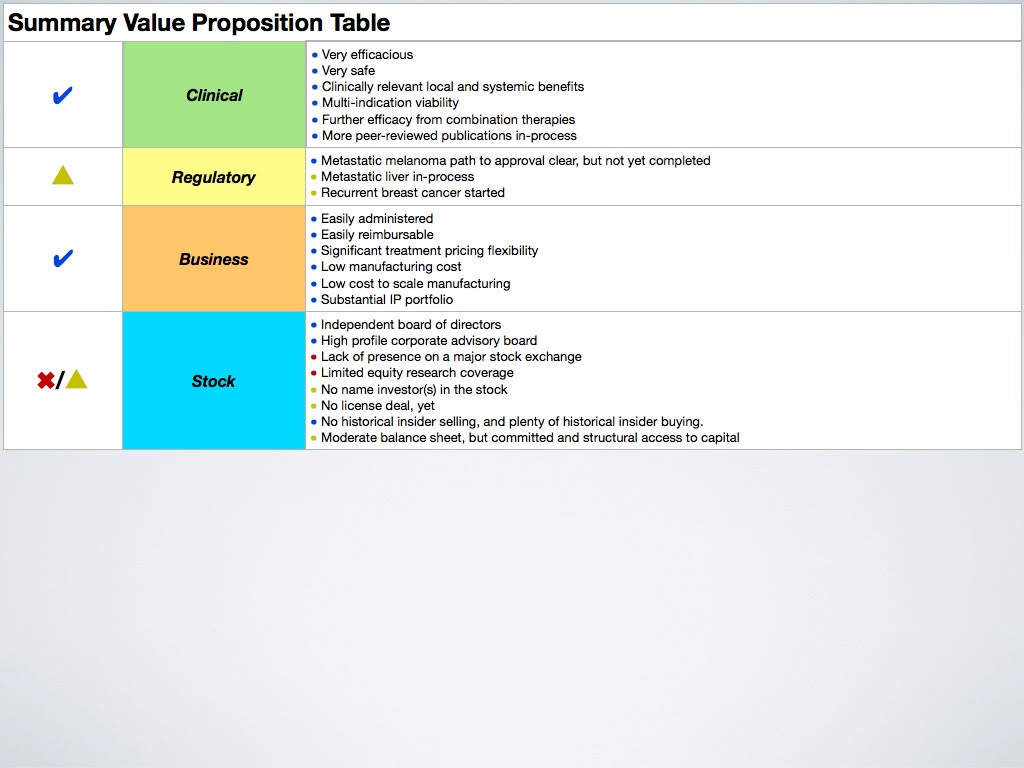
Click on the table below to see a much larger version on your screen. Updated February 2013.
March 11, 2012
Business Value Proposition
Click on the table below to see a much larger version on your screen. Updated February 2013.

January 22, 2012
Double-sided Coin
The clinical value proposition of Provectus is unambiguous: Safe. Targeted. Pre-approved as a diagnostic. Triggers the immune system. This fourth component of the proposition -- immune system triggering -- is too good to be true to some, and snake oil or witches' brew to others. As more information on Moffitt's immunology work is known, as more peer-reviewed abstracts, posters and papers are presented, snake oil or witches' brew become robust, compelling, necessary.
The other side of the coin (of doubt over the triggering of the immune system), as I blogged earlier today, are casual, lazy, weak, empty reasons for why one should not be long Provectus (such as "these folks haven't done anything like 'this' before").
Paradigm shifts more often emanate from individuals closer to the periphery than those at the center. I suspect we'll see a dramatic and timely convergence of acceptance of both Provectus' clinical and investment propositions.
Just because you aren't (in a biotech hotbed) or haven't (brought a drug to market, got an illustrious investor/shareholder or drug partnership) doesn't mean you can't or ultimately won't.
The other side of the coin (of doubt over the triggering of the immune system), as I blogged earlier today, are casual, lazy, weak, empty reasons for why one should not be long Provectus (such as "these folks haven't done anything like 'this' before").
Paradigm shifts more often emanate from individuals closer to the periphery than those at the center. I suspect we'll see a dramatic and timely convergence of acceptance of both Provectus' clinical and investment propositions.
Just because you aren't (in a biotech hotbed) or haven't (brought a drug to market, got an illustrious investor/shareholder or drug partnership) doesn't mean you can't or ultimately won't.
January 8, 2012
Why I’m Long Provectus
Preface
In this letter, I want to share my investment thesis in depth and describe why, at a share price of $0.94 and market capitalization of $103 million (based on Friday’s close), Provectus Pharmaceuticals is an exceptional long idea. This security is the largest holding in our multi-asset portfolio.
For framework, approach and, in some cases, language of this letter, I liberally borrowed from Whitney Tilson’s Why We’re Short Netflix. See here. For quick access to data summations and historical information (rather than have to dig through my notes), I quoted from OneMedPlace’s recent profile on Provectus. See here.
I am not a biotechnology investor, although I have made investments in life sciences companies. My experience in and exposure to different industries includes biotechnology (and life sciences), computer hardware and software, defense and intelligence, environmental services, financial services, gaming, information technology, investment management, mining and nanotechnology.
There are common traits to successful companies and their management teams, businesses, business strategies and tactics, and products and services, irrespective of industry. There also are common traits to successful investments, irrespective of asset class or security sector.
Biopharmaceutical industry participants (e.g., executives, scientists, investors), in other words experts, may poke or blast holes in this letter because of my focus on accuracy rather than precision in drawing conclusions. One might do well to channel mental energy into more productively observing situations and listening to people.
Background
My due diligence is a compilation of nearly four thousand interactions with Provectus management (e.g., calls, queries, questions, e-mails, meetings, attending conferences, etc.) amassed over several years. My own thinking about the company’s prospects evolved over time.
If our portfolio was one hundred percent cash and I was investing from scratch, would I establish this position in Provectus and, if so, how big would it be? The answer is I would have the same position I have today.
Overview
Investors often underestimate or overestimate risk in the context of the return they should expect. Just because a so-called safe asset or security could provide a safe return does not mean the expected return is commensurate (high enough) for that level of risk. Conversely, just because a so-called risky security could generate a robust return does not mean the expected risk is commensurate (too high) for that amount of return.
Provectus falls into the category of an investment opportunity where the risk-reward profile is clearly and visibly out of whack.
Until very recently, the share price trended downward for at least five years, despite: copious, unambiguous pre-clinical, clinical, safety and multi-indication viability data for oncology and dermatology therapies; ease of drug administration and low drug production costs; a broad and deep accompanying intellectual property portfolio; the historical and likely future prudent raising and efficient use of capital; and an intelligent, hard working, ethical and unchanged management team.
Why on earth would I be betting on this stock, when most institutional investors, including most life sciences and biotechnology-focused investors, have completely ignored Provectus? The current valuation is extremely low. There is substantial additional upside above the near-term fair market value. Once the only remaining unknown, the regulatory path for the company’s oncology drug PV-10 – primarily metastatic melanoma, and secondarily hepatocellular carcinoma, and the company’s dermatology drug PH-10 for psoriasis – begins to be resolved, investors will become more aware of the company and the stock’s attractive risk-reward proposition, Acquisitive pharmaceutical companies also will begin accepting the company and its active ingredient’s value propositions.
Valuation
Provectus’ current valuation is very low. The company’s current market capitalization at best is equal to or less than less accomplished, pre-revenue biotechnology companies, and at worst only a fraction (one third to one tenth) of comparable but less substantive companies.
The company’s acquisition value when prospective pharmaceutical acquirers realize Provectus’ promise for oncology (and dermatology) patients is substantially higher than the current valuation.
Clinical Results
Provectus’ clinical results, through trials and the compassionate care program, have been impressive and, because PV-10 is delivered intra-tumorally and not systemically, unprecedented. These results show:
- Superior results for objective response, complete response, durable response and progression free survival; the data suggests superior potential for much better overall survival;
- Multi-indication viability: metastatic melanoma, hepatocellular carcinoma and recurrent breast cancer;
- A high degree of tumor destruction;
- Both local and remote (systemic) effects on diseased tissue; and
- Repeated reproducibility in and across pre-clinical and clinical trials.
“…Rose Bengal…has been…known for [8]0 years as an a liver diagnostic agent…[T]he founders…realized that being a diagnostic agent [Rose Bengal] was already FDA approved for IV therapy and at much higher doses than what would be needed for cancer. Furthermore, thru decades of use, its safety is well established and all preclinical and animal toxicity studies have already been performed historically and are on-file at the FDA. …[T]heir FDA dossier will be significantly easier than if [Rose Bengal]was a brand new agent.”
For example, prior to 1982, the FDA approved Bracco Diagnostics’ Robengatope, which used Rose Bengal Sodium.
There have been no meaningful adverse events. Patients feel transient local pain. Such historical safety means no surprises in future clinical trials.
Regulatory Path
The primary unknown centers on the regulatory path for metastatic melanoma, Provectus’ lead indication. A fourth end-of-Phase-2 meeting with the FDA to complete Phase 3 trial design discussions should occur in February, with the likely outcome being the receipt of the SPA, which should occur by March. There is a parallel track to the SPA effort, which is to seek accelerated approval based on the immunology results from Moffitt Cancer Center.
Australia’s Therapeutic Goods Administration already has to a data analysis and review process to allow early evaluation for marketing approval for metastatic melanoma.
The company could finalize designs for a pivotal hepatocellular carcinoma/liver cancer Phase 2/Phase 3 trial and a pivotal psoriasis Phase 3 trial in 2012.
Once the regulatory path for PV-10 for metastatic melanoma begins to be resolved, Provectus’ valuation should begin to approach fair market value. The clarity of the respective paths for HCC and psoriasis, as will preclinical and compassionate care program data on other solid tumors, will contribute to an already robust valuation.
Ease of Drug Administration
PV-10 currently is injected into target lesions. Doctors do injections in outpatient settings, although a suitably trained nurse practitioner should be able to provide the same service. Injections into tumors on organs inside the body require an imaging assist. In either case, effective administration of the drug does not require a meaningful change to physicians’ current practices. In future, PV-10 could be ingested or deployed intravenously.
For dermatology, patients apply PH-10 as a topical gel to the targeted area of skin.
Treatment Price and Cost to Manufacture
For the purposes of their valuation models, equity research analysts following the stock assumed a treatment price of $20,000 to $30,000. These are arbitrary numbers unrelated to the cost of manufacturing the oncology drug (and for that matter the dermatology drug). At these prices, PV-10’s (and PH-10’s) gross margin exceeds 99%. Following drug approval, the company’s acquirer should have no reimbursement challenges, and will possess tremendous flexibility in setting treatment prices.
Given PV-10’s equivalent to dramatically better efficacy and dramatically better safety profile, predatory pricing – as it relates strictly to competitors’ pricing of their products – could be very lucrative to Provectus/its pharmaceutical company acquirer and devastating to competitors. To be clear, I think pricing flexibility, resulting directly from the cost of producing the drug, could be a strategic competitive wildcard that goes unnoticed.
Also unnoticed is the GMP-level and quick scale-up ability of drug manufacture.
Intellectual Property
“[Rose Bengal is] an ‘old’ agent; the composition of matter patent has expired but [Provectus] has recently filed a synthesis patent that spells a method to manufacture this agent that is devoid of any impurities and is the only formulation that meets the FDA's ICH guidelines. This patent maybe as robust as a composition of matter patent because without using this synthesis protocol, medicinal grade [Rose Bengal] can never be synthesized. Additional ‘picket-fence’ is provided by use, indication, formulation and mechanism of action patents.”
Provectus scooped several companies, including Bristol Myers Squibb, Vical and BioVex/Amgen, by filing a combination therapy patent claiming the combined use of PV-10 and ipilimumab, Allovectin and OncoVEX, respectively, while disproving obviousness on the basis of a new class of agent (i.e., chemoablative immunotherapeutic) for PV-10 and the drug’s highly unanticipated advantage (i.e., priming the pump of the immune system).
Another patent application talks to improved PV-10 potency by combining it with an approved non-oncology drug.
Together with its patent portfolio, the company’s platform of agents (e.g., PV-12) provides an acquirer a long runway of freedom to sell drugs before turning to face generics competition.
Management
Provectus is the story of an old molecule, a business scientist (Craig Dees), two scientists (Tim Scott and Eric Wachter), a businessman (Peter Culpepper), a decade of clinical development, and a journey that began in the 1990s. This four-man team has been together for eight years, and should remain together through the acquisition of the company.
Management is intelligent (e.g., repurposing an old diagnostic compound as an ant-cancer agent, understanding the value of the molecule’s safety history in working through the regulatory process).
Management is very competent (e.g., getting this far in clinical development while accumulating a $102 million deficit during the development stage).
Management is hardworking (e.g., while creating near composition of matter patents and scooping other companies requires intelligence and creativity, only hard work ensures robust execution and implementation).
I believe management to be ethical and have a good business moral compass.
In addition, while not having sold a single share of stock thus far, the principals have made in-kind contributions at inception of the company and exercised options to date at an expense of $20 million.
What If I’m Wrong?
What if I am wrong? What would that scenario look like?
Poor clinical results? Given the reproducibility of pre-clinical and clinical results, likely no.
Adverse events? Given Rose Bengal’s multi-decade, historical safety, likely no.
More time to confirm the regulatory path? This is the likely scenario if I am wrong. I am prepared for the time to achieve regulatory clarity to be longer than expected. Management may have to raise additional capital to fund operations until such time as this ambiguity is resolved to their satisfaction. This, however, is finite and can be bounded by several millions of dollars or several percentage points of potential dilution.
This downside risk, however, is more than commensurate with the vast upside return opportunity when the regulatory ambiguity is indeed resolved.
Conclusion
Provectus is an extremely undervalued stock. The current market capitalization of $103 million simply ignores unambiguous pre-clinical, clinical, safety and multi-indication viability data for oncology therapies; ease of drug administration and low drug production costs; a large intellectual property portfolio; and, an intelligent, hard working, ethical management team.
Once the unknown of the regulatory path begins to be known, Provectus’ valuation should increase. Eventually, the share price will display its substantial upside when acquisitive pharmaceutical companies fully accept Rose Bengal’s value proposition.
Disclaimer
This letter is for informational and educational purposes only and should not be construed to constitute investment advice. Nothing contained herein should constitute a solicitation, recommendation or endorsement to buy or sell any security by the author. The author owns shares of stock of Provectus Pharmaceuticals. He has no obligation to update the information contained herein and may make investment decisions in the future that are inconsistent with the views expressed in this letter. The author makes no representation or warranties as to the accuracy, completeness or timeliness of the information, text or other items contained in this presentation. The author expressly disclaims all liability for errors or omissions in, or the misuse or misinterpretation of, any information contained in this letter.
January 2, 2012
Property Rights
The importance of intellectual property ("IP") to a company (and its value, and valuation) can be both overstated and understated, often at the same time.
It is well understood that IP is an important component of a company's valuation (a contributor to sustaining competitive value). Often, the IP is the cornerstone. Other times, it merely is a key block or brick of the company's foundation.
The company's IP portfolio is robust. You should peruse it. In particular, management's near composition of matter patent is noteworthy and, I believe, and important contributor to enterprise value.
The recognition of that value might be made by the markets and investors in the near-term, or by the acquirer (or licensee) in the long-term.
Dr. Ross' discussion, towards the end of his presentation, about combination therapies got me to thinking about protecting one's IP related to one's drug (and active ingredient) and the patenting process related to combination therapies.
Company ABC files patents for combinations because it (a) prevents other companies from controlling the marketing of ABC's drug in such combinations and (b) provides, in some cases, an opportunity for patent extension; for example, if ABC's drug A is combined with company XYZ's drug X as a new product. The primary value is (a) above, which allows a marketing push to expand application to other indications without relying on a third party to detail the market.
Thus, company ABC would (should) file a combination therapy patent for the combination of drug A with drugs (or classes of agents) B, C, D...n (i.e., math speak for all drugs). A good example of such a combination therapy patent is WO 2010/014784 A2, BMS' Combination of Anti-CTLA4 Antibody with Diverse Therapeutic Regimens for the Synergistic Treatment of Proliferative Diseases patent.
Now, what happens if ABC neglects to include drug {n+1}?
Nothing, because generic disclosure and claims should extend coverage to {n+1}, or at least prevent another the company that developed {n+1} from claiming the (A, {n+1}) combination due to obviousness. The {n+1} owner has trouble claiming (A, {n+1}) due to this obviousness, unless they can show a highly unanticipated advantage. So, it is generally possible for company ABC to add drug {n+1} later, as a continuation of the original patent application, while it is hard for the {n+1} owner to do this due to the obviousness issue.
Omitting drug {n+1} potentially is relevant if {n+1} is unrelated to B...n; for example, drug {n+1} belongs to a new class of agent or has a highly unanticipated advantage.
New class of agent? Yes: chemoablative immunotherapeutic. Here.
Highly unanticipated advantage? Yes: Craig's views on why combination therapies (e.g., PV-10 + radiotherapy, PV-10 + ipilimumab, PV-10 + dacarbazine) seem to work dramatically better, particularly on late stage patients with severe affliction, because of the addition of PV-10 and his hypothesis of its impact on the immune system in order to more effectively leverage the other therapy. Here.
Did BMS omit PV-10 from their combination patent for ipi? Yes.
Did other companies make the same omission? Yes. A sampling: Vical's Allovectin-7 and BioVex's (Amgen's) OncoVEX, among others.
Take a read of these patents, and you'll see.
Smart cookies, those Knoxville folks. What combination therapy patents have they filed?
It is well understood that IP is an important component of a company's valuation (a contributor to sustaining competitive value). Often, the IP is the cornerstone. Other times, it merely is a key block or brick of the company's foundation.
The company's IP portfolio is robust. You should peruse it. In particular, management's near composition of matter patent is noteworthy and, I believe, and important contributor to enterprise value.
The recognition of that value might be made by the markets and investors in the near-term, or by the acquirer (or licensee) in the long-term.
Dr. Ross' discussion, towards the end of his presentation, about combination therapies got me to thinking about protecting one's IP related to one's drug (and active ingredient) and the patenting process related to combination therapies.
Company ABC files patents for combinations because it (a) prevents other companies from controlling the marketing of ABC's drug in such combinations and (b) provides, in some cases, an opportunity for patent extension; for example, if ABC's drug A is combined with company XYZ's drug X as a new product. The primary value is (a) above, which allows a marketing push to expand application to other indications without relying on a third party to detail the market.
Thus, company ABC would (should) file a combination therapy patent for the combination of drug A with drugs (or classes of agents) B, C, D...n (i.e., math speak for all drugs). A good example of such a combination therapy patent is WO 2010/014784 A2, BMS' Combination of Anti-CTLA4 Antibody with Diverse Therapeutic Regimens for the Synergistic Treatment of Proliferative Diseases patent.
Now, what happens if ABC neglects to include drug {n+1}?
Nothing, because generic disclosure and claims should extend coverage to {n+1}, or at least prevent another the company that developed {n+1} from claiming the (A, {n+1}) combination due to obviousness. The {n+1} owner has trouble claiming (A, {n+1}) due to this obviousness, unless they can show a highly unanticipated advantage. So, it is generally possible for company ABC to add drug {n+1} later, as a continuation of the original patent application, while it is hard for the {n+1} owner to do this due to the obviousness issue.
Omitting drug {n+1} potentially is relevant if {n+1} is unrelated to B...n; for example, drug {n+1} belongs to a new class of agent or has a highly unanticipated advantage.
New class of agent? Yes: chemoablative immunotherapeutic. Here.
Highly unanticipated advantage? Yes: Craig's views on why combination therapies (e.g., PV-10 + radiotherapy, PV-10 + ipilimumab, PV-10 + dacarbazine) seem to work dramatically better, particularly on late stage patients with severe affliction, because of the addition of PV-10 and his hypothesis of its impact on the immune system in order to more effectively leverage the other therapy. Here.
Did BMS omit PV-10 from their combination patent for ipi? Yes.
Did other companies make the same omission? Yes. A sampling: Vical's Allovectin-7 and BioVex's (Amgen's) OncoVEX, among others.
Take a read of these patents, and you'll see.
Smart cookies, those Knoxville folks. What combination therapy patents have they filed?
Subscribe to:
Posts (Atom)