Showing posts with label NASDAQ. Show all posts

January 16, 2014

Almost There

When the minutes arrive, what will they say/what will happen? As I wrote yesterday, in meetings such as the one Provectus publicized it had with the FDA on December 16th, the Agency and sponsor reach a consensus during the meeting. The sponsor subsequently waits until the FDA had codified the consensus reached (i.e., has memorialized and sent final meeting minutes) before the sponsor communicates the outcome to the public. There may be (and usually are) collaborative interactions between the Agency and sponsor prior to finalization of the minutes. I think Provectus is in the same situation. I also wrote I further believe the pathway may either be a one- or two-step process, both providing discernible timelines from the drug's approval and commercialization.

Management noted in Wednesday's 8-K filing they "...took the opportunity to provide input into the documentation of meeting minute notes." I believe this input refers to data and statistical analysis related to the topic of tumor destruction (and more broadly locoregional disease control) upon injection of PV-10 into patient lesions. Recall Provectus' European Cancer Congress ("ECC") 2013 poster presentation (poster here, press release here). While the trial was a typical or traditional patient study, Provectus also collected (categorized) data on a per lesion basis. One might almost think of the trial as a "lesion study," where although N was the number of patients or subjects, n was the number of lesions. I believe about or more than a 1,000 lesions were treated and/or observed, of which 491 were treated as target lesions. Among these 491 lesions, 53% achieved complete response ("CR"), 5% partial response ("PR") and 12% stable disease ("SD"). 70% locoregional disease control (CR+PR+SD).

Pieces of Craig's two quotes in the ECC 2013 press release are quite relevant (see my bold underlined emphasis below):
  • "The researchers concluded that PV-10 has a unique immuno-chemoablative profile that offers significant potential due to several important attributes. First, its safety and efficacy compare favorably with existing and emerging therapies. Second, its safety profile makes it an attractive candidate as a combination strategy for treatment of advanced disease. And finally, it provides a powerful combination of rapid reduction of tumor burden with induction of tumor-specific immune response that can achieve rapid disease control in refractory patients with locally advanced melanoma."
  • "Melanoma patients and their caregivers experience profound discouragement upon recurrence of the serious skin manifestations of this disease. The investigators on this study describe the effect of PV-10 as "rapid, durable response" but as the photographs have documented, many of the PV-10 treated tumors almost appear to have never been present. PV-10 was only injected intermittently, when tumors were present during the first 16 weeks of the study, in stark contrast to typical clinical studies where treatment is given until either resistance is engendered or patients experience unacceptable toxicity. We are gratified that response to PV-10 was demonstrated consistently across all study centers, with minimal intervention in patients refractory to multiple prior treatments. PV-10’s unique mechanism of action, alone or in combination with existing or emerging therapy, has the potential to shift the paradigm in oncology, where an intermittent intervention can dramatically reduce disease burden and may prod the immune system into preventing or arresting the formation of life threatening metastases."
Locoregional disease control via PV-10: The company appears to have successfully demonstrated to the FDA that the drug can provide rapid disease control and induce the immune system to delay, reverse or prevent progression of regional disease to distant metastatic disease. That is the key: Delay, reverse or prevent progression of regional disease to distant metastatic disease.

Eric, whose responsibilities at Provectus include biostatistics, may have worked with the FDA to provide or isolate data from the company's metastatic melanoma Phase 2 trial to support statistical significance or relevance of locoregional disease control at a lesion level (not merely at a patient level). p-values, for example, previously have been provided by the company for N (i.e., subjects) in past presentations. p-values, which I use for illustrative purposes (I don't know what specific statistical parameter(s) the Agency would require), for lesions have not. If the FDA recognized new endpoints (tumor- or symptom-based) were appropriate and necessary for PV-10, Eric, following the December 16th meeting, could have recasted already collected and locked data as such for the Agency to consider. If this work indeed was the "input" Provectus took the opportunity to provide, and if accepted by the FDA, then it's not unreasonable for an approval pathway potentially to follow.

Now consider the changes to the website presentation, which was updated today. It seems to me management is saying exactly that: an approval pathway, currently being collaboratively developed with the Agency, should follow.
Click to enlarge the figure.
BTD and/or AA. The approval pathway could be a one- or two-step process, both providing discernible timelines from the drug's approval and commercialization. One-step suggests either regular approval (what I term outright approval on the blog) or accelerated approval ("AA") with the post-marketing requirement ("PMR") of a confirmatory study employing what may be a new symptom-based endpoint appropriate to the local agent. Two-step could be, first, receiving breakthrough therapy designation, and second, after a little time has elapsed to permit further collaboration, receiving regular approval, or obtaining AA with the PMR above, or having to conduct a small bridging study (i.e., a study permitting international citizenry to be among the patient population, now utilizing the new endpoint) prior to then receiving regular approval. If management can achieve agreement with the FDA for regular approval or AA, the next step probably would be for Provectus to submit an NDA filing. The next Provectus PR should herald the approval pathway of the drug.

December 15, 2013

"But I have promises to keep, and miles to go before I sleep..."


Provectus management is far from finished: They certainly have promises to keep, and miles to go before they can sleep. They know this.

Click to enlarge the figure.
In the face of "no news," the stock price has more than doubled since November 1, 2013. One press release:
Three "In the Media" releases:
Four Provectus News e-mails:
  • PV-10 in Advanced Melanoma: High Response Rates, Evidence of Systemic Response, November 27, 2013,
  • PV-10 continues to show robust effect in cutaneous Stage III-IV melanoma, November 20, 2013,
  • Meeting Highlights: 2013 European Cancer Congress, November 18, 2013,
  • Locally developed cancer drug shows 'promising results,' November 7, 2013, and
  • Provectus to Hold Special Meeting of Stockholders December 16, 2013, in Knoxville, Tennessee, November 5, 2013 (not October 24, 2013 as distributed).
    Click to enlarge the table.
    Did something happen that I missed? Or is something going to happen? One press release in the last 45 days or so, yet more than a 100% increase in the share price, the highest volume day (per Yahoo! Finance) at 4.5 million shares traded, and two (#1, December 13 and #4, December 12) of the top ten volume days in company public markets history.

    #8, September 20 and #10, September 30, 2013 were possibly understandable, given Peter's The Wall Street Transcript and The Life Sciences Report interviews on September 16th and 19th, respectively. I'll discuss the memory of #2, September 6 and #9, September 18, 2007 below. One can delve into the stories, or lack thereof, for the other 4 dates, but my message of last week (really, the last two weeks) is the clear, unequivocal surge in share price, traded volume and blog readership (as I've repeatedly said, a digital proxy or indicator of drug, company and stock awareness).

    Click to enlarge the table.
    Speaking of blog readership, I compared key stats for the first fifteen days of December to those of the first fifteen days of the last four months. 50-70% increases in the number of unique visitors (i.e., different IP addresses). 30-40% increases in visits. 60-120% increases in page views.

    Have we been here before? Some people are inclined to think so, comparing the share price of the last few days and weeks to Fall 2007.
    Click to enlarge the figure.
    Click to enlarge the figure.
    I marvel at a Provectus PR about a year earlier (than 2007): LEADING MELANOMA SPECIALIST VALIDATES ABLATIVE ABILITY AND SYSTEMIC EFFECTS OF PROVECTUS ANTI-CANCER AGENT PV-10, September 14, 2006 (why are they shouting?).
    Professor Hersey characterized the results achieved through PV-10 as remarkable, particularly because of the apparent systemic effects of the agent. While further study is needed, Hersey said that PV-10 ablation of the treated tumor appeared to elicit an immune response leading to destruction of untreated cancerous tumors, a response often called the bystander effect, while leaving healthy tissue intact. 
    "We may have found an Achilles heel of these tumors," Professor Hersey stated. "Many who were originally skeptical now believe we have something here. PV-10 appears to function by a novel mechanism that selectively targets the lysosomes of cancer cells, leading to rapid necrosis of treated tumors. This results in destruction of the tumors and may explain its systemic effects. Hence, PV-10 may represent an important new category of oncology agent. Whether it is a major breakthrough in cancer treatment deserves further study. But we have already seen some very impressive responses."
    Bold and underlined emphasis above is mine.

    Click to enlarge the figure.
    2007 seems a lifetime away, before the 2007-2008 financial crisis, which goes by several names and whose time period can be shorter or longer depending on your perspective. Capital markets (e.g., behavior, liquidity, participants, etc.) were different then than now, in a number of ways.

    Did spoken and unspoken words warrant the share price's September run-up? Did lack of words following it, or lack of followup more generally, bring the share price hurtling downwards thereafter? Is this time different? I think yes, and also no. Company principal investigator and Hersey conveyed what management had known for a long, long time: the beneficial local agent had systemic benefit.

    Fast forward to 2013.
    Click to enlarge the figure.
    Moffitt Cancer Center's PLoS paper Intralesional Injection of Rose Bengal Induces a Systemic Tumor-Specific Immune Response in Murine Models of Melanoma and Breast Cancer.
    ...This study was undertaken to elucidate the apparent immune mechanism of this systemic effect following lesion ablation with PV-10...These studies have demonstrated that intralesional PV-10, in addition to reducing the growth of a directly injected tumor, leads to the induction of a robust anti-tumor T cell response and supports the use of PV-10 to induce systemic anti-tumor immunity for the treatment of metastatic melanoma and breast cancer.
    Bold and underlined emphasis above is mine. No, it's not different this time, but yes, Moffitt's further study and validation has assisted Provectus immensely.

    Management has said, for some time, what they view as regulatory clarity will be communicated before year-end. Let's see. Clarity, or put differently the "FDA's voice," I think and believe, is essential for the next phase of the company.

    A day, December 13, 2013, where trading volume was nearly 75% higher than the previous high of more than six years ago, September 6, 2007 is, of course, notable. A closing share price of $1.54 on Friday, more than 100% higher than a closing share price of $0.76 on November 1st is, most certainly, dramatic. But, management, the company, the share price and shareholders have more miles to go before we collectively can sleep.

    It's more than just next week, or the rest of this month and year. It's January, and February, and Q1, ..., of 2014.

    The FDA and regulatory clarity, and [where Provectus is in] the regulatory process.

    Regional transactions in China, India and/or Japan.

    More Moffitt pre-clinical and clinical data, pronouncements and publications.

    Pfizer, where art thou?

    A NASDAQ CM listing?

    Etc.

    Yes, it's different this time.
    Source

    September 28, 2013

    You Gotta Do What You Gotta Do


    Management raised approximately $5.2 million to provide for operating expenses and presumably maintain Provectus’ accounting firm BDO USA’s going concern opinion. Placement agents for the raise were Maxim Group and Network 1 Financial. Using information from the Q2 10-Q, the raise created about 8% dilution on a fully diluted basis.

    The raise itself comes as no surprise to me. And while I initially was surprised by the timing of the closing, given what likely was going on in the background, I probably shouldn’t be.

    You may recall I wrote, on the left hand side of the blog, on August 5th under Fundraising?, before the Q2 10-Q came out on August 8th, about a potential raise: “It's possible, perhaps likely, a Network 1 Financial-like small financing (i.e., several million dollars) is in the offing.” Peter has effectuated these like clockwork for at least the last couple of years.

    Cash at June 30, 2013 was $4.6 million. Monthly cash burn in Q2 was about $656K; however, it had been $992K in Q1 2013 and $1.1 million in Q4 2012. BDO’s minimum threshold seems to be about $5 million. There is both a current and future feature of the going concern issue: It isn’t just about having $5 million on the balance sheet, but also establishing from where the next $5 million would come.

    I don’t think cash burn increased quarter-over-quarter (i.e., Q3-over-Q2), so let’s assume the same cash burn for Q3 and Q4 as in Q2. Provectus then should end the year with more than $5 million, sufficient to maintain BDO’s going concern opinion through year-end and for NASDAQ Capital Markets’ initial listing requirement (see page 9 of this link) related to a prospective listee's minimum stockholders’ equity. Stockholders’ equity is equal to total assets minus total liabilities. For example, as at June 30th, Total Stockholders’ Equity (“TSE”), which you can find at the bottom of page 2 in the 10-Q, was $6.4 million. I’d estimate (without the benefit of seeing Q3’s 10-Q) TSE should exceed $5 million.

    With a $4.6 million June-end cash balance, and assuming a monthly cash burn of $700K (rounding up Q2’s monthly burn), July could have ended with a cash balance of $3.9 million. August could have ended with $3.2 million. Through July, Provectus already would have fallen below [my estimate of] BDO’s minimum cash threshold for the month (let alone falling below it for August).

    At the end of July, the share price was 64 cents. Prior to the Moffitt’s August 22nd’s press release, the share price was 64 cents on the 21st (it closed at 63 cents the day after). Taking subscriptions for the private placement around this time would have been consistent with prior raises that were done (strictly on a common stock component of the placement basis alone): at a premium to the then reported share price. That is, the 75 cents at which the common stock was priced (as part of the placement unit; a unit equals one share of stock and 1.5 warrants) would have exceeded the then share price of, say, 64 cents. When you include the warrant coverage, however, not so much, but that’s been the way of this fund raising world, and I won’t quibble with it.

    I’m guessing Peter raised a couple of million dollars, give or take, in or through August (say, August 20th, when the website presentation was updated). The company’s cash balance would have been around or back over $5 million.

    Peter went to China the week of September 2nd. He didn't return with deal he wanted (even though I think there was a deal to be had). Even if progress were made towards the one he wanted, no such deal materialized over the next week either (the week of September 9th).

    Maybe he went to New York the week of the 16th in hopes of securing a deal with Hisun-Pfizer. And again, it did not get done. Another month of cash burn, this time in September, and Provectus falls below BDO’s threshold again.

    With no deal done, and perhaps with no evidence to demonstrate it would be done forthwith, Peter raised what he needed that week and this week (the website presentations were updated on September 17th and 24th), about $3 million plus or minus.

    On the surface, it looked bad closing and/or announcing the closing of the round’s September 20th (Network 1's, which had been open since earlier in the year) and 26th (Maxim's, which seemed to be recent) tranches, on September 26th, on the heels of interviews by The Wall Street Transcript (16th) and The Life Sciences Report (19th). The interviews provided nice information and opinion, but having them appear prior to making an SEC filing about fund raising gives the perception of being, well, you know, even if one did not intend to be so.

    Dig a little deeper, and perhaps we find that Hisun-Pfizer decided to hold off for want of regulatory clarity (and Provectus did not want to deal with the other interested Chinese suitor).

    In terms of strategy, rationale, process and timing, however awkward or unfortunate, Peter’s fundraising announced this week was consistent with prior ones.

    Provectus should not have to raise more money through at least the end of 2013, by which time I imagine the company thinks they’ll achieve regulatory clarity to catalyze the end game and generate non-dilutive financing by securing a regional deal or two, some or all of which I’m sure they hope would help them up-list the company onto the NASDAQ CM.

    The timing of the publishing of my Seeking Alpha investment letter was coincidental. It might not seem that way to some people, but I can’t do anything about their perception of it or me.

    As of this writing, I have not sold any of the shares we have bought.

    May 5, 2013

    Sell in May and go away? April showers bring May flowers, and June flowers, and July flowers, and...

    This is a follow-up to my January 27th March Madness post. I added other items denoted by the + prefix to the bolded item title.

    PV-10
    Early-April's AACR annual meeting provided the forum for both Moffitt and Provectus to provide definitive clinical relevance for the drug. In the case of Moffitt, tumor-specific immunity. In the case of Provectus, combination therapy effectiveness. In both cases, systemic benefit. Definitive for the FDA. Definitive for Big Pharma.

    PV-10 + “other stuff”
    I think but cannot fully validate combination therapy interest in PV-10 includes anti-CTLA4 agents (Bristol-Myers Squibb, Pfizer, Astrazeneca), anti-PD-1 agents (Merck, BMS, Roche, GlaxoSmithKline and Teva Pharmaceuticals), BRAF inhibitors (Daiichi Sankyo and GSK), and kinase inibitors (Bayer).

    The liver trials
    The expanded liver P1 trial report must be complete before the company can apply for BTD for liver. How many of the "up to" number of patients are required; up to 24 patients receiving PV-10 and up to 12 patients receiving sorafenib and PV-10. 24 and 12, respectively? Or a subset? Assuming the company achieves breakthrough therapy designation (see below), would a subset and interim analysis, rather than the full set and preliminary final data, be sufficient as the FDA's EOP2 further builds up their understanding and knowledge of PV-10?

    The SPA
    Management guidance is Q2. At this point, I think June may be when we see the SPA achieved. Is management submitting applications for both the SPA and BTD (see below)?

    +Breakthrough Therapy Designation

    The company regularly has asked the FDA for accelerated approval. The manner in which the company has sought to demonstrate PV-10 and PH-10's value proposition (and, thus, rose bengal's value proposition) -- very safe, very efficacious, multi-indication potential -- also is consistent with trying to accomplish an accelerated path to market for the drugs (i.e., efficient and effective use of capital). It seems to me BTD is more like a badge (as the "designation" in the title denotes), and should or must be followed by a pathway. The accelerated pathway may be either accelerated approval or a "faster Phase 3" trial. It seemed Moffitt data presented at AACR was very important to making the case for BTD. Such data may have been available starting in early-April when the AACR conference commenced. Whether the data was transmitted to the FDA then, or remains to be sent in the near-term is unclear. At this point, I think Q3 (July) may be when we see BTD achieved.

    Shelf filings
    The two $50MM common stock filings were pulled in early-April (here and here). The $100MM mixed securities shelf remains.

    The regional license deal for China
    I think Chinese officials, whether governmental and/or pharmaceutical, were present at AACR. I also think Peter met with Chinese officials in Europe during his recent trip there.

    +Wall Street vs. Main Street

    It will be interesting to see what may unfold in the next 60-90 days. When the share price pushes through $2 and the stock lands on the NASDAQ thereafter, a number of retail investors holding Provectus shares are very likely to close their positions (sell their holdings) between $2 and $4 per share. I think there will be an intense turnover of the company's shareholder base. That is, unfortunately, the way of this capital markets world, as institutional/professional investors (hedge funds, mutual funds, etc.) will buy what retail folks sell. I hope they (retail investors) don't, but I think they will. We are, after all, the "dumb money" to them.


    India
    A visit to India likely will be made by Peter in the near-term. Japanese-headquartered Daichii Sankyo owns a majority stake in India-based Ranbaxy Laboratories. There are other interested local Indian companies, too. Pfizer India is an autonomous body capable of its own deal making.

    Japan
    Nearly 20 companies are interested in a regional PV-10 license. Visitors to the blog from Japan are frequent and corporate (pharmaceutical and otherwise) of late.

    Moffitt
    AACR (see PV-10 above). I think human work is moving ahead faster than expected.

    +Value Prop vs. Clinical Relevancy vs. MOA

    To me, value proposition is and has been the most important aspect of my investment thesis: very safe, very efficacious and multi-indication potential. It helps to underscore the risk-return of an investment in Provectus. Clinical relevancy is critical to the FDA and Big Pharma's understanding of where PV-10 fits in, as much as MOA is critical.

    More valuation-raising work to be done
    See below for a sample. I will elaborate on this sketch in a subsequent post.


    Peer-based management compensation proposal coming
    This was not included in the company's proxy statement.

    PH-10
    I think translational work done at a world-renowned university in a laboratory whose head has a world-class reputation with the FDA probably now is complete.

    +Sell to Cheap? Hardly.

    I bet management could and would protect Rose Bengal’s economics in a size and scope commensurate with the depth and breadth of their innovation. There are sufficient blocks of share ownership, when rallied in a coordinated manner, that will support a takeout (end game) valuation management believes is appropriate and sufficient. My reach across the shareholder base is both broad and deep, and growing. Make no mistake of the value of Provectus these blocks recognize and want to see achieved. Make no second mistake of my intensity, determination, capability and competence to ensure this value is realized and monetized...

    January 4, 2013

    $PVCT: Let's Make A Deal?


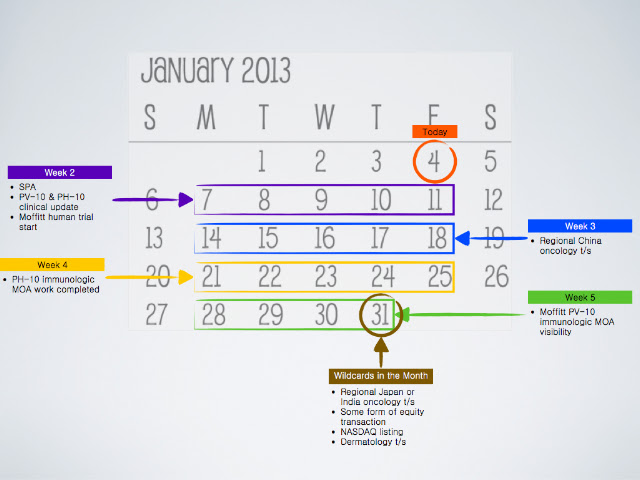
    What to make of the month of January? I think it is fair to write there appears to be a good or great deal of anticipation and expectation.


    So, why not engage in some speculation? I am going to have some fun with this, and see how right or wrong I am, and by how much.

    Click figure to enlarge it.

    January 3, 2013

    $PVCT: NASDAQ Listing Process, When...

    The terminated PVCTP "IPO" remains an incomplete story that has historical interest [to me] to learn more about at some point and make sense of what otherwise was a gray and incomplete picture. I do not think management will re-visit the offering again unless a special situation arises.

    Of much more interest is the potential near-term impact (benefit) of the prior process by which management met all NASDAQ compliance requirements to list Provectus (at the time, with the PVCTP "IPO" mostly but not exclusively in mind). The import of completing this process is the common stock can list after 5 consecutive trading days of the share price closing above $2.

    As an aside, I also expect the company will take its two $50MM common stock shelf filings off the shelf soon, as the $100MM mixed security shelf filing encompassed them for a while and made them superfluous.

    October 24, 2012

    $PVCT.OB: Blog Reader Questions

    Why didn't you mention a dermatology deal as a financing option? Do you think that the company, having embarrassed themselves and backed themselves into a corner, will be inclined to quickly ink a deal of some sort? Also, if the drug is so helpful to cancer patients, why don't they sell it to a big pharmaceutical company and get it in more clinical trials?
    I previously mentioned a dermatology license deal as a financing option here.

    According to management, Provectus does not need money for the foreseeable future (i.e., into August 2013), save to conduct pivotal, key and other clinical trials. Proof of this should be available to confirm or refute around early-November when the 10-Q is filed and available. As such, I do not think management views themselves as backed into a corner. They are keenly aware of what PV-10 and PH-10 are worth, and will strike deals accordingly. The PVCTP "IPO" was primarily about securing a NASDAQ listing, and obtaining money only at the right price and terms.

    Management certainly wants to get the drug into the hands and bloodstreams of as many cancer patients as they can. An acquirer like Pfizer would very likely immediately commence multiple clinical trials to expand the number of indications to which PV-10 would be applied. At the same time, however, management understands the next several quarters are about further demonstrating the size and scope of PV-10's applicability to secure the $7-10 billion they believe the company is worth and the $3-4 billion they expect as an upfront payment in the end-game.

    October 17, 2012

    $PVCT.OB's PVCTP "IPO:" Update on Maxim

    There has been the feeling by some (experienced Wall Street veterans) that either or both of Maxim Group and Network 1 Financial have been "double dealing:" working with Provectus in appropriate, necessary ways to facilitate the "PVCTP" IPO, while at the same time (in other areas of the respective firms) contributing to driving the PVCT.OB share price down for the benefit of firm clients (the math here is simple: if these firms assume Pete will agree to an "at market" conversion ratio, the lower the common stock share price at "IPO" pricing [if the "IPO" goes off], the better the value proposition for the preferred stock).

    In the case of Maxim, as lead underwriter of the PVCTP "IPO," Paul LaRosa, Executive Managing Director - Capital Markets, works with Pete in this regard. See my previous comments here.

    At the same time, Maxim's retail side appears to have been tasked to seek 300+ prospective buyers (since the key NASDAQ listing requirements are a $15MM raise, minimum $4 per share price and 300+ round lot holders). There have been no pricing or other details for the "IPO," because, according to Peter, these parameters continue to be worked out between prospective investors and him. Maxim retail reps have been telling folks, allegedly, the "actual details" of the IPO, which appears to have contributed to the downward pressure on the common stock.

    Have other parts of Maxim been talking down the stock down or facilitating its drop? Communications from Leonard Greenbaum, Maxim's Managing Director - Equity Derivatives, to Dr. Adams appear to indicate such activity or behavior:

    Beginning last week, Mr. Greenbaum appears to have advised the initial sale of common stock (of an existing position) as soon as possible to avoid further losses because the share price was falling rapidly. It appears he also suggested taking an aggressive short position concurrently to take advantage of the greater share price decline Mr. Greenbaum believed was to come because the lower the price of PVCT, the greater the benefit to the eventual holders of PVCTP. It appears he also concluded all existing shareholders had the opportunity to participate in the "IPO," so this was fair.

    Share your Maxim stories with Pete at pete@pvct.com. Please be accurate, and document as many details as you can.

    October 10, 2012

    $PVCT.OB: A Collection Of Thoughts & Non-Thoughts

    Thought: PVCTP "IPO" pricing has not yet been established.

    Non-Thought: Maxim Rep #6 said (paraphrasing) his earlier comments on the call regarding an "at market conversion ratio" as a definitive deal term was hypothetical and he did not know what the conversion ratio was or would be until it was told to him. I said (paraphrasing) I appreciated these latter comments. He must be new to the financial services industry and the Maxim retail desk.

    Non-Thought: This same rep said (paraphrasing) Peter told him the conversion ratio was "at market." When pushed on the veracity of such a claim, he said (paraphrasing) Peter implied it to him. When asked for an e-mail of this be sent to me, none arrived. When he offered to set-up a call first this in the morning with the capital markets/investment banker point person on the deal and I said (paraphrasing) "Please do," no call thus far has materialized.

    Non-Thought: According to Maxim, the PVCTP "IPO" appears to have been pushed off to the week of October 15.

    Non-Thought:
     Maxim Rep #4 empathized with me as a common stock shareholder by saying (paraphrasing) he too felt saddened or aggrieved that "others" were suggesting selling the common stock to buy the preferred stock. An important aspect of customer service indeed is to empathize with a prospective client.

    Thought: According to several sources, Maxim has secured the necessary 300+ prospective "IPO" buyers for the security to be listed on the NASDAQ. This item is important because, aside from establishing the appropriate deal terms for the PVCTP vehicle, the confirmation enables Peter to know whether Provectus can indeed use this financing approach if the board and management chooses to do so.

    Thought: You will recall management has not raised money through common stock or warrant issuances below $1.12 for some time (I should get around to listing such information in a subsequent post in a few days). Raising money at or above this level for philosophical (they have drawn their own line in the sand on this issue) and mechanical (there are several warrant reset provisions for fundraising common stock share prices below $1.12 and other price levels) reasons is important to them. Thus, doing an "at market" conversion ratio, or a ratio utilizing a common share price below $1.12 and/or issuing warrants with exercise prices (when the exercise price of a warrant on a share of PVCTP is translated into a common stock exercise price) below $1.12 would be contrary to management's current position on fund raising, go against recent historical actions and have a significant impact on the overal capital structure of the company.

    Thought: In the month of September, Knight Capital (NITE) appears to have been responsible for less than 25% of traded shares. If, as has been speculated on PVCT stock chat rooms and elsewhere, Dr. Adams' shares are transacted through NITE, more than 75% of selling (and buying) was by folks and entities other than Dr. Adams. I am not focusing on the amount of shares, since there is thoughtful commentary that volume statistics for over-the-counter stocks are much higher than commonly reported (perhaps by as much as half), but rather the relative proportion of transactions.

    Thought: I previously expressed my thoughts about the "IPO" to management. In communicating my view on its pros and cons, Peter clearly indicated to me he would take a thoughtful approach to a PVCTP "IPO" (if the company were to use it). I take him at his word until and unless his word, in my view, is not worth taking any more.

    September 26, 2012

    $PVCT.OB's PVCTP "IPO:" Maxim (update)

    The current Maxim presentation of some of the deal terms:
    • There appear to be 2 lead investors who would subscribe for one-half of the deal.
    • A closing next Wednesday or Thursday,
    • A $4 offering price,
    • An "at market" conversion ratio, where the ratio is based on the common share price at closing/final pricing of the PVCTP "IPO," and
      • i.e., conversion ratio = $4 ÷ closing PVCT.OB share price at PVCTP deal closing
      • The conversion ratio may be lower. That is, a higher-than-actual common share price could be used.
    • At least 40% warrant coverage at an exercise price of a 10% premium to the offering price
      • i.e., $4.40
      • The coverage percent may increase.
    Management needs to know if it can secure a sufficient number of round lot shareholders to meet the minimum NASDAQ listing requirement. Maxim investment bankers and stock brokers are not directly privy to the company's discussions with prospective PVCTP lead investors, but the underwriter is a management tool for this piece of information discovery. The process to determine if there are 300 round lot shareholders to participate in the PVCTP "IPO," should management ultimately decide to utilize it is what it is. The uncertainty it may cause to the common stock share price in the process is an irritant.

    On the topic of the SPA PR, I continue to hold to management's Q3 guidance as my baseline expectation (until I am required my expectation). I am certain to get grief from Hr. Tyrkiet, a chief Investor Village poster, reader of this blog and periodic e-mailer (bring it on Señor Pavo!), about this should no SPA is announced in Q3. Today (last evening to this evening) is Yom Kippur, and I would imagine not an appropriate day on which to issue an important PR. 

    September 25, 2012

    At Last $PVCT.OB Check


    It appears, from Maxim’s recent activities, that for now they are head hunting 300 or so fellow lot holders to join the lead investor(s) for the PVCTP “IPO.” I have received several calls, e-mails and other inquiries asking about my thoughts on the deal details reps have been telling folks.  Maxim’s approach appears sloppy. In a few cases, one might go so far as to say it appears sleazy. The broker-dealer and its representatives, both investment bankers and stockbrokers, get paid when a deal gets done. The business and revenue models are based on closing transactions. As such, Maxim has a very strong incentive to encourage Peter to do a PVCTP “IPO.” If a Maxim rep calls you with details – as of this writing – such details have not yet been established or finalized.

    Discussions continue regarding the sale of the dermatology business (i.e., a comprehensive PH-10 license). A dermatology deal is a parallel effort that could push the common stock to list on the NASDAQ without a PVCTP “IPO.”

    Blog Reader Question

    It seems that the plan is to present a series of good news next week in order to drive the SP above USD 2 and keep it there for the 5 days needed to be listed on NASDAQ. How do you see this?
    Whether this week or next, a series of PRs (e.g., SPA, liver, ESMO, Moffitt, etc.) could drive the common stock share price onto the NASDAQ.

    This news-driven common stock share price rise may be insufficient to effectively raise $20-30MM (via the existing shelf filing) to conduct pivotal, key and other trials. Getting onto the NASDAQ via the common stock is good and important, but a company's currency is its stock and dilution could be substantial or large (a $30MM raise at $2.50 per share is something like a 10-11% dilution).

    The possibility exists this near-term series of news could be insufficient to push the common stock onto the NASDAQ. As a result, raising money becomes more expensive.

    Management has maintained their first choice to minimize dilution and secure necessary trial monies, obviously, is to use significant or sizable upfront payments from a dermatology deal and/or mini-oncology deals (e.g., China, Australasia, etc.). Getting the right deal (e.g., valuation, upfront and milestone payments, royalty percent, etc.) in the context of completed and contemplated regulatory meetings and clinical data may take more time.

    Life sciences players currently not in the stock understand Provectus needs to raise capital soon to run certain trials. These investors want to see how this money is raised -- i.e., understand the risk-reward profile -- before jumping into the PVCT pool: sell common stock, do a license deal or two, sell part of PVCTP to a strategic investor, etc. Once the picture is clear, investors should buy.

    The PVCTP preferred stock offering vehicle, if led by a less price/valuation sensitive strategic investor, provide several benefits at once: raises valuation, facilitates effective fund raising, brings some or many investors off the sidelines, gets a Provectus security on the NASDAQ, goes toward reducing dilution, etc.

    What is management thinking and what situation(s) are they currently facing?

    September 14, 2012

    Blog Reader Statement About $PVCT.OB

    A view from The Peak, Hong Kong
    The price is making me ill. Was the preferred share option a mistep by management? I emailed the company and they seemed to think it would raise the stock price, but this is clearly not true at this point. It's just extraordinarily discouraging after holding the stock for so many years to see it at this point.
    I will have more comments later tonight (my evening in Hong Kong, and your afternoon in Europe or morning in the U.S.) after I return from a reception and dinner at Cafe Deco on The Peak.

    The preferred share offering of PVCTP is a vehicle that would be (i) used to bring a name into the shareholder base, either a corporate (like Pfizer or J&J or another Big Pharma company) or financial (like a well-known life sciences fund) investor, (ii) led by said name, either corporate or financial investor and (iii) at acceptable terms to management that would be beneficial or not punitive or overly dilutive to existing shareholders -- all of which would lead to a NASDAQ-listed security.

    The preferred stock offering may end up going unused for a variety of reasons, such as the common stock makes its way onto the NASDAQ by itself or potential terms of a PVCTP offering are not acceptable.

    September 9, 2012

    Blog Reader Question About $PVCT.OB

    The company didn't list "raising money" in the public market in any news release. They said possible dermatology deal or strategic investment. If this preferred is for the latter then why list it? How can we have a listed security if there is only 1 owner. I think you have to have 300 investors for a security to list on the NASDAQ. If that is the case then some of the details of this could be much less important. What are your thoughts?
    Yes, the preferred stock offering (the "Offering" or PVCTP) must have at least 300 round lot shareholders to list on the NASDAQ, so there will be multiple initial owners of the Offering if and when it is utilized.

    The NASDAQ requires an underwriter for a stock exchange listing, like Maxim. Any investment bank could be brought on as a co-underwriter ("co-manager") alongside or a secondary underwriter below Maxim.

    I think the Offering facility is important for several reasons, and refer to it as a facility to mean a tool that can be used, as opposed to a live offering.

    The PVCTP filing is a preliminary, placeholder document that does not specify the conversion ratio (i.e., the number of shares of common stock into which one share of preferred stock converts) or prospective warrant coverage, which help ascertain the valuation at which the deal will be done and the dilution that would ensue. Management, with feedback from Maxim and based on the interactions with and feedback from corporate and/or financial investors who subscribe to the deal, will set the conversion ratio. Maxim called prospective financial investors about the Offering at least beginning this past Thursday to gauge indications of interest to buy preferred stock.

    As I wrote at the outset of this blog post, there is no certainty Provectus ultimately utilizes the Offering. It is an optional strategy. Being on NASDAQ enables much more visibility and awareness of the stock and company, an obvious observation on my part that refers both to PVCT.OB, when it trades on the major stock exchange, and PVCTP.

    PVCTP is one of several plays that could be run. Some of these plays could be run standalone, and others in some kind of chronological order:
    A. The SPA and/or more Moffitt data may be sufficient to propel the common stock to the NASDAQ. PVCT.OB requires 5 consecutive days above $2 to move to the major stock exchange. 
    B.  The Offering could be used to "up list" the common stock onto the NASDAQ. PVCT.OB would trade higher (i.e., over $2 per share) if PVCTP were sold for $4 per share or higher with a favorable [to the company and existing shareholders] preferred stock conversion ratio. Perhaps the SPA and/or Moffitt PRs were insufficient to move the common stock as high as though, hoped for or needed. Life sciences investors who then would feel comfortable coming off the sidelines could buy a NASDAQ listed security. PVCTP then "drags" PVCT.OB onto the NASDAQ. 
    C.  The Offering could be used to turbo charge the common stock once PVCT.OB trades on the NASDAQ. Management could offer PVCTP after the common stock lists on the NASDAQ. Buyers of the preferred stock likely would include life sciences investors, where the preferred stock conversion ratio probably is more favorable for the company than in B.
    One of several securities could be sold to a Big Pharma company as part of a strategic equity strategy or program:
    • Common stock, likely when PVCT.OB trades on the NASDAQ. Like with J&J's JJDC deal with Genmab, there will be a premium to the then current common stock share price. J&J paid a 30% premium. The transaction price, however, will be anchored ultimately by where the common stock is trading. Duh!: The higher the common stock, the higher the transaction price;
    • A non-listed preferred stock security that either exists today or will be constructed; and
    • PVCTP. Since 300 round lot holders are required, any use of the Offering for a Big Pharma company or its development corporation also would include financial investors.
    Do not dismiss the corporate governance and compliance housekeeping stamp of approval the NASDAQ provided Provectus by its PVCTP listing approval. The process management undertook to complete NASDAQ's process was non-trivial, and takes corporate governance (and all related matters) off the due diligence checklist for serious life sciences (and other institutional) investors.

    September 8, 2012

    Blog Reader Question About $PVCT.OB

    Regarding the new preferred stock issue on the NASDAQ, if and when it starts trading, which would have a price of 4.00, how does that affect the common stock?
    [The source for this answer comes directly or paraphrased from material and text found here. There are other places on the Web to learn about convertible preferred shares. Look here.]

    The market price and behavior of convertible preferred shares (the "convertible") is determined by the conversion premium, the difference between the parity value (or parity price) and the value of the preferred shares if the shares were converted.

    Let's say Provectus issues 4MM convertible preferred shares priced at $4 a share (X), raising "net" proceeds of $16MM. Why $16MM? That's the likely cost of the pivotal metastatic melanoma Phase 3 trial. Management may elect to raise a lower or higher amount for certain reasons. My analysis ignores underwriter fees, the 8% dividend, and the preferred share's warrant coverage (which is not as yet known).

    The conversion ratio (Y) is the number of Provectus common shares (PVCT.OB) investors in the preferred stock offering would receive for each convertible preferred share (PVCTP) they own. The conversion ratio is set by management prior to issue with guidance from Maxim (for now, the lead and only underwriter), although the demand or lack thereof from prospective investors in the offering strongly influences the conversion ratio. The greater the demand for the offering, the stronger management's negotiating position is in lowering the ratio (i.e., less common shares per [one] preferred share). Alternatively, if the demand is weak, management may induce investors to purchase preferred shares by raising the ratio (i.e., more common shares per [one] preferred share).

    In addition, the warrant coverage, which typically is a sweetener in most any equity deals, is a positive influence on the conversion ratio, since management wave the warrant in front of a prospective investor as an inducement, rather than simply solely focusing on adjusting the conversion ratio to make them happy.

    Since the conversion ratio is to be set, and no fund raising has yet occurred, we do not know the ratio (for now). At Friday's closing price of $0.693, the "gross pre-deal break-even" conversion ratio -- the point or ratio where raising money by selling common stock is equivalent to raising money by selling preferred shares (again, ignoring certain items) -- is $4 ÷ $0.693, or 5.77.

    If management can strike a deal whereby the conversion ratio is lower (less dilutive) than 5.77, like 3 or 4 or less, great. If not, one would question why they would raise money via the preferred stock offering, unless there are qualitative or tangibly intangible reasons to do so.

    The conversion ratio shows what price Provectus common stock needs to be trading at in order for the preferred stock shareholder to want to convert his, her or its shares into common stock, which they will do if they the conversion is profitable. This price, known as the conversion price (Z), is equal to the purchase price of the preferred share divided by the conversion ratio. Thus, Z = X ÷ Y. For this analysis, let's assume the conversion ratio is 4. For Provectus, the market conversion price is $4 ÷ 4, or $1.

    PVCT.OB, at the time, then needs to trade higher than $1, or Z, for investors in the preferred stock offering to gain from conversion. If preferred shares convert, and PVCT.OB drops below $1, investors suffer a capital loss. If PVCT.OB rises above $1, investors enjoy a gain.

    $4, or X, also represents the parity value of the preferred shares.

    The value of the converted preferred share is equal to the market price of common shares multiplied by the conversion ratio. At a closing price of $0.693, the value of the preferred shares is $0.693 × 4, or $2.77. This is well below the parity value of $4. At $0.693, the conversion premium is 31% [($4 − $2.77) ÷ $4].

    The lower the premium, the more likely the convertible's market price will follow the common stock value up and down. Higher-premium convertibles act more like bonds since it's less likely that there will be a chance for a profitable conversion.

    Convertibles trade like stocks when the price of common shares moves above the conversion price. If the stock price slips below the conversion price, the convertible trades just like a bond, effectively putting a price floor under the investment.

    August 16, 2012

    Blog Reader Question

    Could you please quantify for me the percentage of companies that apply for an SPA that eventually receive it? Are large investors waiting on the sidelines because they want to see the endpoints and efficacy of PV-10 compared to standard care/placebo? What causes the large investors to wait on the sidelines when their entry point into PVCT could be 3/4 times the present stock price in a relatively short period of time?
    Could you please quantify for me the percentage of companies that apply for an SPA that eventually receive it? Under a well-defined but at times opaque process companies work with the FDA to seek SPAs for their drug compounds and pivotal trials. A cursory Web-based search reveals one or three companies who sought SPAs but ultimately did not secure them because the companies terminated the process (presumably strongly influenced by their interactions with the FDA). As I have written before, I think Provectus has reached a verbal agreement on the SPA with the FDA. We await the PR to make this agreement known.

    Are large investors waiting on the sidelines because they want to see the endpoints and efficacy of PV-10 compared to standard care/placebo? No. The life sciences investors to whom I refer are not waiting for this information, but rather the SPA PR from Provectus. Others wait for the PR and the stock to trade on the NASDAQ. You appear to be referring to the interim analysis of the MM Phase 3 trial or, perhaps, the post-trial analysis.

    What causes the large investors to wait on the sidelines when their entry point into PVCT could be 3/4 times the present stock price in a relatively short period of time? Some of these life sciences specialists (i.e., large investors) want to see management have an SPA fully in hand to provide certainty of the regulatory path. Others want the SPA and the stock to trade on a major exchange like the NASDAQ, together with the comfort that comes with greater liquidity and trading volume. Others, but a much smaller subset, want the SPA, the NASDAQ and the final dispelling of any lack of comprehension about PV-10's systemic benefit that comes with the pending release of more Moffitt murine study work. Despite the return proposition you proffer, these investors consider the risk-return proposition. It is less risky for them to buy upon or after the SPA announcement than before, no matter how much they think the SPA is in the bag for the company.


    Your question is a good one, and one that perplexes me from time to time. I began my capital markets career as a proprietary currency derivative trader for a Top 20 global commercial bank. Then, I spent several years making strategic equity investments in technology start-up companies on behalf of a Fortune 300 corporation that, while guided by business unit goals and interests, provide my team with a very open-ended mandate. This experience was followed by stints opportunistically investing in both privately held and publicly traded companies for an ultra-high net worth individual and, later, a small hedge fund. As I invest for my own firm, I look for the best investment idea, irrespective of who, what, when, where, why and how. This applies to both long and short approaches to an asset class or equity security.

    Inevitably, I have been early to take action in many cases. In most cases, it has worked out because of discipline and conviction in the face of emotional macro and micro reaction, unless the underlying investment theses change. Sometimes, however, I am just plain wrong. For Provectus, I began nibbling in 2007 and 2008, but increased our holdings significantly from 2009 to 2011. I made the decision to convert our profits in mid- to late-2010 (early), from being mostly out of the market starting in late-2007 (early) and returning in March/April 2008 ("lucky"), into more shares of the company.

    Over the course of my career, I have never been truly constrained by the institutional investment charters or frameworks that appear to be restraining the life sciences investors to whom I referred. They have a set of investment rules and criteria they think works best for them and sets them up for success. Management has presented to them, and continues to update them. Many of them see and understand Provectus' clinical, regulatory, business and stock value propositions. The lack of an SPA and the stock on a major exchange seem to be the crux of what holds them back.

    Pete travels a good deal, meeting with existing and prospective equity research analysts, existing and prospective investors, board members, corporate advisory board members, prospective partners, etc. Typically, this travel does not necessitate an Out of Office [automated] e-mail notice, since he is very diligent in responding to inquiries. Occasionally, he utilizes this notice (about 6 times in the last 2 years), traveling for a few days in such instances. In July he traveled for the entire month, utilizing the Out of Office notice:


    Life sciences investors think Provectus will get the SPA, but they want to see it formally and officially in hand. So, they wait, but those who have dipped a toenail or toe into the water, and those who stand at water's edge have been prepped by Pete. These investors, firms and funds will descend on the stock when the SPA is announced. A feed frenzy should ensue when a mini-oncology or dermatology deal is announced. The dam breaks completely when a relationship with Pfizer finally comes to light.

    I will know if I have been early or am wrong in short order.